Catalogue Enrichment from Product Images
Read product photos and back-of-pack images to fill category attributes, mandatory declarations and listing copy for each marketplace, with every value checked before publishing.
- Industry:
- Retail, D2C & Quick Commerce
Who it is for
- Head of E-commerce
- Catalogue Manager
- Marketplace Operations Lead
- D2C Brand Manager
The problem
Every new SKU needs a listing on your website, two or three marketplaces and several quick-commerce apps, each with its own template, attribute list and image rules. Catalogue teams type attributes from samples and artwork files, and errors show up as rejected listings or returns.
Manual attribute entry
Fabric, fit, colour, pattern, net quantity, ingredients and shelf life are keyed by hand from samples, artwork PDFs or photos.
A different template per channel
Each marketplace has its own mandatory fields and allowed values, so listings bounce back with rejection reasons.
Inconsistent attributes
The same colour or size is written several different ways, which breaks filters and search on your own site.
Missing mandatory declarations
Net quantity, MRP, manufacturer or importer details and country of origin missing from a listing create compliance risk and delisting.
What we build
We build an enrichment pipeline that takes product photos, pack artwork and back-of-pack images and produces a complete, channel-ready listing draft. Vision models identify visual attributes such as colour, pattern, neckline or pack type. OCR and an LLM read pack text for net quantity, MRP, ingredients, veg or non-veg mark, FSSAI licence number, manufacturer details and best-before period. Values are normalised to each channel's allowed list and mapped to its template. Titles and bullets are drafted in your brand voice from facts found on the pack or in your product data only. The catalogue team approves before anything is published.
- Extracts visual attributes such as colour, pattern, sleeve, neckline, material look and pack format
- Reads back-of-pack text for net quantity, MRP, ingredients, allergens, FSSAI licence and manufacturer or importer
- Normalises values to each marketplace's allowed list and fills its flat-file template
- Drafts titles, bullets and descriptions using only facts found on the pack or in product data
- Checks image sets against channel rules for background, count, angles and resolution
- Links every attribute to the image region it came from for quick review
How it works
- 01Collect product assetsPhotos, pack artwork and back-of-pack images arrive with the SKU code from the PIM, a shared drive or the photo studio.
- 02Extract attributesVision models read visual attributes and OCR with an LLM reads pack text, each value with a confidence score.
- 03Normalise and mapValues are mapped to each channel's allowed list and template, and missing mandatory fields are listed.
- 04Draft listing copyTitles and bullets are drafted from verified facts, in the style each channel expects.
- 05Catalogue reviewThe catalogue executive checks low-confidence values, declarations and copy, then approves the listing.
- 06Publish and trackApproved listings are exported to each channel, and rejection reasons are fed back into the mapping rules.

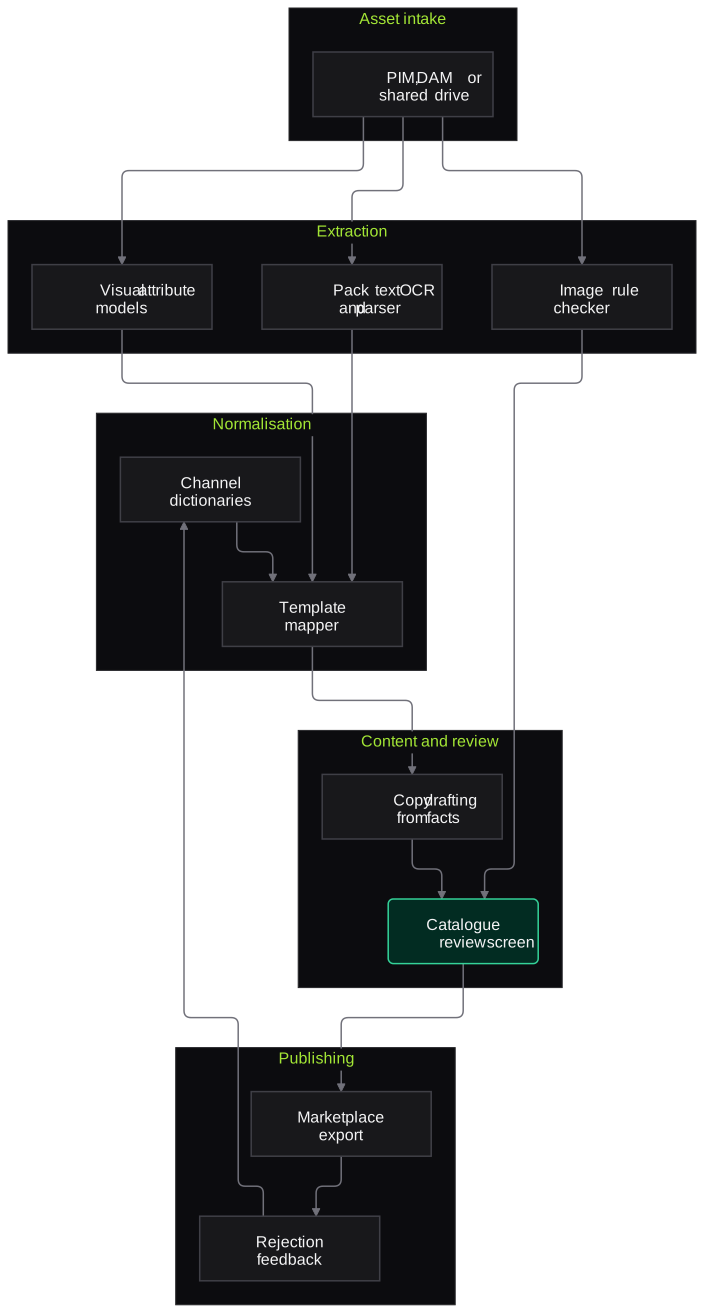
Architecture
- Asset intake
- PIM, DAM or shared drive connector
- SKU and asset grouping
- Extraction
- Visual attribute models by category
- Pack text OCR with LLM field parser
- Image rule checker
- Normalisation
- Channel attribute dictionaries and allowed values
- Template mapper for marketplace flat files
- Content and review
- Copy drafting restricted to verified facts
- Catalogue review screen with image highlights
- Publishing
- Marketplace flat-file and API export
- Rejection feedback loop
Inputs and outputs
Inputs
- Product photos from the studio or supplier
- Pack artwork files and back-of-pack images
- Existing product data from the PIM or ERP item master
- Marketplace category templates and allowed values
- Brand voice and copy guidelines
Outputs
- Attribute set per SKU, normalised for each channel
- Filled marketplace flat files or API payloads
- Draft titles, bullets and descriptions
- Missing declaration and image rule report
- Review log of approved and corrected values
Where people stay in control
Catalogue executives approve every listing before it is published and confirm any low-confidence attribute. Statutory declarations and any health, ingredient or performance claim are always checked against the pack image by a person.
Integrations
- PIM or DAM such as Akeneo, Salsify or an in-house system
- Shopify, Magento or your website CMS
- Marketplace seller portals and flat-file templates
- ERP item master
- Shared drives or photo studio storage
Guardrails
- Copy uses only facts present on the pack or in approved product data
- Attribute values restricted to each channel's allowed list
- Every value linked to its source image region
- No listing published without catalogue approval
Compliance notes
- Mandatory declarations under the Legal Metrology (Packaged Commodities) Rules 2011 are extracted and checked, and the catalogue team confirms them before publishing.
- Food listings carry FSSAI labelling details, such as the licence number and veg or non-veg mark, exactly as printed on the pack.
A typical pilot
Duration: 3 weeks
A few hundred SKUs from one category, enriched for your website and one marketplace, compared with listings your team prepared.
Deliverables
- 01Attribute schema and channel mappings for the pilot category
- 02Working enrichment pipeline and review screen
- 03Filled templates for pilot SKUs
- 04Accuracy report against team-verified listings
- 05Roll-out plan for other categories and channels
What we measure
- Attribute accuracy
- Extracted values compared with values verified by the catalogue team.
- Declaration completeness
- Share of SKUs with all mandatory declarations captured and confirmed.
- Edit effort per SKU
- Fields the reviewer changed and time spent per listing.
- Listing rejections
- Marketplace rejection reasons recorded for pilot SKUs after submission.
FAQs
01Will it make up product claims?
No. Copy is drafted only from text found on the pack or in your approved product data, so claims such as sugar-free or dermatologically tested appear only if the pack states them. Reviewers see the source for each claim.
02Can it handle fashion as well as FMCG?
Yes, with different models. Fashion relies on visual attributes such as pattern, neckline and fit, while FMCG relies more on reading pack text. We pilot on one category first.
03Does it work with marketplace flat files?
Yes. We map attributes to each marketplace's current category template and allowed values and produce files or API payloads in that format. When a template changes, the mapping is updated, not the model.
04Can it write listings in Hindi?
It can draft Hindi or regional-language descriptions for channels that support them, from the same verified facts. A reviewer fluent in the language approves them.
Related use cases
- Retail, D2C & Quick Commerce
Shelf Availability and Planogram Compliance
Turn merchandiser and store shelf photos into SKU-level facings, out-of-stock gaps, price-label checks and planogram scores, with doubtful detections sent to a reviewer.
- Retail, D2C & Quick Commerce
Review and UGC Insights for Product Teams
Classify reviews, Q&A, social comments and return reasons into product issues by SKU and batch, including Hinglish text, and give product teams a weekly digest with source quotes.
- Retail, D2C & Quick Commerce
Guardrail Testing for AI Shopping Assistants
Adversarial testing of AI shopping assistants for unauthorised discounts, wrong prices, order-data leakage and unsafe product advice, with validated findings, fixes and a retest.
- Automotive & Mobility
Spare Parts Catalogue Matching from Photos
Identify spare parts from customer or mechanic photos by reading part numbers, matching catalogue images and filtering by vehicle fitment, then confirm stock and price before quoting.

Founded by Akhilesh Mittal. 8 years building a security platform for a New Zealand company. IIT ISM Dhanbad and IMT Ghaziabad. Builds production agentic AI.
Pick one leak and measure it
Book a discovery call. We will choose one narrow pilot, such as COD confirmation, one claim type or one dark store, run it alongside your current process and report what we measured.