Review and UGC Insights for Product Teams
Classify reviews, Q&A, social comments and return reasons into product issues by SKU and batch, including Hinglish text, and give product teams a weekly digest with source quotes.
- Capability:
- AI Sales & Marketing Automation
- Industry:
- Retail, D2C & Quick Commerce
Who it is for
- Head of Product or Category
- Head of Quality
- Head of Customer Experience
- D2C Brand Manager
The problem
Customers tell you what is wrong with your products every day, in marketplace reviews, Q&A, Instagram comments, support tickets and return reasons. The feedback is spread across channels, often in Hinglish or regional languages, and reaches the product team as an average star rating.
Too much to read
Reviews and comments across marketplaces, your site and social channels outrun any team's ability to read them.
Ratings hide reasons
A three-star rating could mean poor fit, late delivery or a damaged box, and only the text says which.
Hinglish breaks keyword tools
Text like 'fitting thodi tight hai' or 'smell achha nahi' defeats sentiment tools built for English.
Problems found late
A packaging defect or a bad batch shows up in returns weeks after the first reviews mentioned it.
What we build
We build an insights pipeline that collects reviews, Q&A, social comments, support tickets and return reasons from official seller exports, APIs and your own systems. An LLM classifies each item against your product taxonomy, such as size and fit, quality, packaging, delivery, fragrance or skin reaction, at the aspect level and in English, Hindi, Hinglish and regional languages. Mentions are linked to SKU and, where possible, batch or lot. Spike detection flags themes rising faster than usual for a SKU. Product and quality teams get a weekly digest with counts and representative quotes, and safety-related mentions go to quality at once.
- Collects reviews, Q&A, comments, tickets and return reasons from official exports, APIs and internal systems
- Aspect-level classification against your taxonomy, in English, Hindi, Hinglish and regional languages
- Links feedback to SKU, variant and, where available, batch or lot
- Detects rising themes per SKU and alerts the owning team
- Routes mentions of skin reactions, injuries or contamination to the quality team immediately
- Weekly digest with counts, trends and representative quotes linked to the source
How it works
- 01Collect feedbackReviews, Q&A, social comments, tickets and return reasons are pulled daily from approved sources.
- 02Clean and linkPersonal details are stripped, and each item is linked to SKU, variant and batch where possible.
- 03Classify by aspectThe LLM tags each item with aspects and sentiment from your taxonomy, with a confidence score.
- 04Detect safety mentions and spikesSafety-related mentions and unusual rises in a theme are flagged.
- 05Human reviewQuality assesses safety mentions, and analysts check low-confidence items and approve taxonomy changes.
- 06Publish insightsDashboards and a weekly digest go to product, quality and CX teams.

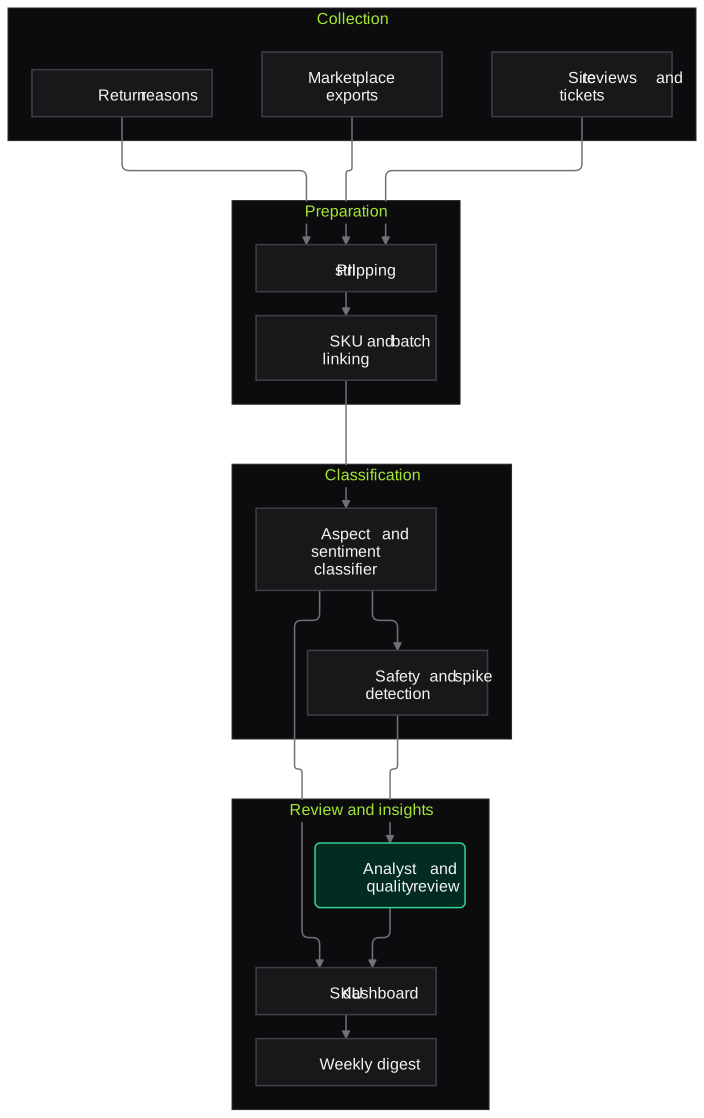
Architecture
- Collection
- Marketplace seller exports and APIs
- Own-site reviews and Q&A
- Helpdesk tickets and OMS return reasons
- Social listening exports
- Preparation
- PII stripping
- SKU, variant and batch linking
- Language detection and transliteration handling
- Classification
- LLM aspect and sentiment classifier using your taxonomy
- Safety mention detector
- Spike detection per SKU and theme
- Review
- Analyst review queue for low-confidence items
- Quality team alert inbox
- Insights
- Dashboard by SKU, theme and channel
- Weekly digest with source quotes
Inputs and outputs
Inputs
- Marketplace reviews and Q&A from seller exports or APIs
- Reviews and questions from your own site
- Support tickets and chat transcripts
- Return reasons from the OMS
- Product taxonomy, SKU master and batch data
Outputs
- Aspect-level tags and sentiment per feedback item
- Theme trends by SKU, variant, channel and batch
- Spike alerts to product owners
- Safety mention alerts to the quality team
- Weekly digest with representative quotes
Where people stay in control
The quality team assesses every safety-related mention, and analysts review low-confidence classifications and approve taxonomy changes. The system does not post public replies or contact reviewers.
Integrations
- Marketplace seller portals and review exports
- Website review platform
- Helpdesk such as Freshdesk or Zendesk
- OMS for return reasons
- BI tools such as Power BI or Looker
Guardrails
- Data collected only through official exports, APIs or with platform permission
- Personal details stripped before analysis
- Every count links back to source quotes
- Regular sampling of classifications against analyst labels
- Safety mentions routed to people, never closed automatically
Compliance notes
- Reviewer names and handles are personal data under the DPDP Act 2023 and are removed before analysis.
- Collection follows each platform's terms of service.
A typical pilot
Duration: 4 weeks
Reviews, tickets and return reasons for one category over the past two quarters, with the weekly digest running for the last two weeks of the pilot.
Deliverables
- 01Taxonomy agreed with product, quality and CX
- 02Working collection and classification pipeline
- 03Dashboard and weekly digest
- 04Accuracy report against analyst-labelled samples, including Hinglish
- 05Roll-out plan for other categories and channels
What we measure
- Classification accuracy
- Tags compared with analyst labels on a random sample, reported separately for English and for Hinglish or regional text.
- Issues confirmed actionable
- Spikes and themes the product or quality team confirms as real issues.
- Time to surface an issue
- Date a theme was flagged compared with when it appeared in return or complaint reports.
- Analyst effort
- Time to prepare the weekly product feedback report, with and without the pipeline.
FAQs
01Can it read Hinglish and regional languages?
Yes. The classifier handles code-mixed and transliterated text, as well as Hindi and common regional languages. The pilot reports accuracy for these separately, so you can see where it is strong and where it needs review.
02Is collecting marketplace reviews allowed?
We use official seller exports, APIs or reports available to you as a seller, and follow each platform's terms. We do not scrape against terms of service.
03Can it tell us which batch has a problem?
Only where batch or lot data can be linked, for example through order and dispatch records or return inspections. Without that link, it reports by SKU and date.
04Does it write replies to reviews?
This system focuses on insights for product teams. Drafting replies is possible, but nothing is posted publicly without a person approving it.
Related use cases
- Retail, D2C & Quick Commerce
Catalogue Enrichment from Product Images
Read product photos and back-of-pack images to fill category attributes, mandatory declarations and listing copy for each marketplace, with every value checked before publishing.
- Retail, D2C & Quick Commerce
Abandoned Cart and Win-Back Automation
Recover abandoned carts and bring back lapsed customers with WhatsApp and email journeys built around cart contents and purchase cycles, measured against a holdout group.
- Retail, D2C & Quick Commerce
Guardrail Testing for AI Shopping Assistants
Adversarial testing of AI shopping assistants for unauthorised discounts, wrong prices, order-data leakage and unsafe product advice, with validated findings, fixes and a retest.
- Hospitality & Travel
Review Response and Reputation Automation
Collect reviews from Google, OTAs and Tripadvisor, draft specific replies in your voice, route complaints to the GM and turn recurring themes into weekly actions for each department.

Founded by Akhilesh Mittal. 8 years building a security platform for a New Zealand company. IIT ISM Dhanbad and IMT Ghaziabad. Builds production agentic AI.
Pick one leak and measure it
Book a discovery call. We will choose one narrow pilot, such as COD confirmation, one claim type or one dark store, run it alongside your current process and report what we measured.