Tampered and Fraudulent Document Detection
Score claim documents for signs of editing, fabrication and reuse, explain each signal, and route high-risk files to your investigation team instead of labelling anyone a fraudster.
- Industry:
- Insurance
Who it is for
- Head of Fraud Control Unit
- Claims Investigation Manager
- Head of Claims
- Chief Risk Officer
The problem
Reimbursement bills, motor repair invoices and death-claim papers are easy to alter with free editing tools. A changed amount on a pharmacy bill, a back-dated discharge summary or one hospital bill reused across several claims rarely stands out to an assessor working through a queue.
Edits are invisible at a glance
A retyped amount or date on a scanned bill looks normal on screen, and forensic checks are too slow to run by hand on every file.
Fabricated documents from templates
Bills generated from online templates can carry real hospital names, plausible GSTINs and registration numbers that only fail on closer checking.
Reuse across claims and channels
The same bill, prescription or photograph can appear in claims under different policies or from different agents, and nobody sees both files side by side.
Investigators get weak referrals
Referrals based on gut feel waste investigation capacity and create unfair friction for genuine customers.
What we build
We build a document forensics layer that runs on every claim document as it is submitted. It examines the file, the image and the content: PDF structure and metadata, signs of local editing or pasted regions in images, arithmetic and date logic, and identifiers such as GSTIN or registration numbers against reference data you hold. It also searches your claim archive for near-duplicate pages. Each document gets a risk score with the specific signals that triggered it and highlighted regions on the page. High-risk files go to your fraud control unit as a case pack; everything else continues through normal processing, with a sample kept for quality review.
- Checks PDF structure and metadata for incremental edits, unusual producer software and font substitutions
- Detects pasted, cloned or locally altered regions in scanned and photographed images
- Recalculates bill totals, taxes and line items and checks date sequences across documents
- Validates GSTIN format and check digit, and hospital and doctor registration numbers against reference data
- Finds near-duplicate pages and photographs across your historical claim archive
- Produces an explained risk score with page overlays and a case pack for investigators
How it works
- 01Collect original filesDocuments are taken as originally submitted, before any compression or re-scanning, together with claim metadata.
- 02Run file and image forensicsPDF structure, metadata and image-level checks look for signs of editing, splicing or generation from templates.
- 03Check content logicArithmetic, dates, identifiers and cross-document consistency are tested against rules and reference data.
- 04Search for reusePerceptual hashes and text fingerprints are compared with the claim archive to find repeated pages or photos.
- 05Score and routeSignals combine into an explained risk score; files above the threshold go to the fraud control unit as a case pack.
- 06Investigate and feed backInvestigators record outcomes, which are used to tune thresholds and retire noisy signals.

Architecture
- Ingestion
- Claim system document feed
- Original-file preservation store
- Claim metadata loader
- Forensic analysis
- PDF structure and metadata analyser
- Image manipulation detector
- Template and font consistency checks
- Content and reference checks
- Arithmetic and date logic rules
- GSTIN and registration validators
- Provider reference data
- Similarity search
- Perceptual image hashing
- Text fingerprint index over the claim archive
- Scoring and case management
- Explained risk scoring
- Investigator case pack with page overlays
- Outcome feedback log
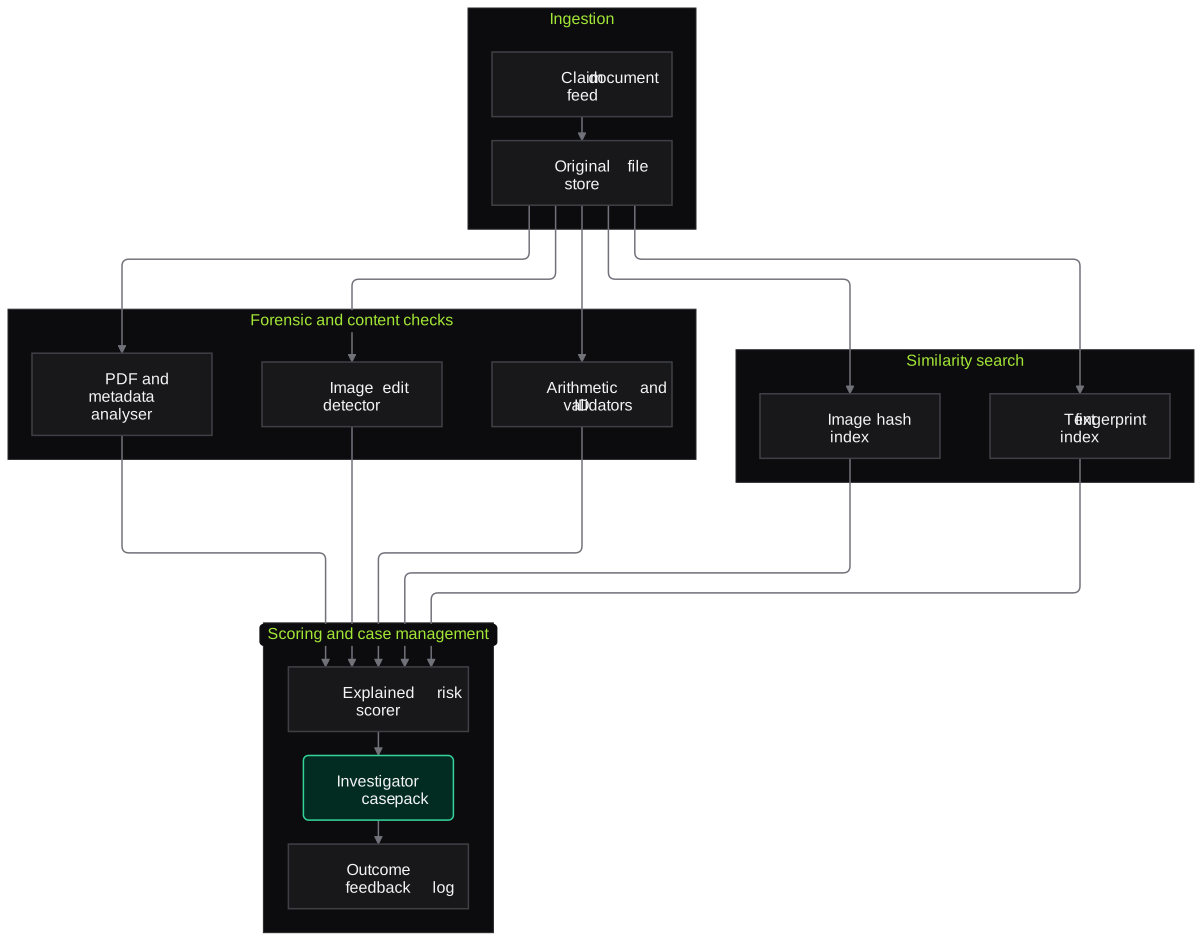
Inputs and outputs
Inputs
- Claim documents as originally submitted: native PDFs, scans and photos
- Claim metadata: policy, claimant, provider, amounts and dates
- Historical claim document archive for reuse search
- Provider master and reference data for GSTIN and registration checks
- Past investigation outcomes, where available, for calibration
Outputs
- Document-level risk score with the list of triggered signals
- Page overlays highlighting suspected edited or pasted regions
- Near-duplicate matches with links to the earlier claims
- Investigator case pack ready for the fraud control unit
- Signal performance log based on investigation outcomes
Where people stay in control
Investigators in your fraud control unit review every high-risk referral and decide whether to investigate, query or clear the claim. The system surfaces signals only; it never rejects a claim or labels a customer, hospital or garage as fraudulent.
Integrations
- Core claims or TPA platform (via API or document export)
- Document management system or claim archive storage
- Fraud control unit case management tool
- Provider and garage master data
- Data warehouse for fraud MIS
Guardrails
- Signals explained in plain language; no unexplained scores reach investigators
- Thresholds set and reviewed with the fraud control unit, with periodic checks for skew against particular regions or provider types
- Re-photographed or heavily compressed documents marked as low forensic value rather than scored as suspicious
- No automatic claim rejection or customer communication
- Original files preserved unaltered for evidential use
Compliance notes
- Supports the fraud monitoring framework and investigation function that IRDAI expects insurers to maintain, without replacing investigator judgement.
- Claim archives are searched only for fraud prevention and claim handling, consistent with purpose limitation under the DPDP Act 2023.
A typical pilot
Duration: 4 weeks
A retrospective run on historical reimbursement claims for one line of business, including files your investigators have already confirmed as tampered and a larger set of cleared claims.
Deliverables
- 01Signal catalogue agreed with the fraud control unit
- 02Forensics pipeline run on the historical sample
- 03Investigator review screen with page overlays
- 04Signal-by-signal performance report
- 05Recommendation on thresholds and production roll-out
What we measure
- Referral precision
- Share of high-risk referrals that investigators agree merit further investigation.
- Known cases caught
- How many previously confirmed tampered files the pipeline flags in the retrospective run.
- False-flag load on clean claims
- Number of cleared claims flagged, reviewed by investigators to see which signals caused them.
- Investigator review time per referral
- Timed on case packs compared with the current referral format.
FAQs
01Will customers be accused on the basis of an AI score?
No. A score is a reason to look closer, not a finding. Investigators decide what happens next, and the case pack shows exactly which signals fired so their reasoning can be checked.
02Does it work on photographs of documents?
Partly. Content, arithmetic and reuse checks work on photos, but pixel-level forensics are weaker once a document has been printed and re-photographed. The system marks such files as low forensic value instead of treating them as suspicious.
03Can it check documents against other insurers' claims?
Only against data you hold or are entitled to use. If you take part in an industry data-sharing arrangement, we can design an interface to it, but we do not assume access.
04How do you avoid unfair targeting of certain hospitals or regions?
Thresholds and signal performance are reviewed by provider type and region during the pilot, and noisy signals are dropped. Investigators see the evidence behind each flag, not a list of whom to suspect.
Related use cases
- Insurance
Health Claim Document Extraction
Turn hospital bills, discharge summaries and investigation reports into structured, checked claim data, with uncertain fields routed to an assessor instead of guessed.
- Insurance
Motor Claim Damage Assessment from Photos
Detect damaged panels and damage types from guided claim photos, check them against the workshop estimate and pre-inspection images, and give surveyors a structured evidence pack.
- Fintech & Payments
Selfie-to-ID Face Match and Document Tamper Checks
Compare a live selfie with the photo on an ID, check liveness and spot edited or replayed ID images, sending borderline cases to a reviewer with highlighted evidence.
- Accounting, Audit & Consulting
Forensic Review of Expense Claims
Review every expense claim, not a sample: read the receipts, check them against travel, leave and policy data, and rank suspicious patterns for forensic investigators.

Founded by Akhilesh Mittal. 8 years building a security platform for a New Zealand company. IIT ISM Dhanbad and IMT Ghaziabad. Builds production agentic AI.
Pick one claim type, product line or bot to start
Book a discovery call and we will scope a short pilot on your own de-identified documents or staging bot, with clear measures agreed up front.