Health Claim Document Extraction
Turn hospital bills, discharge summaries and investigation reports into structured, checked claim data, with uncertain fields routed to an assessor instead of guessed.
- Capability:
- Document Intelligence
- Industry:
- Insurance
Who it is for
- Head of Claims
- TPA Operations Manager
- Claims Assessor Team Lead
- Chief Operating Officer
The problem
A single cashless or reimbursement claim can arrive as dozens of pages: scanned bills, pharmacy receipts, discharge summaries, lab reports and ID proofs, often photographed on a phone. Assessors re-type the same fields into the claims system before they can start the real work of adjudication.
Manual data entry before any decision
Assessors spend their first pass keying patient, hospital, diagnosis, dates and line-item amounts instead of judging the claim.
Inconsistent document quality
Skewed scans, handwritten notes and mixed languages make template-based OCR break on every new hospital format.
Missed mismatches
Dates of admission, room category or billed procedures that contradict the discharge summary are easy to miss under volume.
Turnaround pressure
Regulatory and customer expectations on claim turnaround leave little time for document chasing and rework.
What we build
We build a claim document pipeline that accepts the whole claim file, splits it into individual documents, classifies each one and extracts the fields your adjudication process needs. A large language model reads the documents in context, so a field that appears differently on two hospitals' bills is still captured. Every extracted value carries a confidence score and a link back to the page it came from. Low-confidence fields and rule failures go to an assessor queue, and clean claims move straight to the claims system with an audit trail.
- Splits and classifies mixed claim files: bills, discharge summaries, lab reports, prescriptions, KYC
- Extracts header fields and bill line items, including handwritten and phone-photographed pages
- Cross-checks dates, room category, diagnosis and procedures across documents
- Applies configurable policy rules such as sub-limits, room-rent caps and waiting periods
- Flags possible duplicates against previously submitted claims
- Shows every value with its source page so assessors can verify in one click
How it works
- 01Receive the claim fileDocuments arrive from the hospital portal, email or a TPA upload, and are grouped by claim number.
- 02Split and classifyEach page is assigned to a document type so the right extraction schema is applied.
- 03Extract fieldsOCR plus an LLM extract structured fields and bill line items, each with a confidence score and page reference.
- 04Check confidenceFields below the agreed threshold are sent to an assessor for confirmation instead of being guessed.
- 05Run policy and consistency checksRules compare documents with each other and with the policy schedule, and flag duplicates.
- 06Hand over to the claims systemStructured data, flags and the evidence trail are pushed to the core claims system for adjudication.

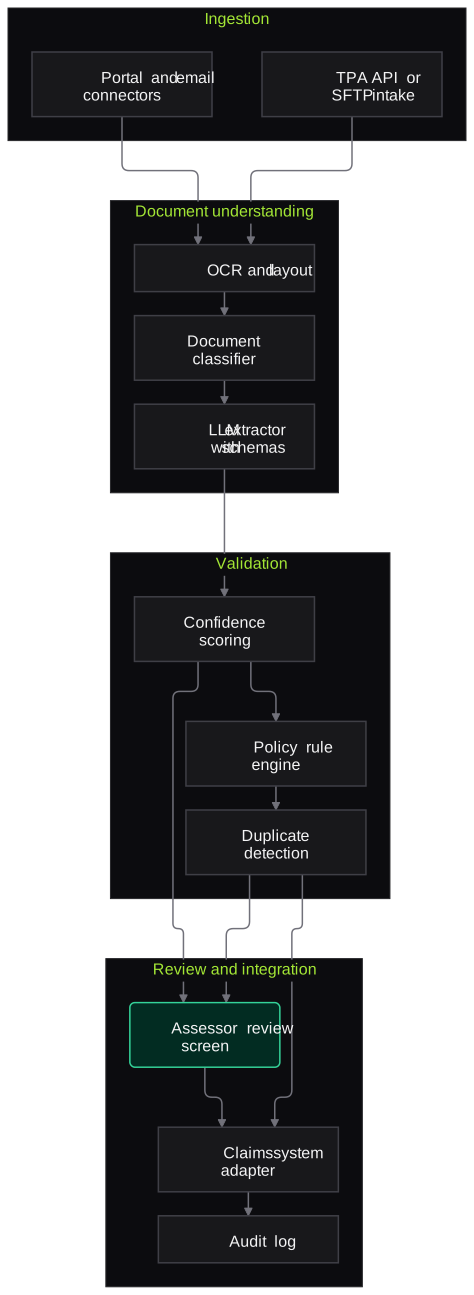
Architecture
- Ingestion
- Email and portal connectors
- SFTP or API intake from TPA systems
- Claim-level document grouping
- Document understanding
- OCR with layout detection
- Document classifier
- LLM field and line-item extractor with JSON schemas
- Validation
- Confidence scoring
- Policy rule engine
- Cross-document consistency checks
- Duplicate detection
- Review
- Assessor review screen with source-page highlights
- Exception queue
- Integration and audit
- Claims system API adapter
- Audit log of every extracted value and reviewer change
Inputs and outputs
Inputs
- Hospital final bill and itemised bill
- Discharge summary
- Investigation and lab reports
- Pharmacy bills and prescriptions
- Policy schedule and member details
- ID and KYC documents (masked Aadhaar)
Outputs
- Structured claim record with header fields and line items
- Field-level confidence scores with source-page links
- List of policy and consistency flags
- Duplicate-claim alerts
- Audit trail of extraction and reviewer edits
Where people stay in control
Assessors confirm any field below the confidence threshold and decide every flagged exception. The system never approves or rejects a claim; it prepares the file so the assessor starts with clean, verifiable data.
Integrations
- Core claims or TPA platform (via API or SFTP)
- Hospital and provider portals
- Email inboxes used for claim intake
- Document management system
- Data warehouse for MIS reporting
Guardrails
- Confidence thresholds per field, agreed with the claims team
- No auto-decision on claims; humans adjudicate
- Personal and health data masked in logs and kept in your cloud region
- Every value traceable to a source page
- Regular sampling of auto-cleared claims for quality review
Compliance notes
- Designed to support data minimisation and purpose limitation under India's DPDP Act 2023.
- Keeps the audit trail insurers need to evidence how each claim was assessed under IRDAI expectations.
A typical pilot
Duration: 3 weeks
One claim type (for example cashless hospitalisation) from two or three high-volume hospitals, run in parallel with your current process.
Deliverables
- 01Extraction schema agreed with your claims team
- 02Working pipeline on a sample of real, de-identified claims
- 03Assessor review screen
- 04Field-level accuracy report against assessor-entered data
- 05Production roll-out plan and cost estimate
What we measure
- Field-level extraction accuracy
- Compared with the values assessors entered for the same claims.
- Share of fields sent for review
- Count of fields below the confidence threshold per claim.
- Assessor handling time per claim
- Timed on a sample of claims with and without the pipeline.
- Flags confirmed as genuine issues
- Assessor feedback on each policy or consistency flag.
Built on related work
Claims reconciliation platform
Packaged-food brand (anonymised)
OCR and LLM platform that matches distributor claims spreadsheets against invoices and proofs, applies policy rules, detects duplicates, recalculates amounts, routes uncertain lines to an exception queue and keeps an audit trail. Finance keeps final approval.
FAQs
01Does this work on handwritten and phone-photographed documents?
Yes, within limits. The pipeline handles skewed photos and common handwriting on bills and prescriptions, and any field it is unsure about is sent for human confirmation rather than guessed. The pilot report shows accuracy separately for printed and handwritten fields.
02Will the AI approve or reject claims?
No. It prepares structured, checked data and flags issues. Adjudication stays with your assessors and medical team.
03Where is the data processed?
In your cloud account or an India region of a major cloud provider, depending on your policy. Health and personal data is masked in logs, and we can use models that do not retain or train on your data.
04How does it connect to our claims system?
Through your system's API, an SFTP drop or a database staging table. We agree the format with your IT team during the pilot.
Related use cases
- Insurance
Pre-Authorisation Request Triage for TPAs
Read incoming cashless requests, check completeness, policy terms and tariffs, and put a prioritised, source-linked summary in front of the TPA medical officer.
- Insurance
Tampered and Fraudulent Document Detection
Score claim documents for signs of editing, fabrication and reuse, explain each signal, and route high-risk files to your investigation team instead of labelling anyone a fraudster.
- Insurance
Claim Status Voice Helpline for Policyholders
An inbound voice agent that verifies callers, explains live claim status in plain language, sends pending-document lists on WhatsApp and transfers complaints and sensitive cases to people.
- Healthcare & Hospitals
Insurance Pre-Auth and Claim File Preparation for Hospitals
Assemble cashless pre-auth, enhancement and final claim files for TPAs, insurers and government schemes, and check each against the payer's checklist before submission.

Founded by Akhilesh Mittal. 8 years building a security platform for a New Zealand company. IIT ISM Dhanbad and IMT Ghaziabad. Builds production agentic AI.
Pick one claim type, product line or bot to start
Book a discovery call and we will scope a short pilot on your own de-identified documents or staging bot, with clear measures agreed up front.