Motor Claim Damage Assessment from Photos
Detect damaged panels and damage types from guided claim photos, check them against the workshop estimate and pre-inspection images, and give surveyors a structured evidence pack.
- Industry:
- Insurance
Who it is for
- Head of Motor Claims
- Motor Surveyor and Loss Assessor
- Motor Claims Desk Manager
- Break-in Inspection Team Lead
The problem
A motor own-damage claim usually starts with photos taken at the roadside or the garage, followed by a workshop estimate listing parts to replace and labour to charge. Surveyors compare the two, often across many claims a day, and decide what was damaged in this accident, what can be repaired and what was already there.
Surveyor capacity is stretched
Surveyors travel between workshops and review photo sets remotely, and simple claims wait behind complex ones.
Estimates drift from the damage
Workshop estimates can include replacement of parts that look repairable or that show no visible damage in the photos.
Old damage and reused photos
Pre-existing dents, photos from a previous claim or images taken before the policy began are hard to catch without side-by-side comparison.
Poor photo sets cause rework
Blurred, dark or incomplete photos mean another visit or another request to the customer, which delays the repair.
What we build
We build a computer vision service that receives guided photos from your self-inspection app or a WhatsApp link, checks that they are usable and cover the required angles, and then detects vehicle parts and damage types such as dents, scratches, cracks, broken glass and deformation. Each damaged panel gets a severity estimate and a repair-or-replace suggestion. The service reads the workshop estimate and highlights lines with no matching visible damage, compares photos with pre-inspection or earlier-claim images to spot pre-existing damage, and checks image metadata for reuse. Surveyors receive a damage map and evidence pack and make the assessment.
- Guided capture checks for blur, lighting, distance and required angles, with instant retake prompts
- Detects vehicle parts and damage types per panel, with a severity estimate and confidence
- Suggests repair or replace per part, using your surveyor guidelines as the reference
- Reads the workshop estimate and flags parts or labour lines with no matching visible damage
- Compares with pre-inspection and earlier claim photos to highlight pre-existing damage
- Checks image metadata and near-duplicates to catch reused or out-of-period photos
How it works
- 01Capture guided photosThe customer, garage or field inspector follows an on-screen guide in the app or a WhatsApp link.
- 02Check photo qualityBlur, lighting and angle coverage are checked, and missing or unusable shots are requested again immediately.
- 03Detect parts and damageModels identify panels and damage types and estimate severity for each.
- 04Compare with estimate and historyThe workshop estimate, pre-inspection photos and earlier claims are compared with the detected damage.
- 05Flag mismatchesEstimate lines without visible damage, possible pre-existing damage and reuse signals are flagged.
- 06Surveyor assessesThe surveyor reviews the damage map and flags, then records the assessment in the motor claims system.

Architecture
- Capture
- Self-inspection app SDK
- WhatsApp Business capture link
- On-device photo quality checks
- Vision models
- Part segmentation model
- Damage type and severity model
- Number plate, VIN and odometer reader
- Comparison
- Workshop estimate extractor
- Pre-inspection and prior claim image matching
- Metadata and near-duplicate checks
- Surveyor review
- Damage map and evidence pack
- Flag review queue
- Correction capture for model retraining
- Integration
- Motor claims system adapter
- Parts catalogue and labour rate lookup
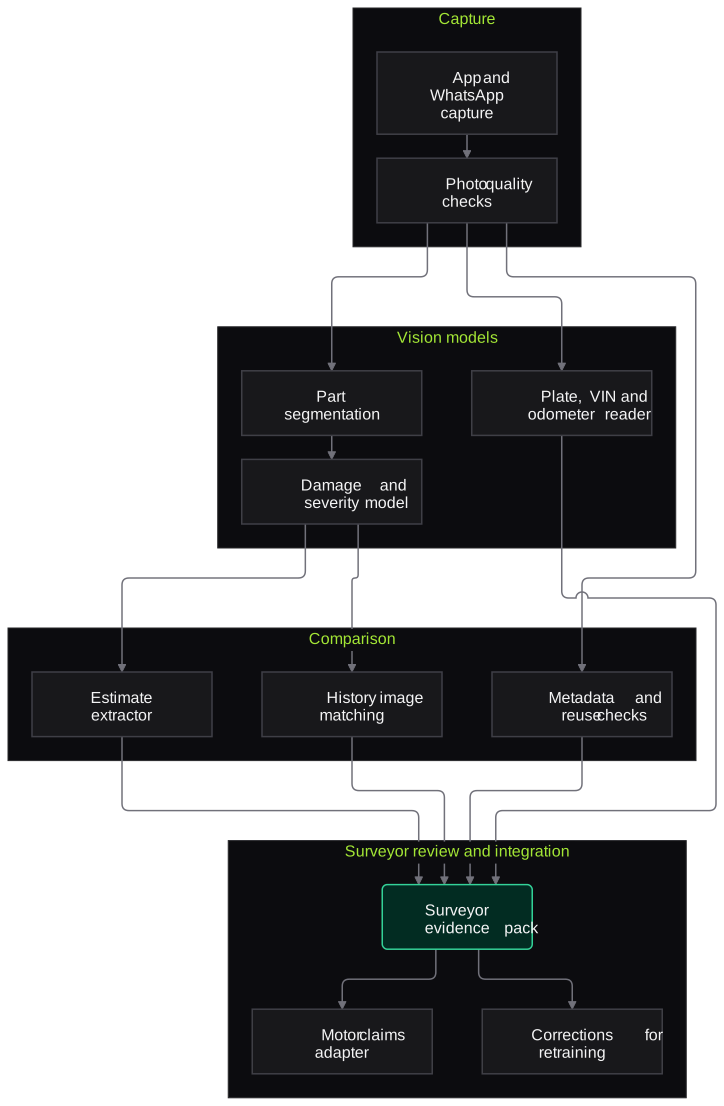
Inputs and outputs
Inputs
- Guided photos or short video of the damaged vehicle
- Workshop repair estimate
- RC, driving licence and policy details
- Pre-inspection or break-in inspection photos
- Claim intimation details: date, place and cause of loss
- Parts catalogue and labour rates you use for assessment
Outputs
- Damage map by panel with damage type, severity and confidence
- Repair-or-replace suggestion per part
- Photo quality and angle coverage report
- Estimate reconciliation flags
- Pre-existing damage and reuse alerts
- Evidence pack for the surveyor
Where people stay in control
Licensed surveyors and loss assessors review every damage map and make the assessment, including what is payable. Both the model's suggestions and the surveyor's final decisions are logged, and corrections are used for retraining.
Integrations
- Motor claims system (via API)
- Self-inspection mobile app or WhatsApp Business API
- Workshop and garage network portal
- Parts catalogue and labour rate master
- Document extraction for RC and driving licence
Guardrails
- Suggestions only; no claim is settled or rejected by the model
- Per-part confidence shown, with low-confidence parts marked for close review
- Faces and third-party number plates blurred before images are used for training
- Image metadata and duplicate checks run on every submission
- Regular review of model performance by vehicle segment and lighting condition
Compliance notes
- The assessment role of licensed surveyors and loss assessors under Indian insurance law is unchanged; the system prepares evidence for them.
- Blurring bystanders and third-party plates before training supports data minimisation under the DPDP Act 2023.
A typical pilot
Duration: 4 weeks
Historical, surveyor-closed own-damage claims for the most common private car segments, followed by a short live trial on new claims from a few network garages.
Deliverables
- 01Damage taxonomy and photo guide agreed with your surveyors
- 02Detection models tuned on your historical claim photos
- 03Surveyor evidence pack view
- 04Agreement report against surveyor assessments
- 05Roll-out plan, including two-wheeler and commercial vehicle extension
What we measure
- Damage detection agreement
- Panels and damage types detected, compared with surveyor-finalised reports on the same claims.
- Repair-or-replace agreement
- Model suggestions compared with the surveyor's decision for each part.
- Retake rate on live captures
- Share of photo sets that needed one or more retakes during the live trial.
- Estimate flags confirmed by surveyors
- Surveyor feedback on each flagged estimate line.
FAQs
01Will this replace our surveyors?
No. It handles the repetitive first look and organises evidence, so surveyors spend their time on judgement. Where a surveyor is required, the surveyor still makes the assessment.
02Does it work for two-wheelers and commercial vehicles?
The approach does, but each segment needs its own training data and photo guide. A typical plan starts with private cars and adds two-wheelers once enough surveyor-labelled claims are available.
03How does it handle night photos, rain and dirt?
The quality check rejects images that are too dark or obscured and asks for a retake. Performance is reported separately for difficult conditions so you know where to rely on it.
04Does it estimate repair cost?
It can price the suggested repairs using your own parts catalogue and labour rates. It does not invent prices, and the surveyor confirms the final figure.
Related use cases
- Automotive & Mobility
Used Car Inspection and Damage Detection
Guided photo capture and damage detection for used-car evaluations, with panel-wise damage maps, odometer and chassis checks and draft refurbishment items for evaluators to confirm.
- Insurance
Tampered and Fraudulent Document Detection
Score claim documents for signs of editing, fabrication and reuse, explain each signal, and route high-risk files to your investigation team instead of labelling anyone a fraudster.
- Automotive & Mobility
RC, Insurance and PUC Document Extraction
Extract and cross-check registration, chassis, owner, hypothecation and validity details from RC, insurance, PUC and fitness documents for used-car, fleet and onboarding teams.
- Insurance
Claim Status Voice Helpline for Policyholders
An inbound voice agent that verifies callers, explains live claim status in plain language, sends pending-document lists on WhatsApp and transfers complaints and sensitive cases to people.

Founded by Akhilesh Mittal. 8 years building a security platform for a New Zealand company. IIT ISM Dhanbad and IMT Ghaziabad. Builds production agentic AI.
Pick one claim type, product line or bot to start
Book a discovery call and we will scope a short pilot on your own de-identified documents or staging bot, with clear measures agreed up front.