Selfie-to-ID Face Match and Document Tamper Checks
Compare a live selfie with the photo on an ID, check liveness and spot edited or replayed ID images, sending borderline cases to a reviewer with highlighted evidence.
- Industry:
- Fintech & Payments
Who it is for
- Head of Customer Onboarding
- Fraud Risk Manager
- KYC Operations Lead
- Product Manager, Onboarding
The problem
Digital onboarding for wallets, cards, lending apps and merchant accounts relies on a selfie and an uploaded ID. Fraudsters reuse stolen ID images, paste a different face onto a genuine card, or hold a phone screen up to the camera instead of their own face.
Screen and printout attacks
Basic face match passes when someone presents a photo of the real customer on another device or on paper.
Edited ID images
Changed dates of birth, swapped photos and altered names are hard to spot at the resolution of a phone upload.
Poor capture conditions
Low light, glare on laminated cards and basic front cameras make genuine customers fail and drop off.
Opaque vendor scores
Off-the-shelf APIs return a score without reasons, which makes reviewer decisions and audit explanations difficult.
What we build
We build a face match and document tamper module that runs inside your onboarding flow or as a back-office service. The capture screen guides the user on lighting and framing and runs a passive liveness check. The selfie is compared with the face on the ID, and the ID image is inspected for signs of editing: inconsistent fonts, artefacts around the photo area, template mismatches and screen moire patterns. Each check returns a score with a reason code and a visual highlight. You set thresholds for pass, review and recapture. Borderline cases go to a reviewer with side-by-side images and highlighted regions, and every decision is logged.
- Guided capture with real-time feedback on blur, glare and framing
- Passive liveness checks for screen replay, printed photos and masks
- Face match between selfie and ID photo with a calibrated similarity score
- Tamper checks on ID images: font and layout consistency, photo-area edits and compression artefacts
- Reason codes and heatmap highlights a reviewer can understand
- Error-rate reporting across lighting conditions, age bands and skin tones on your test set
How it works
- 01Guided captureThe app or web flow guides the user to capture the ID and a selfie, with feedback on lighting, blur and glare.
- 02Liveness checkPassive liveness analysis screens for screen replay, printouts and masks.
- 03Document tamper checkThe ID image is inspected for edits, photo substitution and template inconsistencies.
- 04Face matchThe selfie is compared with the ID photo and scored.
- 05Threshold routingResults fall into pass, manual review or recapture according to thresholds you set per product.
- 06Reviewer decisionA fraud or KYC reviewer decides borderline and flagged cases using side-by-side images, and every outcome is logged.

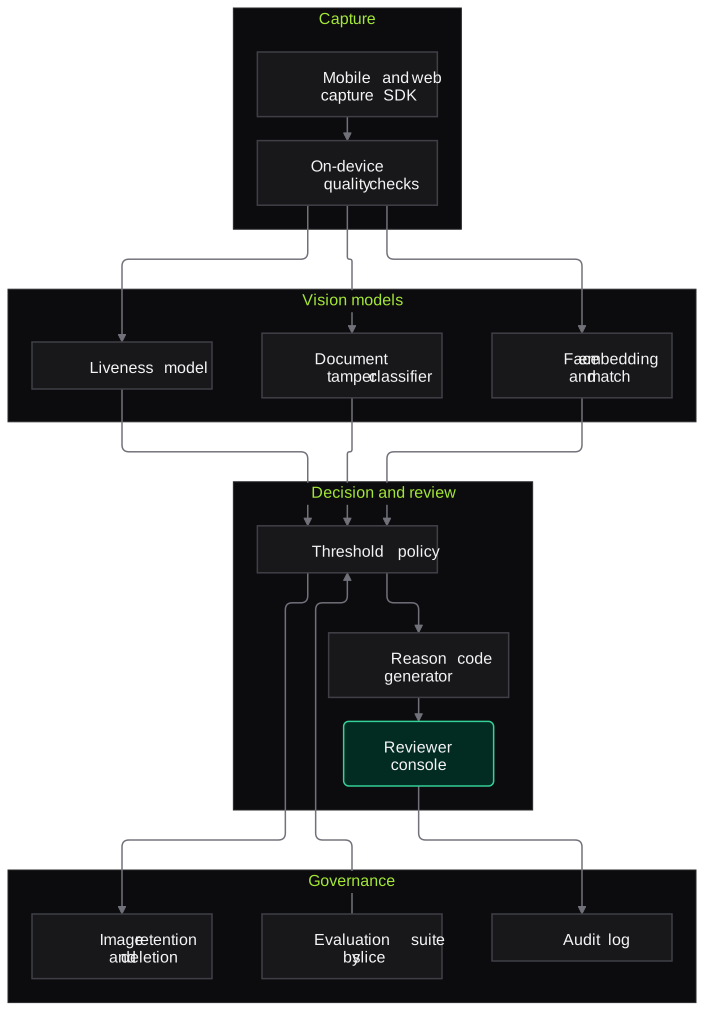
Architecture
- Capture
- Web and mobile capture component
- On-device quality checks for blur and glare
- Vision models
- Passive liveness model
- Document tamper classifier
- Face embedding and match model
- Decision
- Threshold policy per product
- Reason code generator
- Review
- Reviewer console with heatmaps
- Case notes and decision log
- Governance
- Evaluation suite with lighting and demographic slices
- Image retention and deletion jobs
- Audit log
Inputs and outputs
Inputs
- Selfie image or short capture sequence
- ID document image: PAN, passport, driving licence or masked Aadhaar
- Device and capture metadata
- Threshold policy per product
- Labelled sample of genuine and fraudulent past cases for calibration
Outputs
- Liveness, tamper and face match scores with reason codes
- Pass, review or recapture outcome
- Heatmaps highlighting suspect regions
- Reviewer decision log
- Evaluation report by lighting, age band and skin tone
Where people stay in control
Fraud or KYC reviewers decide every borderline and flagged case. Automated action is limited to asking for a recapture; no customer is refused on a model score alone without the review path your policy defines.
Integrations
- Your onboarding app or web flow (SDK or API)
- Existing KYC orchestration or verification vendors
- Fraud case management tool
- Object storage with retention policies
- Core system or customer data platform for onboarding status
Guardrails
- Face images and templates encrypted, kept only for the retention period you define, then deleted
- Aadhaar numbers masked in images before storage, per UIDAI rules
- Thresholds calibrated on your own data and reviewed after every model update
- Error rates checked across skin tone, age band and lighting before go-live
- No face data used for training without explicit, recorded consent
Compliance notes
- Facial images are personal data under the DPDP Act 2023, so consent notices, purpose limitation and deletion are part of the design.
- Strengthens digital onboarding checks but does not replace RBI's video-based customer identification process (V-CIP) where your KYC policy requires it.
- For EU users, biometric data used to identify a person is special-category data under GDPR.
A typical pilot
Duration: 4 weeks
Offline evaluation on a labelled set of past onboarding cases, including known fraud attempts, then a shadow run on live traffic for one product.
Deliverables
- 01Capture flow prototype with quality guidance
- 02Liveness, tamper and face match models configured and calibrated
- 03Evaluation report by capture condition and demographic slice
- 04Reviewer console
- 05Threshold recommendation and roll-out plan
What we measure
- False accept and false reject rates
- Measured on the labelled set at candidate thresholds and reported by slice.
- Recapture rate
- Live sessions asked to recapture, and how many succeed on the next attempt.
- Known fraud caught
- Fraudulent submissions in the test set that are flagged versus missed.
- Reviewer agreement
- How often reviewers agree with the system's borderline flags.
FAQs
01Is this a replacement for video KYC?
No. Where RBI's KYC directions or your policy require V-CIP, you still need it. This module strengthens digital onboarding checks and can also screen images captured during a video KYC session if your process allows.
02How do you avoid bias against some users?
We test on slices of your own data by skin tone, age band, gender where available and lighting, and report error rates for each before go-live. Thresholds are set with those results in view, and borderline cases go to people.
03Do you store customers' faces?
Only as long as your policy says. Images and templates are encrypted, retained for the defined period and then deleted, and they are not used for training without explicit consent.
04Will it work on entry-level Android phones?
Yes. Quality checks run on the device and heavier models run on the server, so capture works on common entry-level phones. During the pilot we test on the devices most of your users have.
Related use cases
- Fintech & Payments
Merchant Onboarding KYC Verification
Read merchant KYC packs, cross-check PAN, GSTIN, bank proof and the merchant's website, and give risk analysts a ready-to-decide file with every check explained.
- Insurance
Tampered and Fraudulent Document Detection
Score claim documents for signs of editing, fabrication and reuse, explain each signal, and route high-risk files to your investigation team instead of labelling anyone a fraudster.
- Banking
Account Opening Document Verification
Check OVDs, PAN, masked Aadhaar, photographs and entity documents in an account opening file against each other and against CKYC, with mismatches routed to an officer.
- Fintech & Payments
DPDP-Aligned AI Data Handling Assessment
Map where personal data flows through your AI features, prompts, logs, vector stores and vendors, and get a gap register and evidence pack against DPDP Act duties for your DPO.

Founded by Akhilesh Mittal. 8 years building a security platform for a New Zealand company. IIT ISM Dhanbad and IMT Ghaziabad. Builds production agentic AI.
Pick one queue and test it on your own data
Book a discovery call. We will choose one workflow, such as merchant KYC review or dispute evidence, and scope a short pilot that runs alongside your current process.