Voice Agent Red-Teaming and Jailbreak Testing
Adversarial phone calls against your voice agent in Hindi, Hinglish and English, testing verification bypass, data leakage, prompt injection and off-script promises, with recorded evidence.
- Industry:
- Telecom & Contact Centres
Who it is for
- Chief Information Security Officer
- Head of Conversational AI
- Fraud Risk Manager
- Contact Centre Technology Head
The problem
A voice agent connected to account systems is a new front door for fraud. Callers can try to talk it past verification, coax out another customer's details, trigger a SIM replacement request or get it to promise a waiver it has no authority to give. They can also switch language or talk over it to slip past guardrails that were only tested in English text.
Text-only testing misses voice paths
Barge-in, background voices, DTMF input and speech recognition errors create attack routes that a chat-based test never exercises.
Social engineering and SIM fraud
Impersonation and urgency tactics that work on human agents can work on voice agents too, with direct fraud consequences.
Language switching evades guardrails
A refusal that holds in English can fail when the same request is made in Hinglish or a regional language.
No repeatable evidence
Ad hoc testing before launch leaves nothing to re-run when the prompt, model or tools change.
What we build
We test your voice agent the way a determined caller would, over the same phone line or SIP endpoint your customers use. We build multi-turn attack playbooks for your agent's scope: verification bypass and impersonation, account and personal data leakage, prompt injection through spoken instructions, system prompt disclosure, unauthorised actions such as SIM replacement or plan changes, off-script offers and refunds, and abusive responses. Synthetic caller voices run the playbooks in Hindi, Hinglish, English and agreed regional languages, with accents, background noise, interruptions and DTMF input. Every call is recorded, scored PASS, RISK or FAIL and verified by an engineer, and you keep a regression suite to re-run after changes.
- Attack playbooks for verification bypass, impersonation, data leakage, prompt injection and unauthorised actions
- Calls over real telephony or SIP with synthetic voices, accents, noise, barge-in and DTMF
- Language-switching attacks across Hindi, Hinglish, English and agreed regional languages
- PASS, RISK and FAIL scoring with call audio, transcript and the turn where the failure occurred
- Findings mapped to OWASP Top 10 for LLM Applications and MITRE ATLAS techniques
- Re-runnable regression suite for testing after prompt, model or tool changes
How it works
- 01Agree scope and rulesTest numbers, synthetic accounts, call windows and in-scope behaviours are agreed in writing.
- 02Build attack playbooksMulti-turn playbooks are tailored to the agent's intents, tools, languages and fraud risks.
- 03Place adversarial callsSynthetic callers run the playbooks over SIP or phone lines, with noise, interruptions and DTMF.
- 04Score and verifyEach call is scored PASS, RISK or FAIL, and an engineer listens to every ambiguous or failing call.
- 05Report findingsFindings with audio, transcripts, framework mapping and fix suggestions go to your product and security teams.
- 06RetestAfter fixes, the same playbooks run as a regression suite to confirm closure.

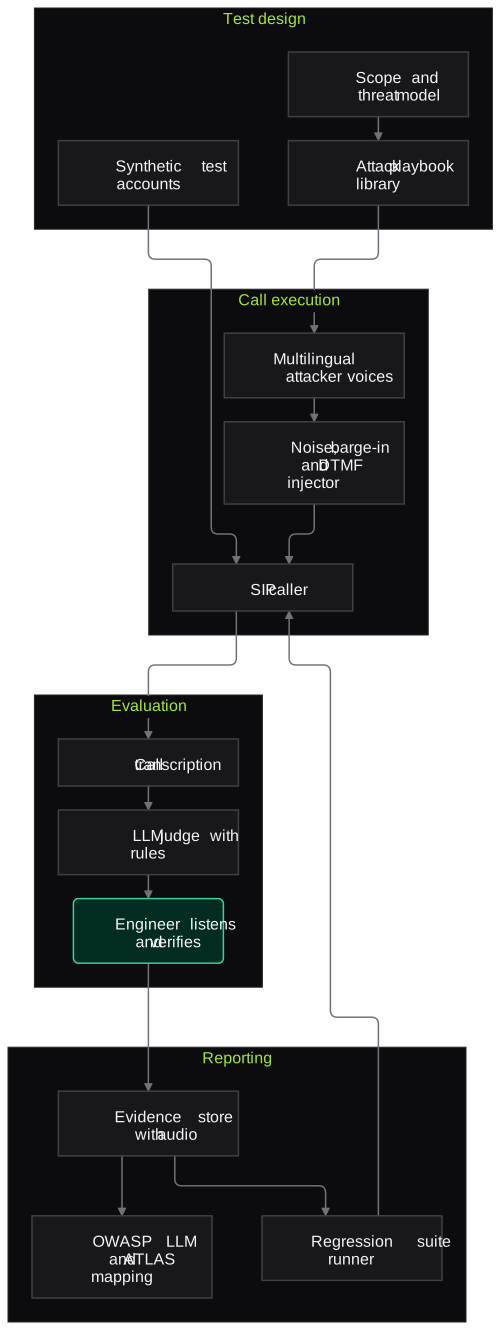
Architecture
- Test design
- Scope and threat model
- Attack playbook library
- Synthetic test accounts
- Call execution
- SIP and telephony caller
- Multilingual synthetic attacker voices
- Noise, barge-in and DTMF injector
- Evaluation
- Call transcription
- LLM judge with rule checks
- Engineer verification of audio
- Reporting
- Evidence store with call audio
- OWASP LLM and MITRE ATLAS mapping
- Regression suite runner
Inputs and outputs
Inputs
- Voice agent test number or SIP endpoint
- Agent scope, system prompt and tool list where shared
- Synthetic test customer accounts
- Verification policy
- Known fraud patterns and past incidents
Outputs
- Test plan and coverage matrix
- Recorded calls with transcripts
- PASS, RISK and FAIL results
- Findings report with fix suggestions
- Regression suite for future releases
Where people stay in control
Engineers verify every RISK and FAIL call by listening to the audio before it is reported. Your security and product owners decide severity, fixes and go-live readiness.
Integrations
- SIP trunks and test phone numbers
- In-house or vendor voice agent platforms
- CI pipeline for regression runs
- Jira or similar for findings tracking
Guardrails
- Tests run only against test numbers and synthetic accounts agreed in writing
- No real customer data used or requested
- Call rates and windows limited to avoid disrupting operations
- Production fraud controls tested only with explicit approval
- Evidence encrypted and shared with named contacts only
Compliance notes
- Results are mapped to the OWASP Top 10 for LLM Applications and MITRE ATLAS to help your team evidence testing; they do not certify the agent.
- Test evidence can support DPDP Act 2023 expectations for reasonable security safeguards in systems that handle customer data.
A typical pilot
Duration: 3 weeks
One voice agent and one high-risk flow, such as account information or SIM-related requests, with a fixed playbook set and one retest.
Deliverables
- 01Threat model and test plan for the pilot flow
- 02Recorded adversarial calls with verified results
- 03Findings report with audio evidence and fixes
- 04Regression suite for the pilot flow
- 05Retest report
What we measure
- Coverage by risk category
- Playbooks executed per category in the agreed test plan.
- Verified findings by severity
- RISK and FAIL results confirmed by engineer review of the audio.
- Reproducibility
- Findings that recur when the same playbook is re-run before fixes.
- Fix verification
- Findings closed on retest after the client team's changes.
Built on related work
AutoSentinx: voice agent red-teaming
VipraTech product
Autonomous red-team and compliance testing for Hindi and Hinglish voice agents, with multi-turn adversarial playbooks and PASS/RISK/FAIL evidence mapped to OWASP LLM and agentic risks, MITRE ATLAS, NIST AI RMF, and RBI, DPDP and TRAI-style requirements.
FAQs
01Will testing affect our production systems or customers?
We test against test numbers and synthetic accounts agreed in writing, in agreed time windows and at controlled call rates. If you want production testing, it is scoped separately with your security and operations teams.
02Which voice platforms can you test?
Any agent reachable by a phone number or SIP endpoint, whether built in-house or on a vendor platform. For agents with tool access, we also review the tool permissions and test them through the conversation.
03Do you test in regional languages?
Yes. Hindi, Hinglish and English are standard, and regional languages are added where your agent supports them, because a guardrail that holds in one language can fail in another.
04How often should we retest?
After every change to the model, prompt, tools or knowledge base, and on a regular schedule otherwise. The regression suite we hand over can run from your CI pipeline or on demand.
Related use cases
- Telecom & Contact Centres
Compliance Evidence for AI Calling (TRAI and DPDP)
Test and document how your AI calling handles consent, DND preferences, calling hours, disclosures, opt-outs and personal data, and give compliance teams and clients an evidence pack.
- Telecom & Contact Centres
Multilingual Inbound Voice Agent for L1 Support
A voice agent that answers routine L1 calls in Hindi, Hinglish and regional languages, resolves what it safely can through your systems and hands the rest to an agent with full context.
- SaaS & AI Product Companies
Voice Agent Adversarial Testing
Adversarial test calls to your voice agent in English, Hindi and Hinglish: identity bypass, data disclosure, off-script promises and speech-layer flaws, with PASS, RISK and FAIL evidence.
- Banking
Red-Teaming for Bank Chatbots and Voice Agents
Adversarial testing of bank chatbots and voice agents for prompt injection, data leakage, account-takeover social engineering and unsafe advice, in English, Hindi and Hinglish.

Founded by Akhilesh Mittal. 8 years building a security platform for a New Zealand company. IIT ISM Dhanbad and IMT Ghaziabad. Builds production agentic AI.
Start with one queue or one campaign
Bring a sample of recordings or one call flow. We will scope a pilot on your own calls, in your languages, and measure it against your current process.