Compliance Evidence for AI Calling (TRAI and DPDP)
Test and document how your AI calling handles consent, DND preferences, calling hours, disclosures, opt-outs and personal data, and give compliance teams and clients an evidence pack.
- Industry:
- Telecom & Contact Centres
Who it is for
- Chief Compliance Officer
- Data Protection Officer
- BPO Client Audit and Risk Lead
- Head of AI Calling Product
The problem
When an operator, BPO or enterprise starts placing calls with an AI agent, the questions from compliance teams, clients and auditors change from whether it works to proof of how it behaves. Did it call only consented numbers within permitted hours, did it disclose that it is automated, did opt-outs take effect, and where do recordings and transcripts go afterwards?
Controls exist only on paper
Policies say numbers are scrubbed and opt-outs honoured, but there is no test evidence that the live system does it.
Logs are scattered
Dialler records, DLT reports, consent systems, CRM and the voice platform each hold part of the story.
Every BPO client audits differently
Each client sends its own questionnaire, and teams rebuild the same evidence by hand for each one.
Rules and behaviour both change
Regulations are amended and the agent changes with every model, prompt or campaign update, so one-off evidence goes stale.
What we build
We build an evidence workflow that tests and documents your AI calling against the obligations that apply to you. First we map requirements from TRAI commercial-communication rules, the DPDP Act 2023, client contracts and your own policies into a control matrix that your compliance team approves. Then each control is tested two ways: scripted test calls that probe behaviour, such as disclosure, opt-out and calls attempted outside permitted hours or to suppressed numbers, and log reconciliation that compares calls actually placed with consent records, preference data and suppression lists. Each control gets a PASS, RISK or FAIL result with evidence attached, and a monitoring job re-runs the checks on a schedule.
- Control matrix built from TRAI commercial-communication rules, the DPDP Act 2023, client contracts and internal policy
- Scripted test calls for disclosure, opt-out, consent capture and out-of-scope handling
- Reconciliation of call logs against consent records, preference data and suppression lists
- Review of recording, transcript and retention settings against stated purpose and policy
- PASS, RISK and FAIL results per control with call audio, logs and screenshots as evidence
- Scheduled re-checks after model, prompt or campaign changes, with drift alerts
How it works
- 01Map obligationsTRAI rules, DPDP obligations, client clauses and internal policies are mapped to a control matrix.
- 02Approve the matrixYour compliance team or DPO approves the controls and the evidence each one needs.
- 03Test behaviour and logsScripted test calls probe agent behaviour while log reconciliation checks the calls actually placed.
- 04Review gapsEvery RISK or FAIL result goes to the compliance officer, who decides remediation or acceptance.
- 05Assemble the evidence packResults, audio, logs and screenshots are organised by control for internal and client review.
- 06Re-check on scheduleChecks re-run after changes and at agreed intervals, with drift reported.

Architecture
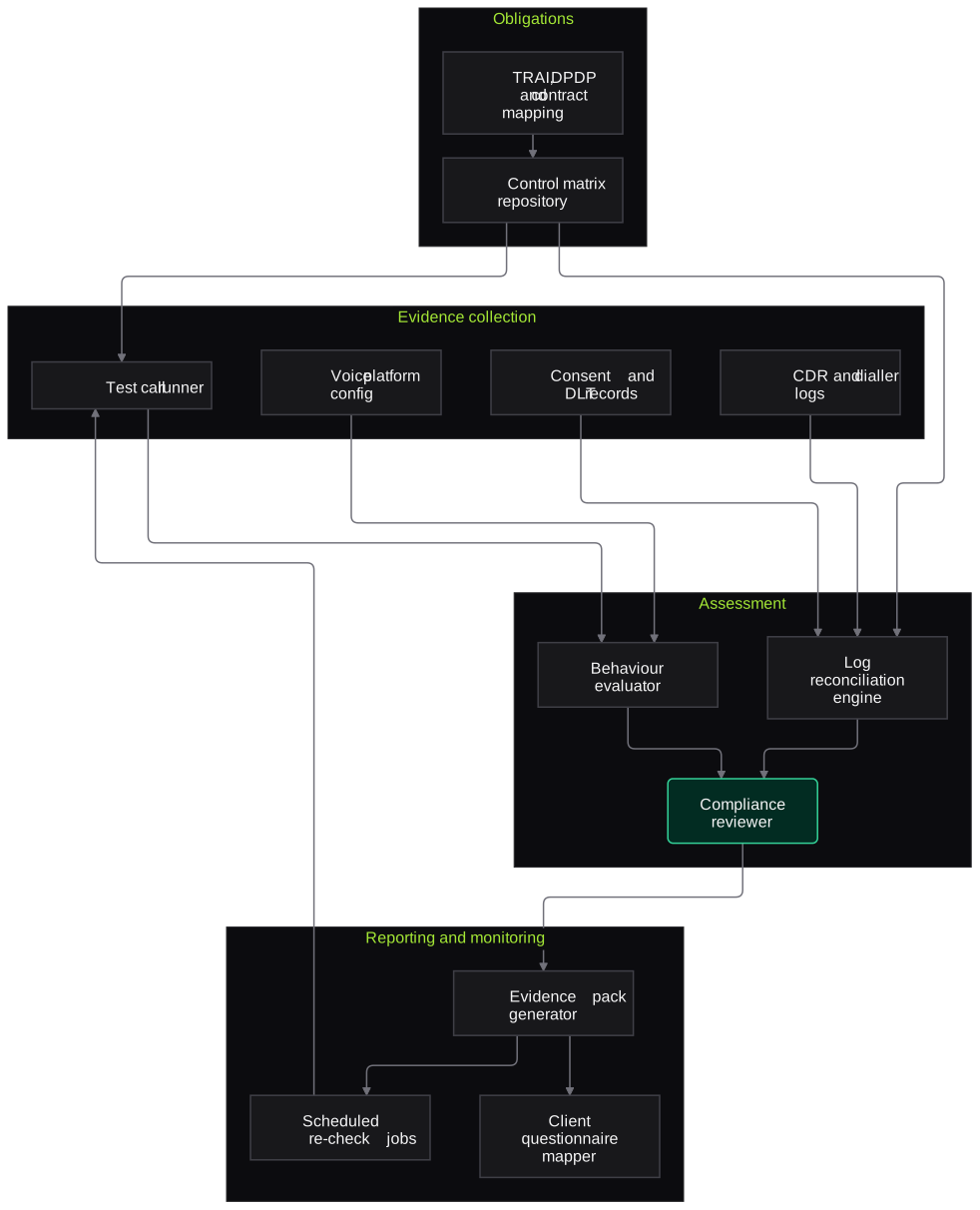
- Obligations
- Regulation and contract mapping
- Control matrix repository
- Evidence collection
- Call detail records and dialler logs
- Consent and DLT records
- Voice platform configuration and logs
- Test call runner
- Assessment
- Log reconciliation engine
- Behaviour evaluator for test calls
- PASS, RISK and FAIL scoring with reviewer sign-off
- Reporting and monitoring
- Evidence pack generator
- Client questionnaire mapper
- Scheduled re-check jobs
Inputs and outputs
Inputs
- Call detail records and dialler logs
- Consent records and preference or scrubbing data
- Voice agent scripts, prompts and configuration
- Recording and retention settings and privacy notices
- Client contracts and audit questionnaires
- Internal calling and privacy policies
Outputs
- Control matrix with status per control
- Test call recordings and results
- Log reconciliation exceptions
- Evidence pack organised by control
- Remediation list
- Scheduled monitoring reports
Where people stay in control
Your compliance officer or DPO approves the control matrix, reviews every RISK and FAIL result and decides remediation or acceptance. Legal interpretation of the rules stays with your compliance and legal advisers; we provide technical tests and evidence.
Integrations
- Dialler or CCaaS platform
- DLT and telemarketer reports
- Consent management platform
- CRM
- GRC tool or SharePoint for evidence storage
- Voice agent platform APIs
Guardrails
- Test calls placed only to designated test numbers
- Logs pseudonymised before analysis
- Evidence pack access restricted to named reviewers
- Each control records which version of the rules it was mapped to
- No legal opinions in the evidence pack
Compliance notes
- Designed to help you evidence alignment with TRAI's commercial-communication rules and the DPDP Act 2023; it is not a legal opinion or a certification.
- Where BPO clients are regulated entities such as banks or NBFCs, their regulator's outsourcing and conduct expectations can be added to the control matrix.
A typical pilot
Duration: 3 weeks
One AI calling flow, such as a single outbound campaign or inbound service line, with an approved control matrix, test calls and one month of logs.
Deliverables
- 01Approved control matrix for the pilot flow
- 02Test call results with recordings
- 03Log reconciliation report
- 04Evidence pack in your preferred format
- 05Monitoring plan and cost estimate
What we measure
- Control coverage
- Controls with attached evidence compared with the controls in the approved matrix.
- Validated exceptions
- Log reconciliation exceptions confirmed by the compliance team.
- Evidence acceptance
- Feedback from compliance reviewers or a client auditor on whether the pack answers their questions.
- Questionnaire response time
- Time to answer a client audit questionnaire using the pack, compared with the last audit.
Built on related work
AutoSentinx: voice agent red-teaming
VipraTech product
Autonomous red-team and compliance testing for Hindi and Hinglish voice agents, with multi-turn adversarial playbooks and PASS/RISK/FAIL evidence mapped to OWASP LLM and agentic risks, MITRE ATLAS, NIST AI RMF, and RBI, DPDP and TRAI-style requirements.
FAQs
01Is this a legal opinion on our compliance?
No. We provide technical tests and evidence against a control matrix your compliance or legal team approves. Interpretation of the rules and the final compliance position stay with them.
02Do you need access to production logs?
For log reconciliation, yes, but pseudonymised extracts are enough: hashed numbers, timestamps, campaign IDs and outcomes. Test calls are made only to test numbers.
03Can the controls cover our BPO clients' own requirements?
Yes. Client contract clauses and sector rules, such as a bank client's expectations on calling conduct, are added to the matrix so one set of evidence can answer several client audits.
04How often are checks re-run?
On a schedule you choose and after any change to the model, prompt, script or campaign set-up. Each run is versioned, so you can show auditors the history.
Related use cases
- Telecom & Contact Centres
Outbound Sales Voice Agent with DND and Consent Checks
An outbound voice agent that dials only numbers cleared against DND preferences, consent records and your opt-out list, pitches within approved scripts and logs every consent outcome.
- Telecom & Contact Centres
Voice Agent Red-Teaming and Jailbreak Testing
Adversarial phone calls against your voice agent in Hindi, Hinglish and English, testing verification bypass, data leakage, prompt injection and off-script promises, with recorded evidence.
- Telecom & Contact Centres
Call QA and Compliance Auditing on Every Call
Score every recorded call against your QA form and compliance script, in Hindi, Hinglish and English, so QA analysts spend their time on the calls that need a human ear.
- Fintech & Payments
DPDP-Aligned AI Data Handling Assessment
Map where personal data flows through your AI features, prompts, logs, vector stores and vendors, and get a gap register and evidence pack against DPDP Act duties for your DPO.

Founded by Akhilesh Mittal. 8 years building a security platform for a New Zealand company. IIT ISM Dhanbad and IMT Ghaziabad. Builds production agentic AI.
Start with one queue or one campaign
Bring a sample of recordings or one call flow. We will scope a pilot on your own calls, in your languages, and measure it against your current process.