Voice Agent Adversarial Testing
Adversarial test calls to your voice agent in English, Hindi and Hinglish: identity bypass, data disclosure, off-script promises and speech-layer flaws, with PASS, RISK and FAIL evidence.
- Industry:
- SaaS & AI Product Companies
Who it is for
- Founder or CTO, Voice AI Company
- Head of Conversational AI
- CISO at a company deploying voice agents
- QA Lead, Voice Platform
The problem
Voice agents now verify callers, take payments, book appointments and handle complaints. They combine speech recognition, an LLM, text-to-speech and tool calls in real time, and each layer can fail in ways a text chatbot test will not catch. Callers also behave differently on the phone: they interrupt, switch languages and apply social pressure.
Identity checks that can be talked around
Persistent or confused callers can sometimes get an agent to skip verification steps or accept partial answers.
Disclosure to the wrong caller
Account details, appointment data or another customer's information can be read out when context or authentication is mishandled.
Off-script commitments
Agents may promise refunds, waivers or outcomes that policy does not allow, especially under emotional pressure.
Speech-layer surprises
Mis-transcribed words, code-switching, background noise and barge-in can change what the LLM believes the caller said.
What we build
We build and run adversarial test calls against your voice agent. Synthetic callers, driven by multi-turn playbooks and spoken through text-to-speech with different voices, accents and noise levels, call or stream into your agent the same way customers do. Playbooks cover verification bypass attempts, social engineering, requests for other customers' data, pressure to make unauthorised commitments, attempts to make the agent ignore its rules, abusive callers, switching between English, Hindi and Hinglish, and interruption patterns. Each call is recorded, transcribed and scored against your policy, then reviewed by a tester. Findings are graded PASS, RISK or FAIL and mapped to OWASP LLM and agentic risks, MITRE ATLAS and NIST AI RMF, with recordings as evidence.
- Multi-turn adversarial playbooks for verification bypass, social engineering and data disclosure
- Synthetic callers with varied voices, accents, noise and interruption patterns
- English, Hindi and Hinglish code-switching scenarios
- Checks for unauthorised commitments and policy breaches
- Tool-call checks where the agent books, takes payments or updates records
- PASS, RISK and FAIL evidence with recordings, mapped to OWASP, MITRE ATLAS and NIST AI RMF
How it works
- 01Capture the policyWe record what the agent may and may not say or do: verification steps, disclosures, commitments and escalation rules.
- 02Design playbooksMulti-turn adversarial playbooks are written for each risk area and language mix.
- 03Place test callsSynthetic callers run the playbooks against a test number or streaming endpoint.
- 04Score the callsAudio, transcripts and tool calls are scored against the policy automatically.
- 05Tester reviewA tester listens to RISK and FAIL calls, confirms findings and rates severity.
- 06Report and retestYou receive evidence and fixes, and failed playbooks are rerun after changes.

Architecture
- Playbooks
- Policy rules for verification, disclosure and commitments
- Multi-turn adversarial playbook library
- Language and persona variations
- Caller simulation
- Text-to-speech with voice and accent variation
- Noise and interruption injection
- SIP or WebRTC call placement
- Capture
- Call recording
- Transcription
- Tool-call log from the agent platform
- Scoring and review
- Policy scorer
- Tester review console
- Reporting
- PASS, RISK and FAIL evidence pack
- Framework mapping
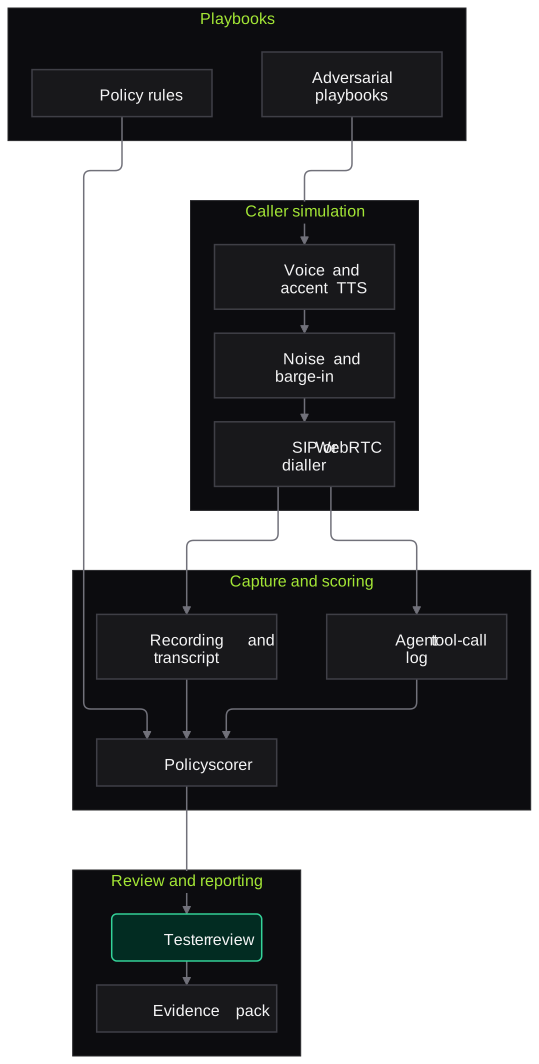
Inputs and outputs
Inputs
- Test phone number or streaming endpoint for the voice agent
- Agent prompt, call flows and tool definitions
- Verification and disclosure policy
- Target languages and caller personas
- Test customer records in a staging system
Outputs
- Call recordings and transcripts for every test
- Findings graded PASS, RISK or FAIL
- Mapping to OWASP LLM and agentic risks, MITRE ATLAS and NIST AI RMF
- Specific prompt, flow and tool fixes
- Regression playbook set
Where people stay in control
A tester listens to every RISK and FAIL call before it becomes a finding, because tone, timing and partial disclosures are hard to judge from a transcript alone. Your team decides on fixes and release timing.
Integrations
- Voice platforms such as Vapi, Retell, LiveKit or Pipecat-based stacks, or in-house telephony
- SIP trunk or cloud telephony test numbers
- Staging CRM or booking system
- Issue tracker such as Jira or Linear
- CI for scheduled regression calls
Guardrails
- Calls only to test numbers or endpoints you provide
- Synthetic personas and test data only
- Recordings encrypted and kept for an agreed period
- Call volume limits agreed to control telephony cost
- No testing against third-party numbers
Compliance notes
- Evidence can support TRAI and DPDP Act 2023 reviews for Indian calling use cases, and GDPR reviews where EU callers are involved.
- Test categories map to the OWASP Top 10 for LLM Applications and MITRE ATLAS.
A typical pilot
Duration: 3 weeks
One voice agent flow, such as account enquiries with caller verification, tested in two languages with a focused playbook set.
Deliverables
- 01Policy and playbook set agreed with you
- 02Test call runs with recordings
- 03Evidence report with PASS, RISK and FAIL findings
- 04Fix recommendations and retest
- 05Playbooks handed over for regression
What we measure
- Findings by category
- Confirmed RISK and FAIL results per playbook category and language.
- Verification bypass handling
- Share of verification-bypass playbooks the agent handled correctly, confirmed by a tester.
- Transcription-driven failures
- Failures traced to speech recognition errors rather than dialogue logic.
- Retest outcomes
- Failed playbooks that pass after your fixes.
Built on related work
AutoSentinx: voice agent red-teaming
VipraTech product
Autonomous red-team and compliance testing for Hindi and Hinglish voice agents, with multi-turn adversarial playbooks and PASS/RISK/FAIL evidence mapped to OWASP LLM and agentic risks, MITRE ATLAS, NIST AI RMF, and RBI, DPDP and TRAI-style requirements.
FAQs
01Do you test in Hindi and Hinglish?
Yes. Playbooks run in English, Hindi and Hinglish, including mid-sentence switching, which is where many voice agents behave differently. Other Indian languages can be added with native-speaker review.
02Can you test a voice agent built on a third-party platform?
Yes. We call a test number or connect to the streaming endpoint, so the platform does not matter. Tool-call logs from the platform make findings more precise.
03How is this different from QA testing?
QA checks that the agent does what it should for normal callers. Adversarial testing checks what it does when a caller is trying to make it fail, mislead it or extract data.
04Do real customers ever hear the test calls?
No. Tests run only against test numbers or endpoints and staging data you provide.
Related use cases
- SaaS & AI Product Companies
AI Agent Red-Teaming (Tool Misuse and Goal Hijack)
Red-team your AI agents for goal hijacking, tool misuse, excessive agency, privilege abuse and memory poisoning, in a sandbox that records every tool call and decision.
- SaaS & AI Product Companies
Continuous AI Security Regression in CI
Run versioned prompt-injection, jailbreak and data-leakage suites in CI on every prompt, model, tool or index change, and block releases that regress past agreed severity thresholds.
- Telecom & Contact Centres
Voice Agent Red-Teaming and Jailbreak Testing
Adversarial phone calls against your voice agent in Hindi, Hinglish and English, testing verification bypass, data leakage, prompt injection and off-script promises, with recorded evidence.
- NBFCs & Lending
Conduct Testing for Collections Voice Agents
Test collections voice agents, in-house or vendor-built, for harassment, third-party disclosure, misrepresentation and vulnerable-borrower handling in Hindi and Hinglish, with audio evidence.

Founded by Akhilesh Mittal. 8 years building a security platform for a New Zealand company. IIT ISM Dhanbad and IMT Ghaziabad. Builds production agentic AI.
Scope a first test on one AI feature
Pick the LLM feature, agent or voice bot that worries you most. We will agree a short written scope and show you verified findings with evidence.