Document Extraction Module for Your SaaS Product
An embeddable extraction service for your SaaS product: schemas per document type, per-tenant fields, confidence and source boxes, a review component and webhooks, running in your cloud.
- Capability:
- Document Intelligence
- Industry:
- SaaS & AI Product Companies
Who it is for
- CTO or VP Engineering
- Product Manager
- Head of Platform
- Founder of a vertical SaaS
The problem
Many SaaS products ask users to upload documents: invoices in AP software, payslips in HR and lending tools, bills of lading in logistics platforms, contracts in procurement suites. Users then type the same data into forms. Building reliable extraction in-house means handling OCR, layouts, model choice, confidence, review and multi-tenancy, which pulls engineers away from the core product.
Users still re-type data
Without extraction, uploads are just attachments and users fill forms by hand, which slows activation and creates errors.
Templates that break
Template-based OCR fails whenever a new supplier, bank or carrier changes its layout.
Customers want their own fields
Each tenant needs a few custom fields or rules, and hard-coded schemas cannot keep up.
Cost and data concerns
Sending every page to the largest model is expensive, and enterprise customers ask where their documents go.
What we build
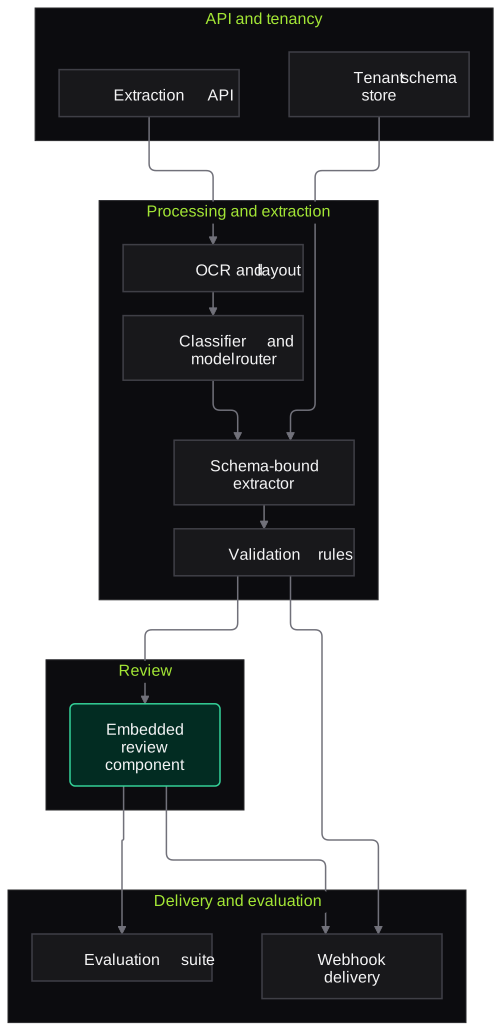
We build a document extraction service that your product calls through an API. Each document type has a versioned JSON schema, and tenants can add custom fields within limits you set. The pipeline runs OCR with layout detection, classifies the document and extracts fields with a language model, returning each value with a confidence score and a bounding box on the source page. Model routing sends easy pages to cheaper models and hard pages to stronger ones. An embeddable review component lets your users confirm low-confidence fields, and their corrections feed back into evaluation. Results go out by webhook. It runs in your cloud account, with tenant isolation and no training on customer documents.
- API service with versioned schemas per document type
- Per-tenant custom fields and validation rules
- Values returned with confidence scores and source bounding boxes
- Model routing by page difficulty to control cost
- Embeddable review component for low-confidence fields
- Evaluation suite tracking accuracy per document type and model version
How it works
- 01Receive the uploadYour product sends the document and tenant ID to the extraction API.
- 02Classify and readOCR and layout detection run, and the document type is identified.
- 03Extract to schemaFields are extracted to the tenant's schema with confidence scores and bounding boxes.
- 04ValidateFormat checks and tenant rules run, such as totals adding up or dates falling in range.
- 05Review if neededLow-confidence or failed fields appear in the embedded review component for the user to confirm.
- 06Deliver and learnResults are sent by webhook, and user corrections are stored for evaluation.

Architecture
- API and tenancy
- Extraction API with authentication
- Tenant registry and schema store
- Usage metering
- Document processing
- OCR with layout detection
- Document classifier
- Model router
- Extraction and validation
- LLM extractor with JSON schema enforcement
- Validation rules per tenant
- Confidence scoring
- Review
- Embeddable review component
- Correction capture
- Delivery and evaluation
- Webhook delivery with retries
- Evaluation suite and accuracy dashboard
Inputs and outputs
Inputs
- Documents uploaded by your users: PDFs, scans and phone photos
- Document types and field definitions you want supported
- Tenant-specific custom fields and rules
- Labelled sample documents for evaluation
- Your cloud account and deployment standards
Outputs
- Structured JSON per document with confidence and bounding boxes
- Review tasks in the embedded component
- Webhook events for downstream workflows
- Accuracy and cost dashboard by document type
- Deployment in your cloud with infrastructure as code
Where people stay in control
Your users confirm low-confidence fields in the review component inside your product, and your team approves schema changes and model upgrades after checking evaluation results.
Integrations
- Your product backend via REST API and webhooks
- Cloud object storage such as S3, Azure Blob Storage or Google Cloud Storage
- Hosted model providers or self-hosted models
- Your frontend framework for the review component
- Observability stack for metrics and logs
Guardrails
- Tenant isolation in storage, processing and logs
- No training on customer documents, with provider retention disabled where available
- Schema and model changes released only after evaluation passes
- Personal data masked in logs
- Per-tenant rate limits and usage metering
Compliance notes
- Deployment in your cloud and region supports data residency commitments under GDPR and the DPDP Act 2023.
- Audit logs of extraction and user corrections help evidence data handling in customer security reviews.
A typical pilot
Duration: 4 weeks
One or two document types that matter most to your users, integrated with a staging version of your product.
Deliverables
- 01Schemas for the chosen document types
- 02Extraction API deployed in your cloud
- 03Embeddable review component
- 04Evaluation report on your labelled samples
- 05Integration guide and production plan
What we measure
- Field-level accuracy
- Extracted values compared with labelled ground truth per document type.
- Share of fields sent to review
- Count of fields below confidence or failing rules per document.
- Cost per document
- Model and compute cost per processed document, logged by the service.
- Latency
- Time from upload to webhook, measured in staging.
FAQs
01Can we white-label the review component?
Yes. It is built to sit inside your product with your styling, so users never leave your app.
02Which models does it use?
We choose per document type based on evaluation results and cost, using hosted providers or self-hosted models. The router lets you change models without changing your API.
03How do you handle enterprise customers' data concerns?
The service runs in your cloud account and region, isolates tenants, masks personal data in logs and does not train on customer documents.
04Who owns the code?
Ownership is agreed in the contract, and the usual arrangement is that you own what we build for you. We hand over the service, infrastructure code, schemas and evaluation suite, and can support it after launch.
Related use cases
- SaaS & AI Product Companies
Security Questionnaire Answering Assistant
Draft answers to security and AI due-diligence questionnaires from your own policies, reports and past answers, with citations, confidence and owner approval before anything goes to a customer.
- Fintech & Payments
Invoice and GST Data Extraction for B2B Payments
Extract GSTINs, HSN lines, tax splits and IRN data from supplier invoices before a B2B payment or invoice financing is released, with tax-logic and duplicate checks.
- NBFCs & Lending
Loan Application Document Extraction
Read loan files from branches, DSAs and digital journeys, extract KYC, income and business fields into your LOS, and flag missing or inconsistent documents before credit review.
- Logistics & Supply Chain
Freight Invoice Audit Against Rate Contracts
Audit every carrier or transporter freight bill against your rate contracts, shipment data and PODs, recalculate each charge and flag overbilling, duplicates and unsupported surcharges.

Founded by Akhilesh Mittal. 8 years building a security platform for a New Zealand company. IIT ISM Dhanbad and IMT Ghaziabad. Builds production agentic AI.
Scope a first test on one AI feature
Pick the LLM feature, agent or voice bot that worries you most. We will agree a short written scope and show you verified findings with evidence.