Freight Invoice Audit Against Rate Contracts
Audit every carrier or transporter freight bill against your rate contracts, shipment data and PODs, recalculate each charge and flag overbilling, duplicates and unsupported surcharges.
- Capability:
- Document Intelligence
- Industry:
- Logistics & Supply Chain
Who it is for
- Head of Logistics
- Logistics Finance Controller
- Accounts Payable Manager
- Transport Procurement Manager
The problem
Shippers and 3PLs pay many carriers and transporters, each billing in its own format: per-trip FTL bills, PTL and courier invoices with weight slabs, fuel surcharges, ODA, detention and loading charges. Rate contracts sit in spreadsheets, PDFs and email amendments, so most audit teams check a sample and pay the rest.
Rates that drift from contract
Old rates, wrong lane slabs and fuel surcharges calculated on the wrong base slip into bills.
Weight and dimension disputes
Carriers bill on a volumetric or charged weight that differs from the shipped weight in your system.
Unsupported accessorial charges
Detention, multi-point delivery, ODA and handling charges are billed without supporting evidence or approval.
Duplicates across formats
The same trip billed twice, once on a consolidated invoice and again on a supplementary bill, is hard to spot by hand.
What we build
We build a freight audit pipeline that reads each carrier invoice and its annexure, whether PDF, Excel or scan, and extracts every shipment line. Each line is matched to the shipment in your TMS or ERP and to its POD, then recalculated from the applicable rate contract: lane, vehicle type, weight slab, fuel surcharge formula and agreed accessorials. Differences, missing approvals and possible duplicates are listed with the expected amount and the reason. Clean lines are approved for payment, and variance lines are queued for the logistics team to accept or dispute, with a draft debit note where needed.
- Extracts shipment lines from PDF, Excel and scanned freight bills and annexures
- Digitises rate contracts into lane, vehicle, slab, fuel and accessorial rules with effective dates
- Recalculates each line and shows expected versus billed amount per charge
- Checks charged weight against shipped weight and dimensions in your system
- Flags detention, ODA and other accessorials without supporting evidence or approval
- Detects duplicate billing across invoices and billing cycles
How it works
- 01Receive invoicesCarrier invoices and annexures arrive by email, portal or AP system and are grouped by carrier and billing period.
- 02Extract linesEvery shipment line is extracted with LR or AWB number, lane, weight and each charge component.
- 03Match shipments and PODsLines are matched to TMS shipments and PODs, and unmatched lines are flagged.
- 04Recalculate chargesThe applicable contract rate is applied and the expected amount is computed per charge component.
- 05Review variancesLines with variances, missing evidence or possible duplicates go to the logistics team to accept or dispute.
- 06Approve and postApproved amounts and dispute notes are posted to the ERP for payment and carrier communication.

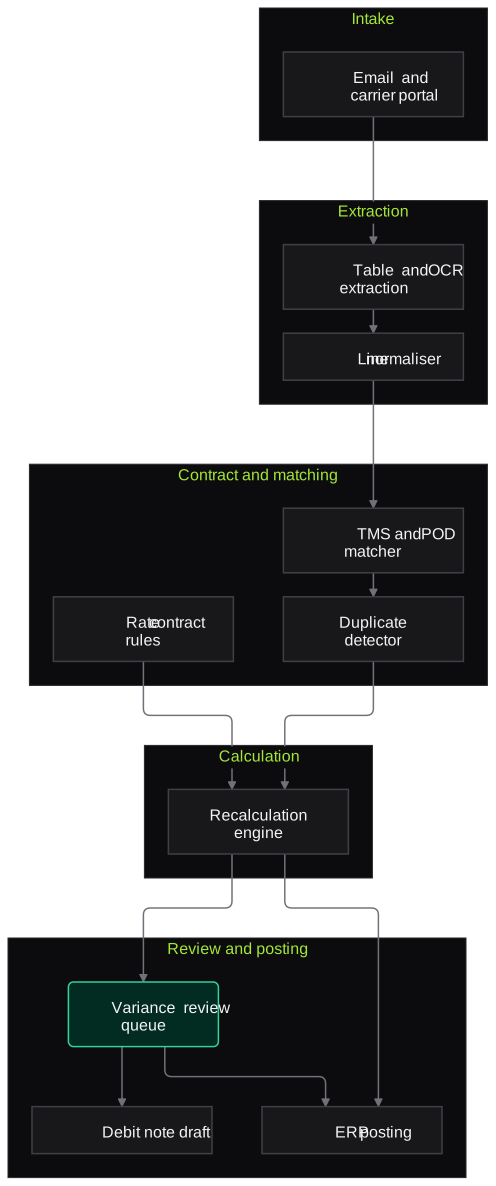
Architecture
- Intake
- Email and carrier portal connectors
- AP system invoice feed
- Extraction
- Table extraction for PDF and Excel annexures
- OCR for scanned bills
- LLM line normaliser
- Contract and matching
- Rate contract rule store
- TMS shipment and POD matcher
- Duplicate detector
- Calculation
- Charge recalculation engine
- Fuel surcharge formula library
- Review and posting
- Variance review queue
- Debit note drafts
- ERP posting adapter
Inputs and outputs
Inputs
- Carrier and transporter invoices with annexures
- Rate contracts, tariff sheets and amendment letters
- Shipment data from the TMS or ERP
- PODs and detention or loading evidence
- Fuel price reference used in surcharge clauses
Outputs
- Line-level audit result: approved, variance or unmatched
- Expected versus billed amount per charge component
- Duplicate billing alerts
- Draft dispute notes or debit notes
- Carrier-wise variance reports
Where people stay in control
The logistics or finance team decides every variance, unmatched line and possible duplicate before payment. Procurement reviews the digitised rate rules when they are first set up and whenever a contract changes.
Integrations
- ERP such as SAP, Oracle or Tally for accounts payable
- TMS for shipment and weight data
- POD repository or ePOD app
- Carrier portals and email
- Contract repository or spreadsheets holding rate cards
Guardrails
- Every recalculation shows the contract clause and rate applied
- No automatic disputes; people decide what is raised with carriers
- Rate rules versioned with effective dates
- Unmatched lines never auto-approved
- Sampling of auto-approved lines each billing cycle
Compliance notes
- Supports GST input tax credit checks by matching carrier GSTIN and invoice details with your records; the GST treatment of freight under forward or reverse charge stays with your tax team.
- Keeps an audit trail of every adjustment for statutory and internal audit.
A typical pilot
Duration: 4 weeks
Two or three carriers on one mode, such as FTL or courier, using closed billing cycles your team has already audited.
Deliverables
- 01Digitised rate contracts for the pilot carriers
- 02Working audit pipeline with TMS and POD matching
- 03Variance review screen
- 04Audit report compared with your team's own audit
- 05Production plan and cost estimate
What we measure
- Line extraction accuracy
- Extracted lines and charges reconciled with invoice totals and checked on a manual sample.
- Variances confirmed
- Variance lines your team agrees are genuine after review.
- Variances missed
- Known issues from your earlier audits checked against what the pipeline flagged.
- Audit effort per invoice
- Team time per invoice with and without the pipeline.
Built on related work
Claims reconciliation platform
Packaged-food brand (anonymised)
OCR and LLM platform that matches distributor claims spreadsheets against invoices and proofs, applies policy rules, detects duplicates, recalculates amounts, routes uncertain lines to an exception queue and keeps an audit trail. Finance keeps final approval.
FAQs
01Our rate contracts are messy spreadsheets and emails. Is that a problem?
It is the normal starting point. We digitise them into rules during the pilot and ask procurement to confirm each one. Amendments are added as new versions with effective dates.
02Can it handle courier invoices with thousands of AWBs?
Yes. Large Excel or CSV annexures are processed line by line, and scanned PDFs go through OCR first. Processing time per invoice is reported during the pilot.
03Does it dispute invoices with carriers directly?
No. It prepares the variance list and draft dispute notes, and your team decides what to send. Carrier-facing variance reports can be shared through a portal if you choose.
04How is this different from our ERP's three-way match?
An ERP match compares invoice totals with purchase orders or goods receipts. Freight audit recalculates each shipment from contract terms, weights and accessorial rules, which a standard ERP match does not do.
Related use cases
- Logistics & Supply Chain
Proof of Delivery Capture and Verification
Check every POD photo or scan for consignment number, date, signature, stamp and remarks, match it to the shipment in your TMS, and flag short, damaged or doubtful deliveries before billing.
- Logistics & Supply Chain
E-Way Bill and GST Document Validation
Check that each consignment's tax invoice or delivery challan, e-way bill and vehicle details agree before dispatch, then track validity and Part B updates while goods are in transit.
- Manufacturing
Purchase Order, GRN and Invoice Three-Way Matching
Read supplier invoices, match every line to POs and GRNs in SAP or Tally, check GST details and tolerances, propose debit notes and send only real exceptions to accounts payable.
- Retail, D2C & Quick Commerce
Vendor Invoice and Credit Note Reconciliation
Match vendor invoices, GRNs, RTVs and credit notes, recalculate what each vendor owes you from the agreements, and chase missing or short credit notes with evidence.

Founded by Akhilesh Mittal. 8 years building a security platform for a New Zealand company. IIT ISM Dhanbad and IMT Ghaziabad. Builds production agentic AI.
Start with one lane, one carrier or one hub
Book a discovery call to pick a narrow pilot on your own PODs, freight bills or customer calls, and compare the results with your team's current process.