Loan Application Document Extraction
Read loan files from branches, DSAs and digital journeys, extract KYC, income and business fields into your LOS, and flag missing or inconsistent documents before credit review.
- Capability:
- Document Intelligence
- Industry:
- NBFCs & Lending
Who it is for
- Head of Credit Operations
- Central Processing Hub Manager
- Chief Credit Officer
- Head of DSA and Channel Partnerships
The problem
A personal, business or loan-against-property file brings together KYC, salary slips or ITRs, GST returns, Udyam registration, bank statements and property papers. Files sourced by DSAs often arrive as WhatsApp photos or merged PDFs, and the processing hub types fields into the LOS before an underwriter can even open the case.
Re-keying before credit review
Processing staff key applicant, employer, income and business details from documents into LOS screens, and every typo travels into the credit memo.
Incomplete files found late
Missing ITR years, unsigned forms or an expired address proof are found by the underwriter, sending the file back to the DSA.
Inconsistencies across documents
Income on salary slips, Form 16, ITR and bank credits, or turnover across GST returns and financials, rarely match exactly and need judgement.
Formats that vary by segment
Salaried, self-employed professional and small business files each need different documents and fields, which template-based tools handle poorly.
What we build
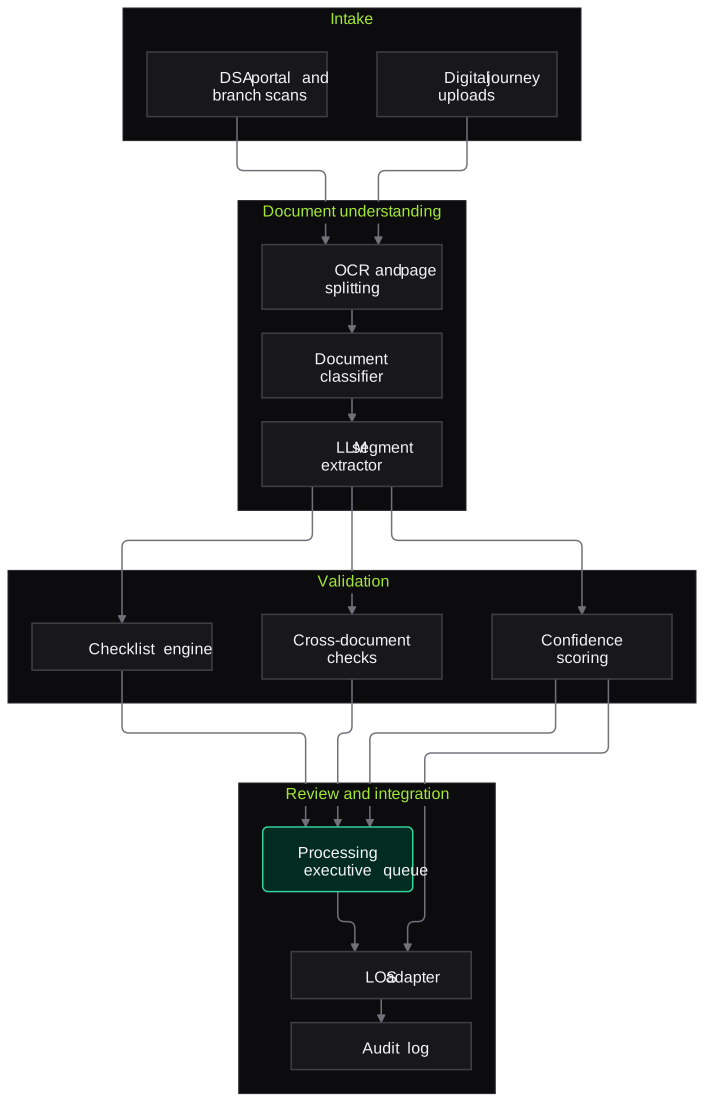
We build an extraction pipeline that takes the whole loan file, splits merged PDFs and photo sets into documents, classifies each one and extracts the fields your LOS and credit memo need for that segment. A language model reads documents in context, so a salary slip from a small employer or a CA-prepared computation of income is still captured correctly. The pipeline checks the file against your document checklist for the product, compares names, dates of birth, addresses and income figures across documents, and lists inconsistencies with page references. Clean files are posted to the LOS; low-confidence fields and checklist gaps go to a processing executive.
- Splits merged PDFs and phone-photo sets into individual documents and classifies them
- Extracts KYC, employment, salary, ITR computation, GST return and Udyam fields with page references
- Segment-specific checklists for salaried, self-employed and business loans
- Cross-document checks on identity, address and declared versus documented income
- Masks Aadhaar at intake and reads PAN, voter ID, passport and driving licence
- Posts structured data to the LOS and returns a gap list to the DSA or branch
How it works
- 01Collect the fileDocuments arrive from the DSA portal, branch scanners, email or the digital journey and are grouped under the application ID.
- 02Split and classifyMerged files are split, pages are typed, and duplicates and unreadable pages are identified.
- 03Extract fieldsSegment-specific schemas extract identity, employment, income and business fields with confidence scores.
- 04Check the fileThe product checklist confirms required documents, and cross-document rules compare identity and income figures.
- 05Processing reviewLow-confidence fields, inconsistencies and gaps go to a processing executive who confirms values or requests documents.
- 06Post to the LOSVerified data and the evidence trail are posted to the LOS, ready for underwriting.

Architecture
- Intake
- DSA portal and branch scanner connectors
- Email and digital journey upload API
- Application-level grouping
- Document understanding
- OCR for scans and phone photos
- Page classifier for KYC, income and business documents
- LLM extractor with segment schemas
- Validation
- Product checklist engine
- Cross-document identity and income checks
- Confidence scoring
- Review
- Processing executive queue
- Gap list generator for DSAs and branches
- Integration and audit
- LOS API adapter
- Audit log of values and edits
Inputs and outputs
Inputs
- Loan application form and declarations
- KYC documents: PAN, masked Aadhaar, voter ID, passport or driving licence
- Salary slips, Form 16 and employment letters
- ITR acknowledgements, computation of income and financial statements
- GST returns, Udyam registration and business licences
- Product document checklist and credit memo field list
Outputs
- Structured, LOS-ready applicant and income data
- Checklist status with missing and expired items
- Cross-document inconsistency list with page links
- Gap list for the DSA or branch
- Audit trail of extracted values and edits
Where people stay in control
Processing executives confirm low-confidence fields and resolve inconsistencies, and underwriters assess every file. The pipeline does not judge creditworthiness; it hands over clean, verifiable data.
Integrations
- Loan origination system (via API or staging table)
- DSA portal or partner app
- Credit bureau integration already used by the lender
- Document management system
- CRM for application tracking
Guardrails
- Aadhaar masked at intake per UIDAI rules
- Field-level confidence thresholds agreed with credit operations
- Inconsistencies reported, never silently resolved
- Personal data masked in logs and kept in the lender's chosen region
- Sampling of auto-posted files for quality checks
Compliance notes
- Supports need-based data collection and purpose limitation expected under RBI digital lending rules and the DPDP Act 2023.
- Keeps a document-level audit trail useful for internal audit and partner due diligence.
A typical pilot
Duration: 3 weeks
One product and segment, such as unsecured business loans for self-employed borrowers, on de-identified historical files from two or three DSAs, compared with LOS data keyed by your team.
Deliverables
- 01Checklist and extraction schema for the pilot product
- 02Working pipeline on de-identified files
- 03Processing review screen
- 04Field accuracy and checklist report
- 05Production plan with LOS integration approach
What we measure
- Field extraction accuracy
- Extracted values compared with LOS data verified by processing staff for the same files.
- Checklist gap detection
- Gaps found by the pipeline compared with gaps underwriters raised on the same files.
- Fields routed for review
- Low-confidence fields per file, by document type.
- Processing time per file
- Timed for executives with and without the pipeline on matched samples.
FAQs
01Can it read documents photographed on a phone?
Yes. The pipeline corrects skew and lighting and reads typical DSA phone photos. Fields it cannot read with confidence are sent for review, and the pilot reports accuracy separately for scans and photos.
02Does it handle ITRs and CA-prepared financials?
Yes. It reads ITR acknowledgements, computations of income, balance sheets and profit and loss statements, and maps key figures to your credit memo fields. Credit judgement on those figures stays with the underwriter.
03Will it slow down DSA submissions?
No. Processing runs in the background after upload, and DSAs receive a gap list sooner than they would after manual review.
04Which LOS platforms do you integrate with?
We integrate through the LOS's APIs or a staging table, which covers common commercial and in-house systems. The exact mapping is agreed with your IT team in the pilot.
Related use cases
- NBFCs & Lending
Bank Statement Analysis for Underwriting
Analyse bank statements from PDFs, scans and Account Aggregator data to surface income, obligations, bounces and red flags, with every figure traceable to transactions.
- NBFCs & Lending
Property and Title Document Summarisation for Home Loans
Read sale deeds, encumbrance certificates, revenue records and approvals for home loans and LAP, build a chain-of-title summary and flag gaps for the advocate and credit team.
- NBFCs & Lending
Loan Lead Qualification Agent for DSA and Web Leads
Contact new loan leads from DSAs, aggregators and your website within minutes by voice or WhatsApp, check serviceability and basic fit with consent, and route ready applicants to sales.
- Banking
Account Opening Document Verification
Check OVDs, PAN, masked Aadhaar, photographs and entity documents in an account opening file against each other and against CKYC, with mismatches routed to an officer.

Founded by Akhilesh Mittal. 8 years building a security platform for a New Zealand company. IIT ISM Dhanbad and IMT Ghaziabad. Builds production agentic AI.
Test one lending workflow on your own files
Book a discovery call to scope a short pilot, from statement analysis to a conduct-safe reminder agent, and judge it on measured results before scaling.