AI Agent Red-Teaming (Tool Misuse and Goal Hijack)
Red-team your AI agents for goal hijacking, tool misuse, excessive agency, privilege abuse and memory poisoning, in a sandbox that records every tool call and decision.
- Capability:
- AI Security & Compliance
- Industry:
- SaaS & AI Product Companies
Who it is for
- CTO or Head of AI Engineering
- CISO
- Agent Platform Lead
- Product Security Engineer
The problem
Agents do more than answer questions. They read tickets and emails, call internal APIs through function calling or MCP servers, write to databases and trigger workflows. Once an agent can act, a successful manipulation is no longer a bad answer; it is an action taken with your credentials.
Goal hijacking through content
An agent that reads emails, web pages, tickets or documents can be steered by instructions placed in that content, not only by the user.
Tools with more power than the task needs
Broad API scopes, shared service accounts and write access granted for convenience turn small manipulations into real impact.
Missing checks between steps
Multi-step plans, agent-to-agent hand-offs and long-term memory let one poisoned input affect many later actions.
No trace of why an agent acted
Without tool-call logs and decision traces, teams cannot tell whether an action came from the user, the content or a fault.
What we build
We red-team your agents in a sandbox that mirrors production tools with safe test data. First we map every tool, its permissions and the credentials behind it, and identify which inputs an outsider could influence. We then run adversarial scenarios: user-driven and content-driven goal hijacking, tool misuse and unsafe parameter choices, privilege escalation through chained tools, memory and context poisoning, and attempts to skip human-approval steps. Scenarios follow OWASP guidance on agentic AI threats and map to MITRE ATLAS techniques. Every run is traced at the tool-call level, so each finding shows the input, the plan, the calls made and the effect. Fixes cover narrower scopes, approval gates, input separation and output checks.
- Tool and permission inventory with a map of untrusted input sources
- Goal hijacking scenarios through user input and planted content
- Tool misuse, unsafe parameter and chained privilege escalation tests
- Memory, context and multi-agent hand-off poisoning tests
- Human-approval bypass and excessive agency checks
- Tool-call traces for every finding, mapped to OWASP agentic guidance and MITRE ATLAS
How it works
- 01Inventory tools and trustWe list every tool, scope and credential the agent can use, and every input source an outsider could influence.
- 02Build the sandboxTools are pointed at test systems or safe mocks, so harmful actions have no real effect.
- 03Run adversarial scenariosScenario sets for goal hijacking, tool misuse, privilege abuse and memory poisoning run against the agent.
- 04Trace and detect impactEvery tool call is recorded and checked against what the agent should be allowed to do.
- 05Tester reviewA tester confirms each unsafe action, explores variations and rates severity.
- 06Fix and retestWe recommend permission, approval and input-handling changes, then rerun the scenarios.

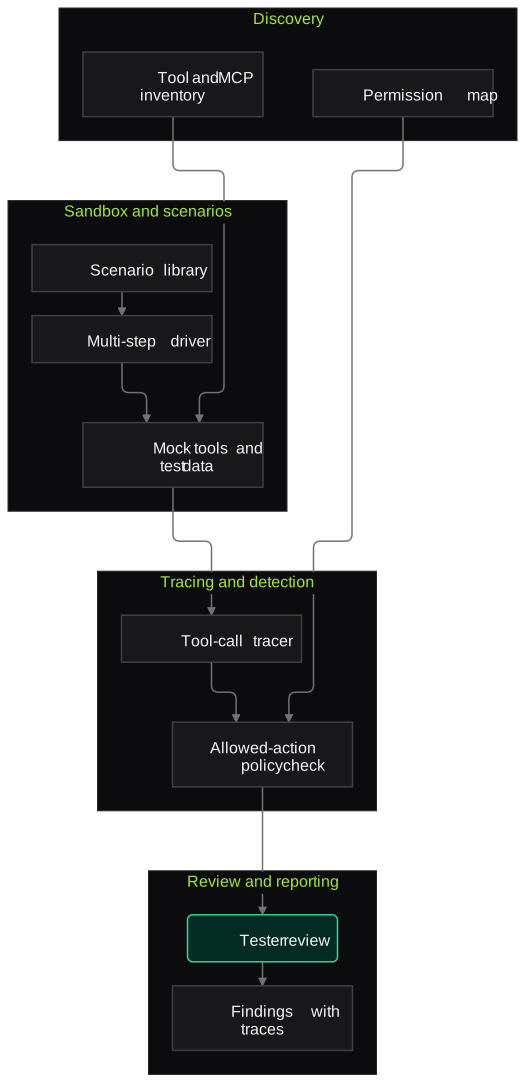
Architecture
- Discovery
- Tool and MCP server inventory
- Permission and credential map
- Untrusted input source map
- Sandbox
- Mock or test instances of each tool
- Seeded test data and canary records
- Scenario engine
- Adversarial scenario library
- Multi-turn and multi-step driver
- Planted-content generator for indirect injection
- Tracing and detection
- Tool-call tracer
- Policy checker for allowed actions
- Review and reporting
- Tester review console
- Findings with traces and fixes
Inputs and outputs
Inputs
- Agent configuration: system prompt, model, planner and memory settings
- Tool and MCP server definitions with scopes
- Staging or sandbox access with test credentials
- List of actions that need human approval
- Example tasks the agent is meant to perform
Outputs
- Tool and permission risk map
- Findings with tool-call traces and impact
- Mapping to OWASP agentic guidance and MITRE ATLAS
- Recommended scope reductions and approval gates
- Reusable scenario set for regression
Where people stay in control
A tester confirms every unsafe action and rates its severity in the context of your business. Your engineering team decides which permission and approval changes to make before the retest.
Integrations
- Agent frameworks such as LangGraph, LangChain, OpenAI Agents SDK or custom planners
- MCP servers and internal APIs in staging
- Observability and tracing tools
- Issue tracker such as Jira or Linear
- CI pipeline for scenario regression
Guardrails
- All tools pointed at sandbox or mock systems during testing
- Canary records used to detect data access without touching real data
- Kill switch and stop conditions agreed before any run
- No production credentials available to the test runner
- Evidence encrypted and retained only as agreed
Compliance notes
- Maps to OWASP Top 10 for LLM Applications risks including excessive agency and prompt injection, and to OWASP guidance on agentic AI threats.
- Findings support human oversight and risk management evidence under NIST AI RMF, and under the EU AI Act where it applies.
A typical pilot
Duration: 3 weeks
One agent with a handful of tools in a sandbox, covering goal hijacking, tool misuse and approval bypass.
Deliverables
- 01Tool and permission risk map
- 02Sandbox scenario runs with traces
- 03Findings report with fixes
- 04Retest after changes
- 05Scenario set for ongoing regression
What we measure
- Unsafe actions found
- Count of confirmed unsafe tool calls by category and severity.
- Permission reduction
- Tools and scopes narrowed or gated after findings, taken from the change list.
- Approval gate effectiveness
- Scenarios in which approval steps blocked an unsafe action on retest.
- Scenario outcomes at retest
- Share of failed scenarios that pass after fixes.
FAQs
01Do you need access to production tools?
No. We prefer sandboxed or mocked tools with realistic test data. Where a tool cannot be mocked, we agree tight scopes and stop conditions with you first.
02Which agent frameworks do you test?
Any framework, because we test behaviour through tool calls and outcomes. Our background includes building supervisor-style multi-agent systems with function calling and MCP tool servers, so we know where these designs tend to break.
03What fixes do you usually recommend?
Narrower tool scopes and per-user credentials, human approval for high-impact actions, clear separation of instructions from untrusted content, checks before tools run, and logging that ties each action to its trigger.
04Is this a one-off test?
It can be, but agents change often. Most teams keep the scenario set and run it in CI whenever prompts, tools or models change.
Related use cases
- SaaS & AI Product Companies
LLM Application Penetration Test (OWASP LLM Top 10)
A scoped pentest of your LLM feature and the app around it: prompt injection, data disclosure, output handling, excessive agency and system-prompt leakage, with reproducible evidence.
- SaaS & AI Product Companies
Continuous AI Security Regression in CI
Run versioned prompt-injection, jailbreak and data-leakage suites in CI on every prompt, model, tool or index change, and block releases that regress past agreed severity thresholds.
- SaaS & AI Product Companies
Agentic Security Testing for Web Apps and APIs
Supervisor-led AI agents map your web app and APIs, test OWASP Top 10, API and business-logic flaws, confirm each issue live, and hand tester-reviewed findings with evidence to your team.
- Fintech & Payments
AI Agent Permission and Tool-Use Security Review
Find out what your AI agents can actually do: which tools, credentials and money-moving actions they reach, where approvals sit, and whether injected text can make them misuse tools.

Founded by Akhilesh Mittal. 8 years building a security platform for a New Zealand company. IIT ISM Dhanbad and IMT Ghaziabad. Builds production agentic AI.
Scope a first test on one AI feature
Pick the LLM feature, agent or voice bot that worries you most. We will agree a short written scope and show you verified findings with evidence.