AI Agent Permission and Tool-Use Security Review
Find out what your AI agents can actually do: which tools, credentials and money-moving actions they reach, where approvals sit, and whether injected text can make them misuse tools.
- Capability:
- AI Security & Compliance
- Industry:
- Fintech & Payments
Who it is for
- CISO
- Head of Platform Engineering
- Head of Payment Operations
- AI and ML Engineering Lead
The problem
Payment companies are giving agents real permissions: issuing refunds under a limit, updating merchant records, querying ledgers, triaging disputes, or acting through MCP servers wired to internal systems. The risk moves from what the model says to what it does. One over-scoped service account or missing approval step can turn a prompt injection into a payout.
Over-scoped credentials
Agents often run on a shared service account with far more access than any single task needs.
Missing approval gates
Irreversible actions such as refunds, payout releases or changes to a merchant's settlement account run without a human or second check.
Injection reaching tools
Text in tickets, emails or merchant notes can steer an agent into calling tools in ways nobody intended.
Weak audit trail
Logs show that an API was called, but not which agent called it, on whose behalf, or why.
What we build
We review your agents the way an attacker and an auditor would. First we build an inventory: every agent, every tool and MCP server it can call, the credentials behind each tool and the actions those credentials allow, including any that move money or change payout details. We compare this with what each agent actually needs and mark the excess. Then we test in staging: planting instructions in tickets, emails and data fields, attempting cross-merchant actions, chaining tools and pushing past limits. You get a permission matrix, validated findings with tool-call traces, and concrete controls such as scoped tokens, transaction limits enforced outside the model, allowlists and human approval on high-impact actions.
- Inventory of agents, tools, MCP servers, credentials and reachable actions
- Least-privilege gap analysis per agent and per tool
- Review of approval gates, limits and kill switches on money-moving and account-changing actions
- Adversarial testing for goal hijack, tool misuse and indirect prompt injection in staging
- Audit log review covering agent identity, on-behalf-of user, inputs and tool calls
- Control recommendations with example policies and code-level fixes
How it works
- 01InventoryWe document each agent, its tools and MCP servers, the credentials used and the actions each credential allows.
- 02Mark high-impact actionsRefunds, payouts, settlement account changes, KYC status changes and bulk data exports are tagged as high-impact.
- 03Gap analysisGranted permissions are compared with what each task needs, and missing approvals or limits are recorded.
- 04Adversarial testingIn staging, we attempt goal hijack, cross-merchant actions and injected instructions through realistic data channels.
- 05Validate findingsEach issue is reproduced and rated by impact, with the tool-call trace as evidence.
- 06Controls and retestWe recommend specific controls, review your fixes and retest the high-impact paths.

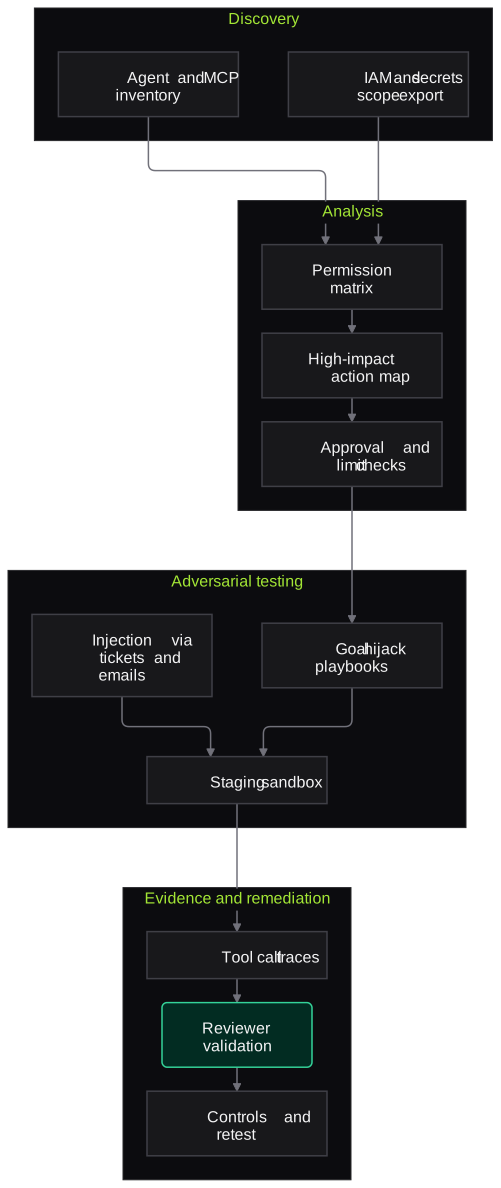
Architecture
- Discovery
- Agent and MCP server inventory
- Credential and scope export from IAM and secrets manager
- Action catalogue per tool
- Analysis
- Permission matrix builder
- High-impact action map
- Approval and limit checks
- Adversarial testing
- Goal hijack and tool misuse playbooks
- Injection seeding through tickets, emails and records
- Staging sandbox with test merchants
- Evidence and remediation
- Tool-call trace capture
- Finding validation and severity rating
- Control recommendations and retest tracker
Inputs and outputs
Inputs
- List of agents and their intended tasks
- Tool definitions, MCP server configurations and API specifications
- IAM roles, service accounts and token scopes
- Approval workflows and transaction limits
- Staging environment with test merchants and customers
- Agent and API logs
Outputs
- Permission matrix per agent, tool and credential
- List of high-impact actions with their current controls
- Validated findings with tool-call traces
- Recommended controls with example policies
- Retest report
Where people stay in control
Our testers validate every finding before it is reported. Your security, engineering and payment operations leads decide which controls to apply, and we recommend human approval on any action that moves money or changes payout details.
Integrations
- Agent frameworks such as LangGraph, OpenAI Agents SDK or custom orchestrators
- MCP servers and internal tool APIs
- Cloud IAM and secrets managers on AWS, Azure, GCP or Vault
- Logging and SIEM such as Splunk, Elastic or Datadog
- Jira for findings and remediation tracking
Guardrails
- Testing only in staging with test merchants and synthetic balances
- No real refunds, payouts or account changes triggered at any point
- Read-only access to IAM and configuration during discovery
- Written stop conditions for any unexpected effect outside staging
- Evidence encrypted and deleted at the end of the retention period
Compliance notes
- Supports the accountability and human oversight practices recommended in RBI's FREE-AI framework.
- Findings map to excessive agency and related risks in the OWASP Top 10 for LLM Applications.
A typical pilot
Duration: 2 to 3 weeks
One agent with real tool access, such as a refund or dispute triage agent, reviewed end to end with one retest.
Deliverables
- 01Agent and tool inventory
- 02Permission matrix and gap analysis
- 03Adversarial test results with traces
- 04Control recommendations
- 05Retest report
What we measure
- Excess permissions
- Granted actions not needed by the agent's defined tasks, counted per tool.
- High-impact actions without approval
- Money-moving or account-changing actions that run without a human or second check.
- Exploitable paths
- Validated paths from untrusted input to a high-impact tool call.
- Closure at retest
- Findings confirmed fixed versus still open after remediation.
FAQs
01We use a vendor's agent platform. Can you still review it?
Yes, as far as its configuration and permissions are visible to you. We review the tools, credentials and approval settings you control and test behaviour in your staging tenant.
02Do you test MCP servers?
Yes. MCP servers are tools with their own permissions and inputs, so we include them in the inventory and test whether an agent can be steered into misusing them.
03Will testing touch real money?
No. All testing runs in staging with test merchants and synthetic balances, under written rules of engagement.
04What baseline controls do you recommend?
Scoped, per-task credentials, hard transaction limits enforced outside the model, and human approval for refunds above a limit, payouts and payout-detail changes. The model should never be the only thing between an instruction and a money movement.
Related use cases
- Fintech & Payments
Pre-Launch Security Assessment for LLM Features
Test a new chatbot, copilot or LLM feature for prompt injection, cross-customer data leakage, off-policy answers and unsafe output handling before release, with evidence and a retest.
- Fintech & Payments
DPDP-Aligned AI Data Handling Assessment
Map where personal data flows through your AI features, prompts, logs, vector stores and vendors, and get a gap register and evidence pack against DPDP Act duties for your DPO.
- SaaS & AI Product Companies
AI Agent Red-Teaming (Tool Misuse and Goal Hijack)
Red-team your AI agents for goal hijacking, tool misuse, excessive agency, privilege abuse and memory poisoning, in a sandbox that records every tool call and decision.
- Banking
AI Governance Evidence Pack for Banks
Inventory the bank's AI and ML systems and assemble the evidence boards, auditors and supervisors ask for: purpose, data, testing, monitoring, incidents and accountable owners.

Founded by Akhilesh Mittal. 8 years building a security platform for a New Zealand company. IIT ISM Dhanbad and IMT Ghaziabad. Builds production agentic AI.
Pick one queue and test it on your own data
Book a discovery call. We will choose one workflow, such as merchant KYC review or dispute evidence, and scope a short pilot that runs alongside your current process.