Vendor Invoice and Credit Note Reconciliation
Match vendor invoices, GRNs, RTVs and credit notes, recalculate what each vendor owes you from the agreements, and chase missing or short credit notes with evidence.
- Capability:
- Document Intelligence
- Industry:
- Retail, D2C & Quick Commerce
Who it is for
- CFO or Finance Controller
- Accounts Payable Manager
- Vendor Accounts Lead
- Category Finance Manager
The problem
Retailers and quick-commerce operators deal with hundreds of vendors, each sending invoices, credit notes and statements in their own format. Credit notes for short supply, damages, returns to vendor, price drops and promotional support are agreed in one place and issued, or not, somewhere else.
Credit notes that never arrive
Credit notes promised for RTVs, damages or price protection are missed, short or applied to the wrong invoice, and nobody tracks the balance.
Vendor statements that do not agree
Vendor statements of account and your ledger disagree, and finding the difference means going through months of transactions line by line.
Evidence scattered across systems
Short receipts sit in the WMS, RTV notes in store systems, promo agreements in email and credit notes in PDF attachments.
GST mismatches
Credit notes that do not reference the right invoice, or are missing from GSTR-2B, affect input tax credit and need follow-up.
What we build
We build a reconciliation engine that brings together vendor invoices, GRNs, short-receipt and damage reports, return-to-vendor notes, promotional and price-protection agreements, credit notes and vendor statements. OCR and an LLM read the PDFs and spreadsheets vendors send. For each trigger event, such as an RTV or a price drop, the system recalculates the credit you are owed from the agreement and source quantities, then matches it to credit notes received. Missing, short and duplicate credit notes are flagged with evidence. Finance approves adjustments, and the system drafts vendor dispute emails and an open-items ageing report.
- Reads vendor invoices, credit notes, debit notes and statements in PDF, scan and spreadsheet form
- Links each expected credit to its trigger: short GRN, damage report, RTV, price drop or promo agreement
- Recalculates expected credit amounts from agreements and source quantities, not from vendor documents
- Flags missing, short, duplicate and misapplied credit notes
- Reconciles vendor statements of account against your ledger and lists differences with reasons
- Drafts vendor dispute emails with the evidence attached and tracks responses
How it works
- 01Gather documents and eventsVendor documents come from email and portals; GRN, RTV and promo data come from the WMS, ERP and category teams.
- 02Extract and normaliseInvoices, credit notes and statements are read into a common structure with confidence scores.
- 03Recalculate expected creditsFor each trigger event, the expected credit is calculated from agreements and source quantities.
- 04Match and flagExpected credits are matched to credit notes received; gaps, shorts and duplicates are flagged.
- 05Finance reviewVendor accounts reviews exceptions, confirms adjustments and approves dispute emails.
- 06Post and trackApproved entries are posted to the ERP, and open items are aged and followed up.

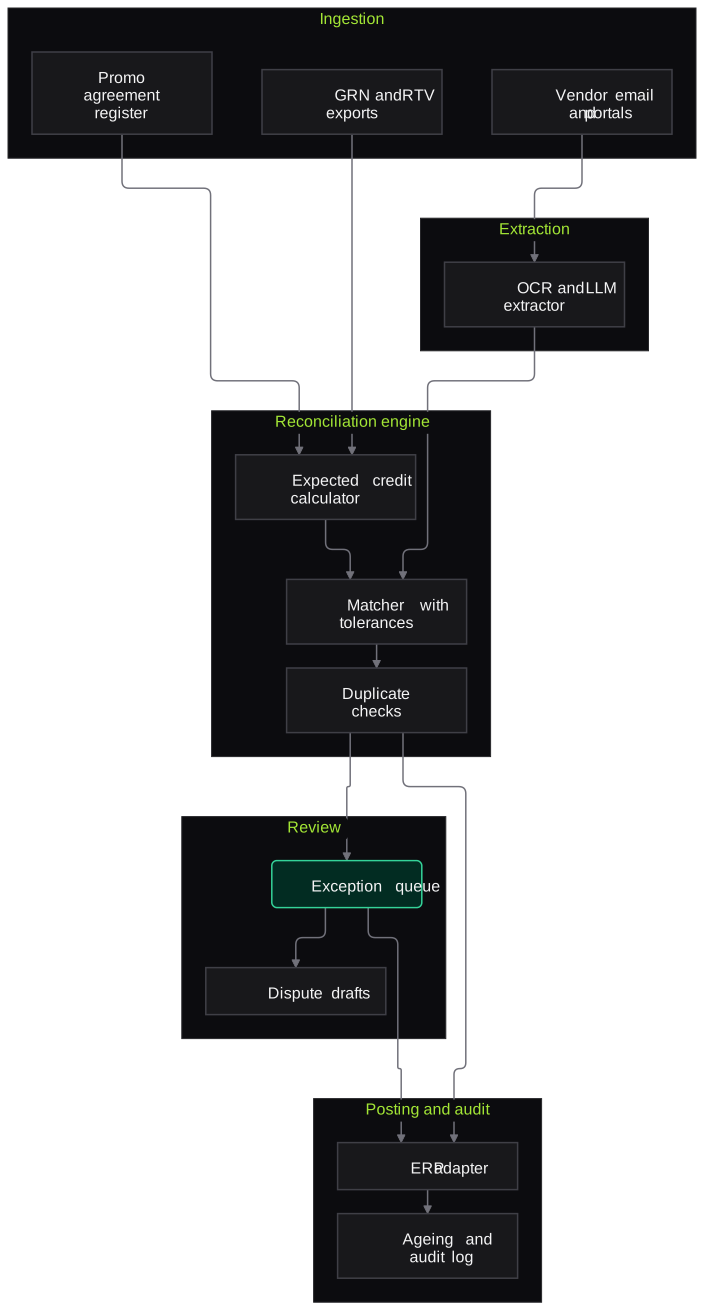
Architecture
- Ingestion
- Vendor email and portal connectors
- WMS GRN and RTV exports
- Promo and price-protection agreement register
- Extraction
- OCR with table detection
- LLM extractor for invoices, credit notes and statements
- Reconciliation engine
- Expected-credit calculator from agreements
- Many-to-many matcher with tolerances
- Duplicate and misapplication checks
- Review
- Exception queue with evidence panel
- Dispute email drafts and response tracking
- Posting and audit
- ERP adapter for adjustments
- Open-items ageing and audit log
Inputs and outputs
Inputs
- Vendor invoices, credit notes and debit notes
- Vendor statements of account
- GRN, short-receipt and damage reports from the WMS
- Return-to-vendor notes
- Promotional support and price-protection agreements
- Vendor ledger and GSTR-2B data
Outputs
- Line-level reconciliation per vendor
- List of missing, short, duplicate and misapplied credit notes with evidence
- Statement of account difference report
- Draft vendor dispute emails
- Open-items ageing and audit trail
Where people stay in control
Vendor accounts approve every adjustment and every dispute sent to a vendor, and category managers confirm the terms of promotional and price-protection agreements. Uncertain lines are flagged for review rather than passed.
Integrations
- ERP such as SAP, Oracle, Microsoft Dynamics or Tally
- WMS and store systems for GRN and RTV data
- Vendor portal or AP mailbox
- GST compliance tool for GSTR-2B
- Email for dispute follow-up
Guardrails
- Expected credits recalculated from agreements and source data, not copied from vendor documents
- Uncertain lines flagged, never silently matched
- Duplicate credit note detection across periods
- No postings without finance approval
- Full audit trail of matches, edits and approvals
Compliance notes
- Credit notes are checked for references to the original invoice, which supports your tax team's GST and GSTR-2B reconciliation.
- The audit trail supports statutory audit of vendor balances.
A typical pilot
Duration: 4 weeks
The top vendors of one category for one quarter, using your finance team's completed reconciliation as the benchmark.
Deliverables
- 01Agreed rules for each credit type
- 02Working reconciliation for the pilot vendors
- 03Exception queue and dispute drafts
- 04Comparison report against finance's reconciliation
- 05Roll-out plan and integration design
What we measure
- Agreement with finance reconciliation
- Line-level results compared with your finance team's completed reconciliation for the same period.
- Open credits identified
- Missing or short credit notes found with evidence and confirmed by vendor accounts.
- Exception rate and reasons
- Lines routed to review per vendor, by reason.
- Reconciliation time per vendor
- Effort to close a vendor reconciliation, with and without the system.
Built on related work
Claims reconciliation platform
Packaged-food brand (anonymised)
OCR and LLM platform that matches distributor claims spreadsheets against invoices and proofs, applies policy rules, detects duplicates, recalculates amounts, routes uncertain lines to an exception queue and keeps an audit trail. Finance keeps final approval.
FAQs
01Vendors send statements in every format. Will that work?
Yes. Statements and credit notes are read in context, whether PDF, scan or spreadsheet, and mapped to a common structure. For your own system exports, such as GRN and RTV reports, we agree and freeze the formats before go-live.
02Who decides whether a vendor owes us money?
Your finance team. The system shows the recalculated amount, the agreement and the source quantities side by side, and finance approves any adjustment or dispute.
03Can brands use this to reconcile deductions from retailers and quick-commerce platforms?
Yes. The same engine works in reverse, matching debit notes and deductions raised by modern trade and quick-commerce accounts against your invoices, delivery proofs and agreed terms.
04Does it post entries in our ERP?
It prepares adjustment entries for your ERP through an API, import file or staging table, and posts only after finance approval.
Related use cases
- Retail, D2C & Quick Commerce
Distributor Trade Claims and Scheme Settlement
Read distributor claim sheets and proofs, apply scheme rules from your circulars, recalculate eligible amounts, catch duplicates and give finance a clean credit note sheet to approve.
- Retail, D2C & Quick Commerce
Dark-Store Picking and Packing QC
A camera at the packing station checks each tote against the order before the bag is sealed, catching wrong variants, missing items and near-expiry stock, and keeps an image per order.
- Manufacturing
Purchase Order, GRN and Invoice Three-Way Matching
Read supplier invoices, match every line to POs and GRNs in SAP or Tally, check GST details and tolerances, propose debit notes and send only real exceptions to accounts payable.
- Accounting, Audit & Consulting
GST Return Reconciliation (GSTR-2B vs Books)
Match GSTR-2B and 2A data against the purchase register invoice by invoice, find ITC at risk before GSTR-3B is filed, and draft supplier follow-ups for approval.

Founded by Akhilesh Mittal. 8 years building a security platform for a New Zealand company. IIT ISM Dhanbad and IMT Ghaziabad. Builds production agentic AI.
Pick one leak and measure it
Book a discovery call. We will choose one narrow pilot, such as COD confirmation, one claim type or one dark store, run it alongside your current process and report what we measured.