GST Return Reconciliation (GSTR-2B vs Books)
Match GSTR-2B and 2A data against the purchase register invoice by invoice, find ITC at risk before GSTR-3B is filed, and draft supplier follow-ups for approval.
- Capability:
- Document Intelligence
- Industry:
- Accounting, Audit & Consulting
Who it is for
- Partner, GST Practice
- Indirect Tax Manager
- Accounts Payable Lead
- CFO of a multi-GSTIN business
The problem
Before filing GSTR-3B each month, someone downloads GSTR-2B for every GSTIN and compares it with the purchase register. Input tax credit depends on suppliers reporting invoices correctly, so differences in invoice numbers, GSTINs, dates or tax heads turn directly into credit that is deferred, reversed or questioned later in an ASMT-10 scrutiny notice or a DRC-01C intimation.
Invoice numbers never match exactly
INV/24-25/0045 in the books is 45 or INV0045 in GSTR-2B, so lookups fail and juniors match lines by eye.
Volume across GSTINs and clients
Firms run this for many clients and registrations against the same monthly deadline, and the reconciliation gets squeezed.
Supplier follow-up is manual
Emails to suppliers who missed GSTR-1, used the wrong GSTIN or reported the wrong period are drafted one by one and tracked in a spreadsheet.
Decisions are not recorded
When a notice arrives months later, it is hard to show why credit was claimed or deferred for a particular invoice.
What we build
We build a GST reconciliation engine that takes GSTR-2B and, where needed, GSTR-2A files for each GSTIN, downloaded from the portal or fetched through your GSP, and reconciles them against the purchase register from the books. It normalises invoice numbers, GSTINs, dates and tax heads, then matches in passes: exact, normalised invoice number, value and date within tolerance, and one-to-many for split or consolidated invoices. Where only invoice PDFs exist, the document layer extracts the fields first. Every line lands in a category, such as matched, value mismatch, in books but not in 2B, or wrong GSTIN. The accountant decides ITC treatment, and supplier follow-ups are drafted for approval.
- Imports GSTR-2B and GSTR-2A JSON or Excel files per GSTIN, plus purchase register exports
- Invoice-number normalisation for prefixes, financial-year tags, separators and leading zeros
- Tolerance-based matching on taxable value, IGST, CGST and SGST split, and invoice dates
- Extracts fields from purchase invoice PDFs where the register is incomplete
- Categorised mismatch report with ITC-at-risk summary by supplier
- Drafts supplier follow-up emails and carries open items into the next month
How it works
- 01Load 2B and the purchase registerGSTR-2B files for each GSTIN and the purchase register for the same period are imported side by side.
- 02Normalise fieldsInvoice numbers, GSTINs, dates and tax heads are cleaned so formatting differences do not block matches.
- 03Match in passesExact, normalised, tolerance and one-to-many passes run in order, each match tagged with the rule that produced it.
- 04Review mismatchesLow-confidence matches and mismatched lines go to the tax associate, who confirms the category.
- 05Decide ITC and follow upThe GST manager decides whether credit is claimed, deferred or reversed, and approves supplier emails.
- 06Report for GSTR-3BAn ITC working and supplier-wise open items are produced for return preparation and carried forward.

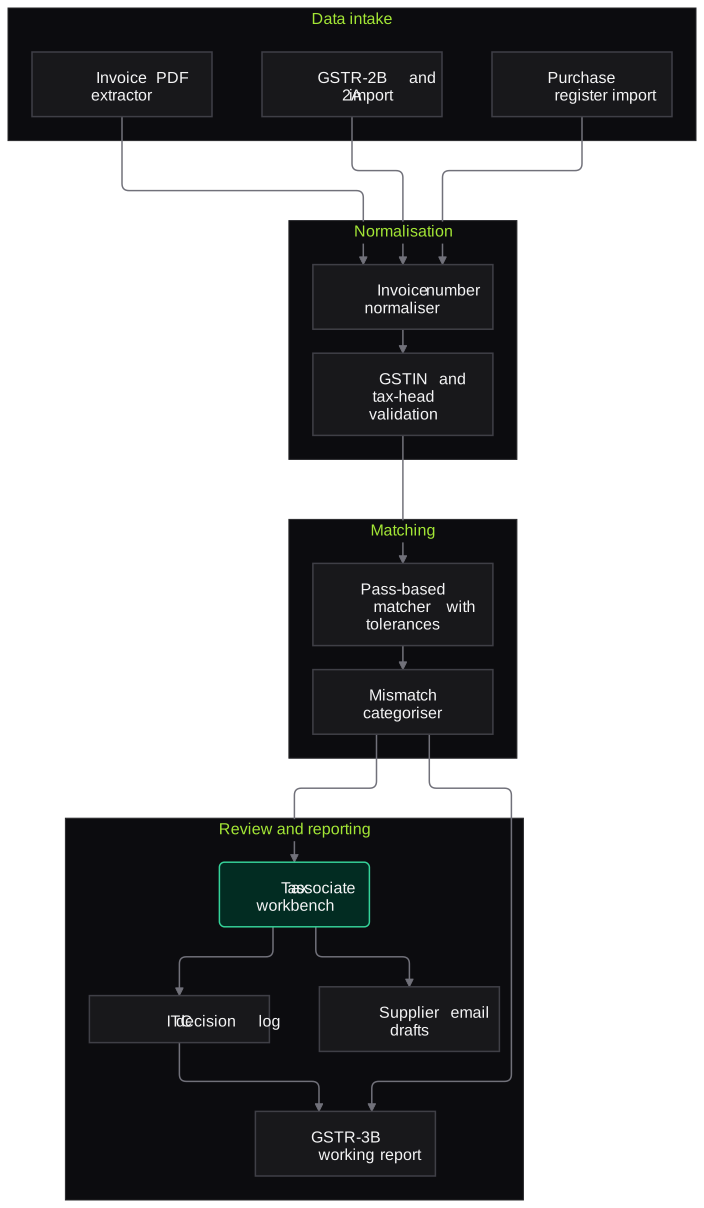
Architecture
- Data intake
- GST portal JSON and Excel import
- Optional GSP API connector
- Purchase register import from the books
- Normalisation
- Invoice number normaliser
- GSTIN format, checksum and state-code validation
- Tax-head mapping
- Matching
- Pass-based matcher with client tolerances
- Invoice PDF extractor for register gaps
- Mismatch categoriser
- Review and action
- Mismatch workbench for tax associates
- ITC decision log
- Supplier email drafts
- Reporting
- GSTR-3B ITC working
- Supplier-wise ageing of open items
Inputs and outputs
Inputs
- GSTR-2B and GSTR-2A downloads per GSTIN
- Purchase register or ledger export
- Purchase invoice PDFs where needed
- Vendor master with GSTINs and contacts
- Open items carried forward from earlier months
Outputs
- Line-level reconciliation with mismatch category
- ITC-at-risk summary by supplier
- Working for the ITC section of GSTR-3B
- Supplier follow-up email drafts
- Decision log for audit and notice replies
Where people stay in control
The tax associate confirms low-confidence matches, and the GST manager or partner decides whether each disputed credit is claimed, deferred or reversed. Supplier emails are sent only after a person approves them.
Integrations
- GST portal downloads or a GSP API
- Tally Prime, Zoho Books or SAP
- Gmail or Outlook for supplier follow-ups
- Practice management software
- Excel templates used for return preparation
Guardrails
- GSTIN format and checksum validation before matching
- Tolerances set per client and logged with each match
- No automatic ITC decisions; a named person records each one
- Open items carried forward so nothing drops out between months
- Totals tied back to the GSTR-2B summary and the books
Compliance notes
- Under GST, input tax credit generally depends on the supplier reporting the invoice so that it appears in the recipient's GSTR-2B; the tool helps you evidence that check, while eligibility decisions stay with the tax professional.
- The decision log supports replies to scrutiny notices by showing what was matched, by which rule, and who decided.
A typical pilot
Duration: 3 weeks
Two or three GSTINs over the last three return periods, reconciled in parallel with your existing process.
Deliverables
- 01Normalisation and matching rules tuned to the pilot clients
- 02Reconciliation output in your format
- 03Mismatch workbench and decision log
- 04Comparison report against your manual reconciliation
- 05Roll-out plan and cost estimate
What we measure
- Agreement with manual reconciliation
- Line-by-line comparison of match categories with the team's completed reconciliations.
- Additional mismatches found
- Count of discrepancies the manual process missed, as confirmed by the tax associate.
- Preparation time per GSTIN
- Hands-on time per GSTIN per month, compared with the current process.
- Supplier follow-up closure
- Open items resolved in the following month after supplier emails were sent.
Built on related work
Claims reconciliation platform
Packaged-food brand (anonymised)
OCR and LLM platform that matches distributor claims spreadsheets against invoices and proofs, applies policy rules, detects duplicates, recalculates amounts, routes uncertain lines to an exception queue and keeps an audit trail. Finance keeps final approval.
FAQs
01Do we need GSP or API access to the GST portal?
No. The engine works with GSTR-2B and GSTR-2A files downloaded from the portal. If you already use a GSP, we can fetch the same data through it to save the download step.
02How does it deal with different invoice number formats?
It normalises prefixes, financial-year tags, separators and leading zeros before matching, then applies amount and date tolerances you set for each client. Every match shows which rule produced it.
03Can it file GSTR-3B or claim ITC for us?
No. It prepares the reconciliation and the ITC working. The decision to claim, defer or reverse credit and the filing itself stay with your team.
04We handle many clients. Is data kept separate?
Yes. Each client and GSTIN is a separate workspace with its own access controls, tolerances and history, so carry-forward items and decisions never mix across clients.
Related use cases
- Accounting, Audit & Consulting
Bank and Ledger Reconciliation
Match bank statements in any format against the cash book or ledger, explain unmatched items and produce a BRS the reviewer can tick through, with ambiguous matches held for a person.
- Accounting, Audit & Consulting
TDS and ITR Document Extraction for Tax Practices
Read Form 16, 26AS, AIS, capital gains statements and investment proofs, reconcile TDS and reported income, and hand preparers a draft computation with every mismatch flagged.
- Accounting, Audit & Consulting
Audit Sampling and Vouching from Invoices
Select samples from the ledger, pull invoices, GRNs and payment proofs, and check each voucher against the entry, with every exception sent to the audit senior.
- Fintech & Payments
Invoice and GST Data Extraction for B2B Payments
Extract GSTINs, HSN lines, tax splits and IRN data from supplier invoices before a B2B payment or invoice financing is released, with tax-logic and duplicate checks.

Founded by Akhilesh Mittal. 8 years building a security platform for a New Zealand company. IIT ISM Dhanbad and IMT Ghaziabad. Builds production agentic AI.
Start with one engagement
Pick one reconciliation, one audit area or one tax-season workflow. We will scope a short pilot on your own documents and show the results against work your team has already done.