Distributor Trade Claims and Scheme Settlement
Read distributor claim sheets and proofs, apply scheme rules from your circulars, recalculate eligible amounts, catch duplicates and give finance a clean credit note sheet to approve.
- Capability:
- Document Intelligence
- Industry:
- Retail, D2C & Quick Commerce
Who it is for
- Head of Sales Finance
- Trade Marketing Manager
- Claims Settlement Team Lead
- Head of Distribution
The problem
FMCG and packaged-food brands run many schemes through distributors at once: quantity slabs, free goods, retailer display payments, damage and expiry returns, rate differences, and transport or salesman reimbursements. Every month each distributor sends a claim sheet with supporting invoices and proofs, and a small team checks them before finance issues credit notes.
Every distributor's sheet looks different
Claims arrive as spreadsheets, PDFs and photos in each distributor's own format, so the team re-keys before it can check anything.
Scheme rules live in circulars
Validity dates, eligible SKUs, slabs and caps are scattered across circulars and emails, and different checkers apply them differently.
Duplicates and ineligible lines
The same invoice claimed twice, claims under expired schemes or for ineligible SKUs, and inflated quantities slip through under volume.
Settlement backlogs hurt the relationship
Slow settlement delays credit notes, and distributors hold payments or cut orders while they wait.
What we build
We build a claims platform that reads each distributor's claim sheet and supporting documents, normalises every line into a standard claim structure and matches it to secondary invoices, retailer acknowledgements and photo proofs. A scheme rule engine, configured from your circulars with validity dates, SKUs, slabs and caps, checks eligibility and recalculates the amount for each line. Duplicates are checked across months and distributors. Lines that pass go to a credit note sheet; uncertain or failed lines go to an exception queue with the reason and are never silently passed. Finance keeps final approval, and every decision is logged.
- Reads claim sheets, invoices, retailer acknowledgements and display photos in any distributor format
- Scheme rule engine built from circulars, with validity dates, SKU lists, slabs, caps and version history
- Recalculates the eligible amount for every claim line and shows it beside the claimed amount
- Detects duplicate claims across months, schemes and distributors
- Exception queue with reason codes for finance and trade marketing
- Credit note sheet for finance approval and a line-by-line settlement statement for each distributor
How it works
- 01Receive claims and proofsDistributors upload claim sheets and supporting documents through a portal or email, tagged by month and scheme.
- 02Normalise claim linesEach line is extracted into a standard structure of distributor, scheme, invoice, SKU, quantity and claimed amount.
- 03Match proofsLines are matched to secondary invoices, acknowledgements and photos from the DMS and uploads.
- 04Apply scheme rules and recalculateThe rule engine checks eligibility, recalculates the amount and looks for duplicates.
- 05Exception reviewUncertain or failed lines go to finance or trade marketing with the reason and evidence.
- 06Approve and settleFinance approves the credit note sheet, and distributors receive a line-by-line settlement statement.

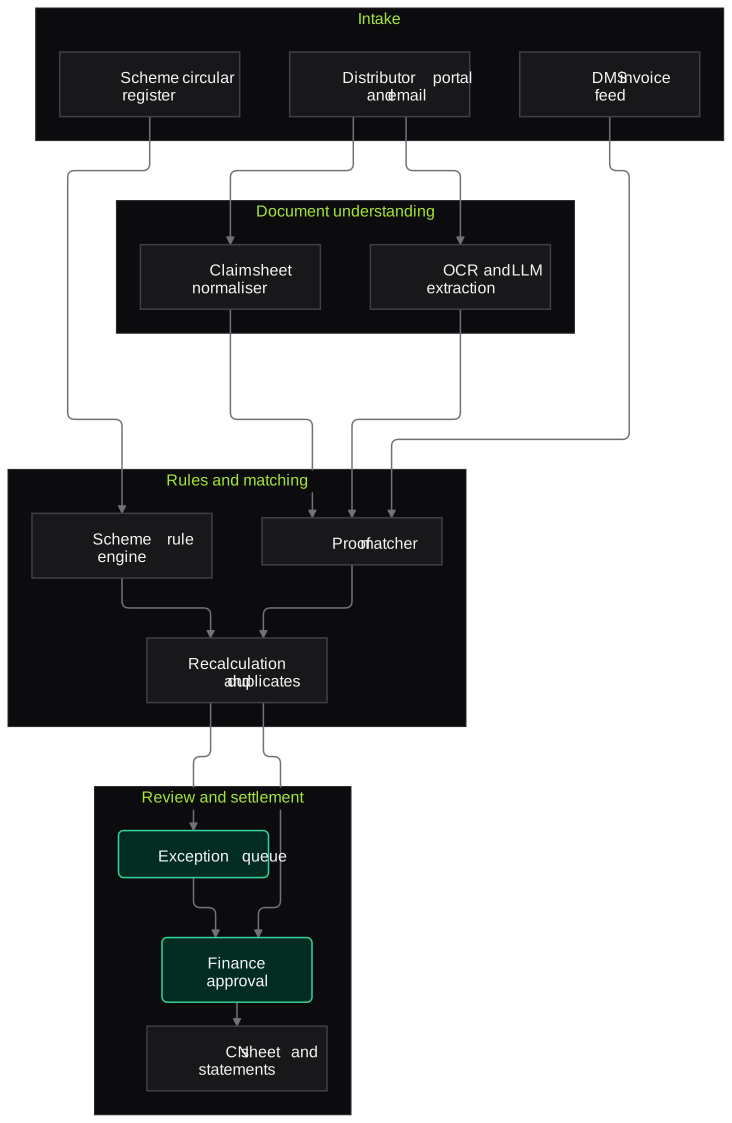
Architecture
- Intake
- Distributor portal and email upload
- DMS secondary sales and invoice feed
- Scheme circular register
- Document understanding
- Spreadsheet normaliser for varied claim formats
- OCR and LLM extraction for invoices and acknowledgements
- Rules and matching
- Scheme rule engine with versioned circulars
- Proof matcher
- Recalculation and duplicate detection
- Review
- Exception queue with reason codes
- Finance approval of credit note sheets
- Settlement and audit
- Credit note sheet export to the ERP
- Distributor settlement statements
- Audit trail of every line decision
Inputs and outputs
Inputs
- Distributor claim sheets in Excel, CSV or PDF
- Secondary sales invoices from the DMS
- Retailer acknowledgements, display photos and damage or expiry notes
- Scheme circulars with dates, SKUs, slabs and caps
- Previous claims and settlements for duplicate checks
- Finance mapping of claim types to ledgers
Outputs
- Normalised claim lines with recalculated eligible amounts
- Exception list with reason codes and evidence
- Duplicate claim alerts
- Credit note sheet for finance approval
- Settlement statement for each distributor
- Audit trail of every line decision
Where people stay in control
Finance keeps final approval of every credit note sheet, and trade marketing rules on any scheme interpretation the rule engine cannot settle. Uncertain lines are always flagged for a person rather than passed.
Integrations
- Distributor management system for secondary sales
- ERP such as SAP or Tally for credit notes
- Distributor portal or claims mailbox
- Shared drive or SharePoint for circulars
- BI tools for claims reporting
Guardrails
- No line approved without a matched proof
- Scheme rules versioned with a reference to the source circular
- Recalculated amount always shown beside the claimed amount
- Duplicates blocked until a reviewer clears them
- Input formats agreed and frozen before go-live
Compliance notes
- The GST treatment of scheme discounts and credit notes depends on how schemes are agreed and documented; the system keeps the links between circular, invoice and credit note that your tax team needs.
- A complete audit trail supports statutory audit of trade spends.
A typical pilot
Duration: 4 weeks
One claim type, such as quantity-slab schemes, for the distributors of one region, using one month of finance-settled claims as the benchmark.
Deliverables
- 01Rule configuration for the pilot schemes
- 02Working claims pipeline and exception queue
- 03Credit note sheet in your finance format
- 04Line-level comparison with finance-settled outcomes
- 05Roll-out plan for other claim types and regions
What we measure
- Agreement with finance outcomes
- Line-level approve, reject and amount results compared with finance's settled claims.
- Duplicates and ineligible lines caught
- Flags raised by the system and confirmed by finance.
- Share of lines needing review
- Lines routed to the exception queue, by reason code.
- Settlement cycle time
- Time from claim receipt to an approved credit note sheet, compared with the current process.
Built on related work
Claims reconciliation platform
Packaged-food brand (anonymised)
OCR and LLM platform that matches distributor claims spreadsheets against invoices and proofs, applies policy rules, detects duplicates, recalculates amounts, routes uncertain lines to an exception queue and keeps an audit trail. Finance keeps final approval.
FAQs
01Our schemes change every month. How are rules kept up to date?
Trade marketing or the claims team enters each new circular into the rule register with its dates, SKUs and slabs, and the engine applies the version valid for the claim period. Ambiguous circulars are flagged for clarification instead of guessed.
02Will distributors need to change their claim format?
Not necessarily. The system reads varied formats, though agreeing a standard template over time reduces exceptions. We freeze the formats used in the pilot before sign-off.
03Can it check display claim photos?
It checks that a photo exists, matches the retailer and period, and is not reused from another claim. Judging whether the display met the agreed standard can be added with shelf recognition.
04Where does the data sit?
In your cloud account or an India region of a major cloud provider. Distributor and pricing data is not used to train models, and access is role-based.
Related use cases
- Retail, D2C & Quick Commerce
Vendor Invoice and Credit Note Reconciliation
Match vendor invoices, GRNs, RTVs and credit notes, recalculate what each vendor owes you from the agreements, and chase missing or short credit notes with evidence.
- Retail, D2C & Quick Commerce
Shelf Availability and Planogram Compliance
Turn merchandiser and store shelf photos into SKU-level facings, out-of-stock gaps, price-label checks and planogram scores, with doubtful detections sent to a reviewer.
- Manufacturing
Dealer Lead and Reorder Automation
Use dealer billing history to send timely WhatsApp reorder suggestions, flag dealers going quiet, and qualify new dealer enquiries before they reach the area sales manager.
- Accounting, Audit & Consulting
GST Return Reconciliation (GSTR-2B vs Books)
Match GSTR-2B and 2A data against the purchase register invoice by invoice, find ITC at risk before GSTR-3B is filed, and draft supplier follow-ups for approval.

Founded by Akhilesh Mittal. 8 years building a security platform for a New Zealand company. IIT ISM Dhanbad and IMT Ghaziabad. Builds production agentic AI.
Pick one leak and measure it
Book a discovery call. We will choose one narrow pilot, such as COD confirmation, one claim type or one dark store, run it alongside your current process and report what we measured.