Customer Demand Letter and Receipt Reconciliation
Match stage-linked demand letters with bank credits, home-loan disbursements, TDS certificates and GST, unit by unit, and give the CRM team an accurate statement of account.
- Capability:
- Document Intelligence
- Industry:
- Real Estate & Construction
Who it is for
- Head of CRM and Collections
- Finance and Accounts Manager
- Post-Sales Executive
- Chief Financial Officer
The problem
On a construction-linked plan, every slab or milestone triggers a demand to every buyer in that tower. The money comes back in pieces: buyer contributions, disbursements from several lenders, TDS deducted by the buyer and GST on each instalment. The CRM and accounts teams spend days matching credits to units before they can send an accurate statement or a reminder.
Bank credits without a unit reference
Disbursements show only a lender's name or loan account, and buyer transfers carry a name that may not match the allottee.
TDS gaps that look like shortfalls
When a buyer has deducted TDS but the certificate has not arrived, the unit looks short-paid and gets an incorrect reminder.
Interest and GST errors
Interest on delayed payment, GST on each instalment and waivers agreed by sales are calculated in spreadsheets that drift from the agreement terms.
Disputes at possession
Buyers challenge statements of account at possession or resale, and reconstructing years of demands and receipts pulls the team away from current collections.
What we build
We build a reconciliation engine that reads demand letters, payment plans, bank statements, lender disbursement advices, TDS certificates and receipts, and maintains a ledger per unit. It matches each credit to a unit using amounts, names, loan references, dates and open demands, and proposes the match with a confidence score. Credits it cannot place go to an unallocated queue with suggested units. It tracks pending TDS certificates against each deduction, computes interest and GST from terms configured from your agreement, and produces a statement of account and an overdue list. Accounts approve allocations and waivers before anything reaches a buyer.
- Reads demand letters, payment schedules, bank statements, lender disbursement advices and receipts
- Matches credits to units using amount, payer name, loan account, date and open demands
- Tracks buyer TDS deductions against Form 16B certificates received
- Splits receipts into base price, GST and other charges as per your configuration
- Calculates interest on delayed payment from configured agreement terms, with approved waivers applied
- Generates unit-wise statements of account and overdue lists for reminders
How it works
- 01Load demands and plansPayment plans, milestone dates and demand letters raised for each unit are imported from the CRM or read from PDFs.
- 02Ingest receiptsBank statements, lender disbursement advices, cheque and UPI receipts and TDS certificates are read daily.
- 03Match credits to unitsEach credit is matched to a unit and demand with a confidence score and the evidence for the match.
- 04Route exceptionsLow-confidence matches, unidentified credits and TDS gaps go to an accounts queue with suggested units.
- 05Accounts approvalAn accountant confirms allocations, interest waivers and corrections, and the ledger updates.
- 06Issue statements and remindersApproved statements of account are generated, and genuine overdues feed the reminder workflow.

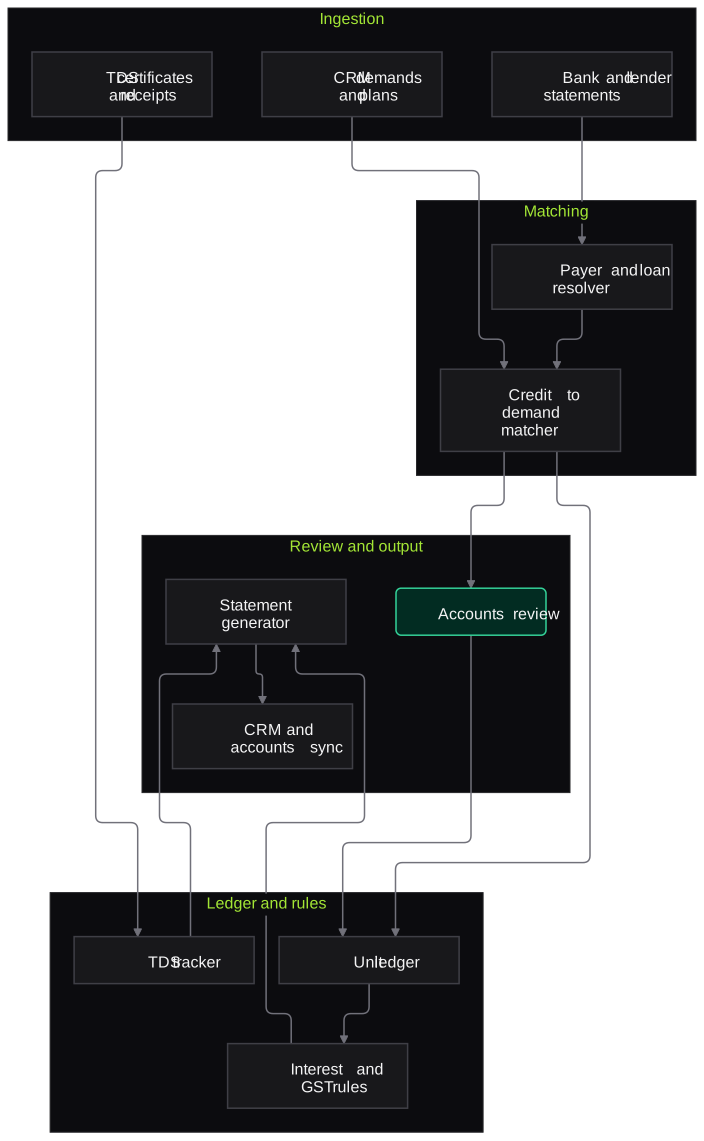
Architecture
- Ingestion
- CRM export of units, plans and demands
- Bank statement and disbursement advice reader
- TDS certificate and receipt intake
- Matching
- Payer and loan reference resolver
- Amount and demand matcher with confidence
- Unallocated credit queue
- Ledger and rules
- Unit ledger
- Interest, GST and charges rules
- TDS certificate tracker
- Review and output
- Accounts review screen
- Statement of account generator
- CRM and accounting sync
Inputs and outputs
Inputs
- Payment plans and milestone completion dates
- Demand letters and cost sheets per unit
- Bank statements of collection accounts
- Lender disbursement advices and tripartite agreement details
- Form 16B TDS certificates and buyer receipts
- Agreed interest terms and approved waivers
Outputs
- Unit-wise ledger with matched demands and receipts
- Unallocated credits list with suggested units
- Pending TDS certificates per unit
- Statements of account ready for review
- Overdue list for reminders, excluding TDS and allocation gaps
Where people stay in control
Accountants approve every allocation below the confidence threshold, every interest calculation that leads to a charge and every waiver. Statements and reminders go out only after the CRM team has reviewed them.
Integrations
- Real estate CRM or ERP such as Salesforce, Sell.Do or Farvision
- Bank statement downloads or bank APIs
- Tally or SAP for accounts
- Email and WhatsApp for statements and reminders
- Shared drive for lender advices and TDS certificates
Guardrails
- No buyer communication without human approval
- Interest and GST rules configured from your agreement and checked by finance
- Every match stores its evidence: amount, reference and demand
- Allocations are reversible, with a logged reason
- Bank and identity data masked in logs
Compliance notes
- Helps track TDS deducted by buyers on property purchases and the certificates they issue, as configured by your finance team.
- Keeps receipts traceable by project and collection account, which supports the CA certification needed for withdrawals from the RERA project account.
A typical pilot
Duration: 3 weeks
One tower, reconciling demands and receipts for a recent period from bank statements and CRM data, compared with the ledger your accounts team already maintains.
Deliverables
- 01Matching rules and interest configuration for the pilot tower
- 02Reconciled unit ledgers and unallocated credit list
- 03Accounts review screen
- 04Draft statements of account for a sample of units
- 05Comparison report against your existing ledger
What we measure
- Correct automatic matches
- Accountant review of matched credits against your existing ledger.
- Unallocated credits resolved
- Credits in your suspense list that the engine places with a suggestion the accountant accepts.
- TDS gaps identified
- Units flagged for a missing Form 16B that the team confirms.
- Time to produce statements
- Time taken for a batch of statements with and without the engine.
FAQs
01Can it handle home loans from many different banks?
Yes. Disbursement advices and statement narrations differ by lender, so we build a resolver that learns each lender's reference format and links it to the buyer's loan account. New lenders are added as they appear.
02Will it send reminders on its own?
No. It produces an overdue list that excludes units waiting only on a TDS certificate or an unallocated credit. Your CRM team approves the list before any reminder goes out.
03How is interest on delayed payment calculated?
From the terms your finance and legal teams configure from the agreement, such as rate and calculation basis, with waivers applied once approved. Each calculation shows its inputs so it can be explained to a buyer.
04Can it rebuild history for units sold years ago?
Yes, from historical bank statements, demands and receipts, though older scanned documents need more review. Many teams start with current towers and backfill older ones before possession.
Related use cases
- Real Estate & Construction
Contractor Bill Verification Against BOQ
Check every RA bill line against the work order BOQ, measurement records, previous bills and recovery rules, so billing engineers certify from a verified sheet instead of re-adding.
- Real Estate & Construction
Sale Agreement and Title Document Review
Check each agreement for sale against the booking form, cost sheet and RERA record, and build a title chain from land documents with gaps flagged for your advocate.
- Real Estate & Construction
Personalised Nurture Campaigns for Home Buyers
Keep undecided buyers engaged with WhatsApp and email updates matched to their stage, budget and objections, built from approved project facts, and alert sales when interest returns.
- Accounting, Audit & Consulting
Bank and Ledger Reconciliation
Match bank statements in any format against the cash book or ledger, explain unmatched items and produce a BRS the reviewer can tick through, with ambiguous matches held for a person.

Founded by Akhilesh Mittal. 8 years building a security platform for a New Zealand company. IIT ISM Dhanbad and IMT Ghaziabad. Builds production agentic AI.
Pick one project and one painful workflow
Book a discovery call and we will scope a short pilot on one project, such as RA bill checks for a single contractor or lead qualification for one launch, run in parallel with your current process.