Bank and Ledger Reconciliation
Match bank statements in any format against the cash book or ledger, explain unmatched items and produce a BRS the reviewer can tick through, with ambiguous matches held for a person.
- Capability:
- Document Intelligence
- Industry:
- Accounting, Audit & Consulting
Who it is for
- Partner, Outsourced Accounting Practice
- Accounts Manager
- Finance Controller
- Audit Senior
The problem
Firms that keep books for clients reconcile bank accounts every month, and audit teams test those reconciliations at year end. Statements arrive as password-protected PDFs, scans and CSVs in every bank's layout, and narrations such as NEFT or UPI references rarely carry the invoice number the ledger needs.
Every bank prints differently
Each bank, and sometimes each branch or download channel, uses its own layout, so templates and macros break whenever a client changes banks.
Grouped and partial receipts
One credit settles three invoices, arrives net of TDS or bank charges, or comes as a bulk UPI settlement, and simple amount matching fails.
Stale unreconciled items
Uncleared cheques and unidentified receipts sit in suspense for months because no one has time to trace them.
Reviewers cannot see the logic
A BRS built in Excel with manual ticks shows the result but not why each line was matched.
What we build
We build a reconciliation workflow that reads bank statements in PDF, scanned or CSV form, normalises them into one transaction table and matches them against the cash book or bank ledger exported from Tally, Zoho Books, Busy or SAP. Matching runs in passes: exact amount and date, UTR and cheque references, party names found in narrations, then grouped matches where one credit settles several invoices or arrives net of TDS or charges. Each proposed match carries a reason and a confidence score. Low-confidence matches and unmatched items go to an exception queue with suggested explanations, and the final BRS is generated with the trail behind every line.
- Parses statement PDFs, including password-protected and scanned copies, plus bank CSV and Excel exports
- Extracts UTR, cheque number, UPI reference and counterparty from narrations
- Rule-based and fuzzy matching, including one-to-many and many-to-one groupings
- Recognises net-of-TDS receipts, bank charges, interest and reversals, and proposes journals for approval
- Ageing of unreconciled items with suggested follow-up actions
- BRS output in the firm's format with the match reason on each line
How it works
- 01Collect statements and ledgerStatements arrive by upload or email and the bank ledger is exported from the client's accounting software.
- 02Parse and normaliseTransactions are extracted, opening and closing balances are checked, and narrations are split into references and party names.
- 03Match in passesExact, reference, party and grouped matching runs in order, each match tagged with its reason and confidence.
- 04Review uncertain matchesThe accountant confirms or rejects low-confidence and grouped matches and investigates unmatched items.
- 05Approve adjustment entriesProposed journals for charges, interest or TDS are approved by the accountant before they are posted.
- 06Generate the BRSThe reconciliation statement and the carry-forward list of unreconciled items are produced for review.

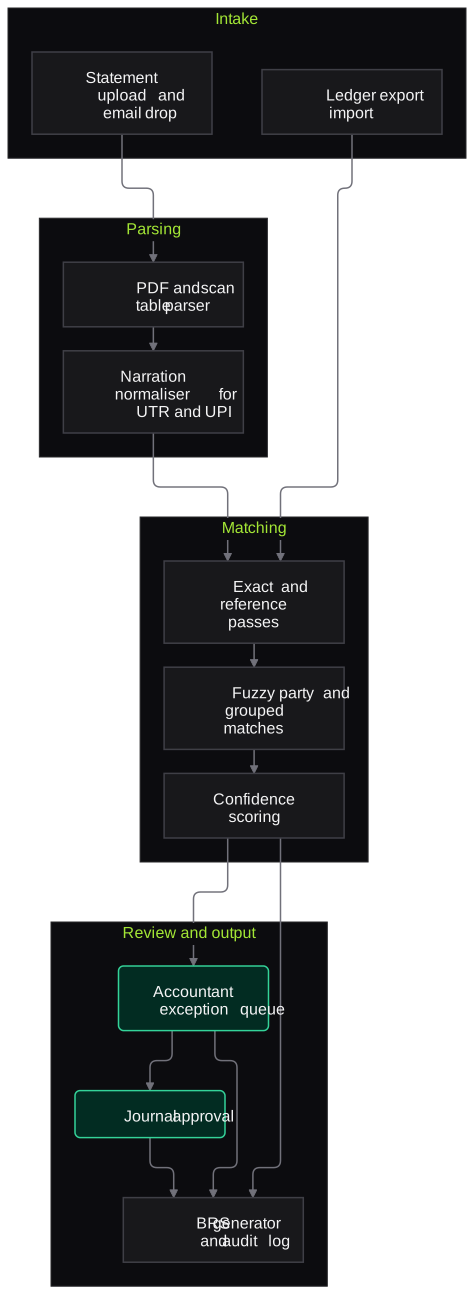
Architecture
- Intake
- Statement upload and email drop
- Ledger export import from Tally, Zoho Books, Busy or SAP
- Parsing
- PDF and scanned table parser
- Password handling in memory
- Narration normaliser for UTR, cheque and UPI references
- Matching engine
- Exact and reference passes
- Fuzzy party matching
- Grouping solver for one-to-many matches
- Confidence scoring
- Review
- Exception queue with suggested explanations
- Journal proposal and approval
- Output and audit
- BRS generator
- Audit log of matches and approvals
Inputs and outputs
Inputs
- Bank statements (PDF, scanned, CSV or Excel)
- Cash book or bank ledger export
- Customer and vendor masters
- Open invoice and bill lists
- Prior-period BRS and carry-forward items
Outputs
- Matched transaction pairs with match reasons
- Bank reconciliation statement in the firm's format
- Unreconciled items with ageing
- Proposed journal entries awaiting approval
- Audit log of every match and approval
Where people stay in control
Accountants confirm every low-confidence or grouped match and approve any proposed journal before it is posted. The reviewer signs off the BRS, and unexplained items stay open until a person resolves them.
Integrations
- Tally Prime, Zoho Books, Busy or SAP (export or API)
- Bank statement downloads and email inboxes
- Google Drive, OneDrive or SharePoint client folders
- Practice management or task tracking software
Guardrails
- Opening and closing balances checked after parsing to catch extraction errors
- No journal posted without accountant approval
- Match reason and confidence recorded on every line
- Statement passwords used in memory and never stored
- Access restricted by client and engagement
Compliance notes
- Proposed entries are posted by the accountant in the client's books, so the audit trail (edit log) that Companies Act rules require in accounting software stays intact.
- Bank statements contain counterparties' personal data; processing is designed to support DPDP Act 2023 purpose limitation and retention.
A typical pilot
Duration: 3 weeks
Three months of statements for a handful of client bank accounts across two or three banks, reconciled in parallel with your current process.
Deliverables
- 01Parsers for the pilot banks' statement formats
- 02Matching rules configured for the pilot clients
- 03Exception review screen and BRS template
- 04Comparison report against the team's existing BRS
- 05Roll-out plan and cost estimate
What we measure
- Parsing accuracy
- Transactions extracted compared with statement totals and a manual check of sampled pages.
- Match precision
- Share of automatic matches the reviewing accountant accepts on a sample.
- Auto-match coverage
- Share of transactions matched without manual intervention, tracked per bank and client.
- Time to close the BRS
- Elapsed and hands-on time per account per month, compared with the previous process.
Built on related work
Claims reconciliation platform
Packaged-food brand (anonymised)
OCR and LLM platform that matches distributor claims spreadsheets against invoices and proofs, applies policy rules, detects duplicates, recalculates amounts, routes uncertain lines to an exception queue and keeps an audit trail. Finance keeps final approval.
FAQs
01Which banks and statement formats does it handle?
Any bank statement in PDF, scanned, CSV or Excel form. Layouts are learned from samples rather than hard-coded templates, and every parsed statement is checked against its opening and closing balances so a parsing error is caught before matching starts.
02Can it handle one receipt against several invoices?
Yes. Grouped matching looks for combinations of open invoices that explain a receipt, including receipts net of TDS or bank charges. These matches are always shown to the accountant with the reasoning before they are accepted.
03Will it post entries into Tally or Zoho Books?
It proposes journal entries for bank charges, interest or TDS, and an accountant approves them. Posting is done by your team or through an approved import, so the client's software records who entered what.
04How are statement passwords and bank data protected?
Passwords are used in memory to open the file and are not stored. Statements and ledgers stay in your environment, segregated by client, with access limited to the assigned team.
Related use cases
- Accounting, Audit & Consulting
GST Return Reconciliation (GSTR-2B vs Books)
Match GSTR-2B and 2A data against the purchase register invoice by invoice, find ITC at risk before GSTR-3B is filed, and draft supplier follow-ups for approval.
- Accounting, Audit & Consulting
Audit Sampling and Vouching from Invoices
Select samples from the ledger, pull invoices, GRNs and payment proofs, and check each voucher against the entry, with every exception sent to the audit senior.
- Fintech & Payments
Settlement Report and Bank Statement Reconciliation
Match gateway transaction logs, acquirer and UPI settlement files and escrow bank statements, explain the breaks and send only the unexplained ones to your reconciliation team.
- Accounting, Audit & Consulting
Client Document Collection and Follow-Up Agent
A WhatsApp and email agent that sends each client their pending-document list, recognises what they upload, follows up on schedule and shows the team exactly what is still missing.

Founded by Akhilesh Mittal. 8 years building a security platform for a New Zealand company. IIT ISM Dhanbad and IMT Ghaziabad. Builds production agentic AI.
Start with one engagement
Pick one reconciliation, one audit area or one tax-season workflow. We will scope a short pilot on your own documents and show the results against work your team has already done.