Property and Title Document Summarisation for Home Loans
Read sale deeds, encumbrance certificates, revenue records and approvals for home loans and LAP, build a chain-of-title summary and flag gaps for the advocate and credit team.
- Capability:
- Document Intelligence
- Industry:
- NBFCs & Lending
Who it is for
- Head of Legal and Technical Verification
- Empanelled Advocate Coordinator
- Home Loan Credit Manager
- Head of Mortgage Operations
The problem
A home loan or loan-against-property file may hold decades of title documents: sale, gift and partition deeds, encumbrance certificates, mutation entries, tax receipts, approved plans and builder documents, often in Marathi, Hindi, Kannada, Tamil or Gujarati. Empanelled advocates prepare the title search and legal scrutiny report, and credit teams then read that report alongside the documents.
Long chains in regional languages
Deeds in regional languages and older legal phrasing take time to read, and credit staff may not read the language at all.
Breaks in the chain of title
A missing link deed, an unregistered transfer or a mismatch in survey number or area can be missed among dozens of pages.
Encumbrances and restrictions
Existing mortgages, court attachments, tenancies or restrictions on transfer appear in ECs and revenue records in varying formats.
Builder project documents
For under-construction flats, RERA registration, approvals, allotment letters and tripartite agreements must line up with the unit being financed.
What we build
We build a summarisation assistant for the legal and technical verification desk. It reads every property document in the file, including regional-language deeds and scanned revenue records, and extracts parties, dates, registration details, survey or plot numbers, areas and boundaries. From these it builds a chronological chain-of-title table, highlights breaks, mismatched descriptions and encumbrances, and checks the file against your property checklist for the property type and state. Each item links to the page it came from, with an English working translation beside the original text. The empanelled advocate uses the summary while preparing the legal opinion, and the credit manager uses it to read that opinion against the documents.
- Reads deeds, ECs, mutation and revenue records, tax receipts and approvals in English, Hindi and regional languages
- Extracts parties, registration numbers, dates, survey or plot numbers, areas and boundaries
- Builds a chronological chain-of-title table with breaks and mismatches highlighted
- Lists encumbrances, attachments and restrictions found in ECs and revenue records
- State and property-type checklists, including RERA and tripartite documents for builder flats
- Original text and an English working translation side by side for every cited passage
How it works
- 01Receive property documentsScans arrive from the branch, the customer or the builder and are grouped under the loan application.
- 02Classify and extractEach document is typed and key details are extracted, with regional-language text translated for reference.
- 03Build the chain of titleTransfers are ordered by date and linked by parties and property description to form the title chain.
- 04Check for gaps and encumbrancesRules and the language model flag breaks, mismatches, encumbrances and checklist gaps, each with confidence.
- 05Advocate and credit reviewThe empanelled advocate reviews the summary while preparing the legal opinion, and the credit manager reviews open flags.
- 06Record in the loan fileThe summary, flags and resolution notes are stored in the LOS with the legal and technical reports.

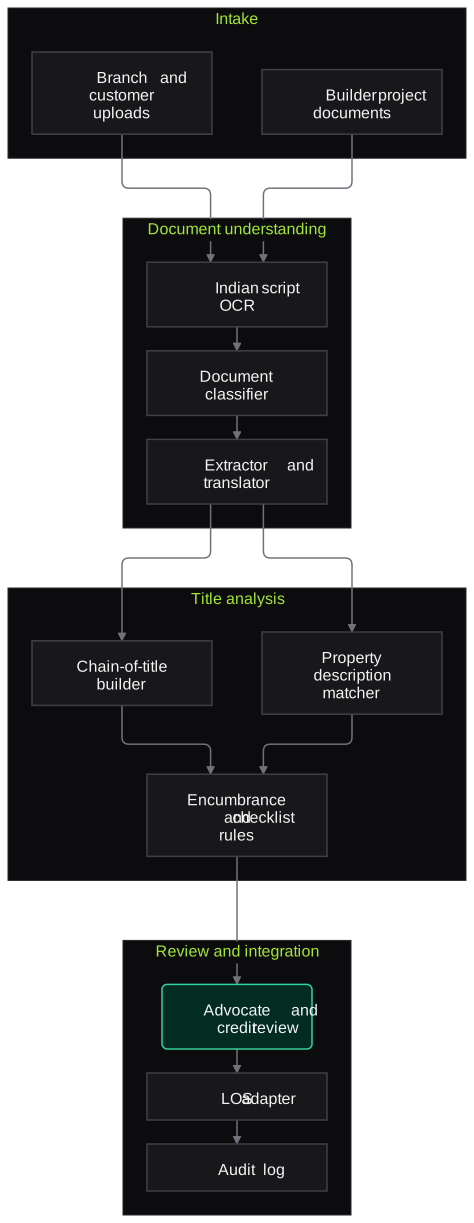
Architecture
- Intake
- Branch and customer upload connectors
- Builder document intake for approved projects
- Loan-level grouping
- Document understanding
- OCR for Indian scripts and stamp paper scans
- Classifier for deeds, ECs and approvals
- LLM extractor and reference translator
- Title analysis
- Chain-of-title builder
- Property description matcher for survey numbers, areas and boundaries
- Encumbrance and checklist rules
- Review
- Advocate and credit review workspace
- Flag resolution notes
- Integration
- LOS document and summary adapter
- Audit log
Inputs and outputs
Inputs
- Sale, gift, partition and other title deeds
- Encumbrance certificates
- Mutation entries and revenue records such as 7/12 extracts, khata or patta
- Property tax receipts and society or association NOCs
- Approved building plan and occupancy or completion certificate
- Builder documents: RERA registration, allotment letter, tripartite agreement
Outputs
- Chronological chain-of-title table with source links
- Property description consistency report
- Encumbrance and restriction list
- Checklist status by state and property type
- Review notes and resolution trail
Where people stay in control
The empanelled advocate gives the legal opinion, and the credit manager decides whether the property is acceptable security. The assistant summarises and flags; it does not give legal advice or certify title.
Integrations
- Loan origination system document module
- Empanelled advocate and valuer portal
- Document management system
- Approved-project records held by the lender
- CERSAI registration workflow already used by the lender
Guardrails
- Translations labelled as working references; the original text is authoritative
- Flags cite source pages, with no inferred ownership without a document
- Low-confidence extraction on old or damaged scans marked for manual reading
- Property and personal data kept in the lender's environment
- No legal conclusions in the output, only facts and flags
Compliance notes
- Supports the lender's property due diligence process; the title opinion remains with qualified advocates as the lender's policy requires.
- Personal data in property documents is handled with purpose limitation and retention controls under the DPDP Act 2023.
A typical pilot
Duration: 4 weeks
Resale residential properties in one state, using historical files where the legal scrutiny report is available for comparison.
Deliverables
- 01State-specific checklist and extraction schema
- 02Working summarisation assistant on historical files
- 03Review workspace for advocates and credit managers
- 04Comparison report against legal scrutiny reports
- 05Plan for adding states and builder projects
What we measure
- Extraction accuracy on key details
- Parties, dates, survey numbers and areas compared with advocate-verified values.
- Chain-of-title agreement
- Title chains built by the assistant compared with those in legal scrutiny reports.
- Issue detection
- Breaks, encumbrances and gaps raised by advocates that the assistant also flagged, and the reverse.
- Review time per file
- Time for credit managers to review legal output with and without the summary.
FAQs
01Does this replace the advocate's legal opinion?
No. The legal scrutiny report and title opinion stay with your empanelled advocates. The assistant gives them and your credit team a structured summary and a list of points to check.
02Which languages can it read?
Hindi, Marathi, Gujarati, Kannada, Tamil, Telugu, Bengali and other major scripts, with quality depending on scan condition. The pilot reports accuracy by language for the state you choose.
03Can it handle very old deeds?
It reads older typed and stamped documents in most cases. Faded or handwritten pages it cannot read with confidence are marked for manual reading rather than guessed.
04Does it work for flats in builder projects?
Yes. For approved projects it checks RERA registration, approvals, allotment letters and tripartite agreements against the unit details, and can reuse project-level documents across loans in the same project.
Related use cases
- NBFCs & Lending
Loan Application Document Extraction
Read loan files from branches, DSAs and digital journeys, extract KYC, income and business fields into your LOS, and flag missing or inconsistent documents before credit review.
- NBFCs & Lending
Co-Lending and Portfolio File Audit
Check every loan file in a co-lending tranche, assignment pool or portfolio buyout against eligibility criteria and the loan system, listing missing documents and mismatches before money moves.
- Real Estate & Construction
Sale Agreement and Title Document Review
Check each agreement for sale against the booking form, cost sheet and RERA record, and build a title chain from land documents with gaps flagged for your advocate.
- Real Estate & Construction
RERA and Project Document Data Extraction
Collect project listings, unit inventory and filed documents from state RERA portals into a clean, comparable dataset, with quarter-on-quarter changes flagged for analysts.

Founded by Akhilesh Mittal. 8 years building a security platform for a New Zealand company. IIT ISM Dhanbad and IMT Ghaziabad. Builds production agentic AI.
Test one lending workflow on your own files
Book a discovery call to scope a short pilot, from statement analysis to a conduct-safe reminder agent, and judge it on measured results before scaling.