Bank Statement Analysis for Underwriting
Analyse bank statements from PDFs, scans and Account Aggregator data to surface income, obligations, bounces and red flags, with every figure traceable to transactions.
- Capability:
- Document Intelligence
- Industry:
- NBFCs & Lending
Who it is for
- Chief Credit Officer
- Underwriting Team Lead
- Head of Risk Analytics
- Fraud Control Unit Manager
The problem
For self-employed and thin-file borrowers, the bank statement is often the most honest picture of cash flow. Underwriters read months of transactions to estimate income, spot other EMIs, count cheque and NACH bounces and judge whether balances are genuine, while fraudsters edit PDFs or route funds in circles to inflate turnover.
Formats that vary by bank
Statements from different banks, password-protected PDFs, scans and Account Aggregator data each need separate handling before analysis can begin.
Income hard to separate from noise
Salary, business receipts, transfers between own accounts, loan disbursals and cash deposits look similar in narration text.
Hidden obligations
EMIs to other lenders, informal loans and recurring payments are spread across narrations that differ by bank and channel.
Edited statements and circular flows
Altered PDFs, recalculated balances and round-tripping between related accounts are hard to catch by eye.
What we build
We build a statement analysis service that accepts e-statement PDFs, scanned copies and Account Aggregator data. It parses transactions, recomputes running balances and checks PDF integrity, then categorises each transaction using rules and a language model that reads narrations in context, including UPI, NEFT, NACH and cheque patterns. The service computes the metrics your credit policy uses, such as average balances on set dates, monthly credits net of own-account transfers, existing EMIs and bounce counts, and highlights red flags like sudden credit spikes, circular transfers or cash-heavy months. Every figure links to its underlying transactions, so the underwriter can verify it before using it in the credit memo.
- Parses statements from major Indian banks, scanned copies and Account Aggregator FI data
- Running-balance recomputation and PDF metadata checks to flag possible tampering
- Transaction categorisation for salary, business receipts, transfers, EMIs, bounces and cash
- Credit-policy metrics such as average bank balance, net monthly credits and existing obligations
- Red-flag detection for circular transfers, related-party flows, credit spikes and window dressing
- Underwriter view with every metric drilled down to its transactions
How it works
- 01Receive statementsStatements arrive as uploaded PDFs, scans or consented Account Aggregator data linked to the application.
- 02Parse and verifyTransactions are parsed, balances recomputed and document integrity checked, with failures flagged.
- 03Categorise transactionsRules and a language model categorise each transaction and identify counterparties and recurring patterns.
- 04Compute policy metricsMetrics defined in your credit policy are computed per account and across accounts, net of own-account transfers.
- 05Flag risksTamper signals, bounces, undeclared EMIs and unusual flows are listed with linked transactions.
- 06Underwriter reviewThe underwriter reviews metrics and flags, corrects categories where needed and uses the output in the credit memo.

Architecture
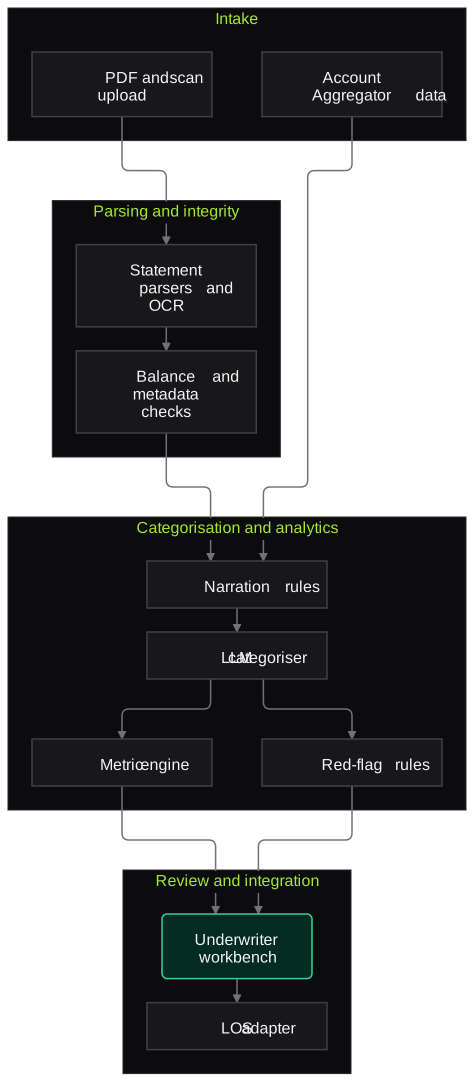
- Intake
- PDF and scan upload with password handling
- Account Aggregator FIU data receiver
- Application linking
- Parsing and integrity
- Bank-specific and generic table parsers
- OCR for scanned statements
- Balance recomputation and PDF metadata checks
- Categorisation
- Narration rules for UPI, NEFT, NACH and cheques
- LLM categoriser for ambiguous narrations
- Counterparty and recurrence detection
- Analytics
- Credit-policy metric engine
- Red-flag rules
- Cross-account netting
- Review and integration
- Underwriter workbench with drill-down
- LOS and credit memo adapter
- Category correction feedback
Inputs and outputs
Inputs
- E-statement PDFs, including password-protected files
- Scanned or photographed statements
- Account Aggregator FI data shared with consent
- Credit policy metric definitions
- Applicant's declared income and existing obligations
Outputs
- Categorised transaction ledger per account
- Credit-policy metrics with transaction drill-down
- Bounce, EMI and obligation summary
- Tamper and red-flag report
- Underwriter corrections captured for model improvement
Where people stay in control
Underwriters review every metric and flag before it enters the credit memo, and the fraud control unit reviews integrity failures. The service never sets eligibility or limits; it provides verified evidence.
Integrations
- Loan origination system
- Account Aggregator ecosystem through the lender's FIU integration
- Credit bureau data for obligation cross-checks
- Fraud or risk case management system
- Document management system
Guardrails
- Metrics computed by deterministic code; the language model only categorises narrations
- Integrity failures always routed to fraud control, never auto-rejected
- Account Aggregator data used only for the consented purpose and duration
- Statement data masked in logs and retained per policy
- Category corrections reviewed before retraining
Compliance notes
- Account Aggregator data is processed within the consent artefact's purpose and retention terms under RBI's NBFC-AA framework.
- Supports data minimisation under the DPDP Act 2023 and need-based data collection under RBI digital lending rules.
A typical pilot
Duration: 3 weeks
Statements from historical self-employed loan files across five or six common banks, compared with underwriter workings, plus a set of known tampered statements.
Deliverables
- 01Metric definitions encoded from your credit policy
- 02Working analysis service on historical statements
- 03Underwriter workbench
- 04Accuracy report against underwriter workings
- 05Tamper detection results on known cases
What we measure
- Parsing completeness
- Parsed transactions and closing balances reconciled with statement totals for each file.
- Metric agreement with underwriters
- Computed metrics compared with underwriter workings for the same files, with differences explained.
- Categorisation accuracy
- Categories checked by underwriters on a sample of transactions per file.
- Tamper detection on known cases
- Known altered statements flagged or missed, and genuine statements falsely flagged.
FAQs
01Do you support Account Aggregator data?
Yes. AA data arrives as structured FI data, so parsing errors disappear and the same categorisation and metrics apply. PDFs remain supported for borrowers who do not use AA.
02Can it detect edited statements?
It checks PDF metadata, fonts, layout consistency and running balances, and flags statements that fail. These are signals for fraud control rather than proof, so every flag is reviewed by a person.
03Can we use our own credit policy definitions?
Yes. Metrics such as average balance dates, income netting rules and bounce definitions are configured from your policy and versioned when it changes.
04Does it replace our underwriters?
No. It removes manual parsing and counting so underwriters spend their time on judgement. Every figure is traceable, and they can correct categories when context calls for it.
Related use cases
- NBFCs & Lending
Loan Application Document Extraction
Read loan files from branches, DSAs and digital journeys, extract KYC, income and business fields into your LOS, and flag missing or inconsistent documents before credit review.
- NBFCs & Lending
Co-Lending and Portfolio File Audit
Check every loan file in a co-lending tranche, assignment pool or portfolio buyout against eligibility criteria and the loan system, listing missing documents and mismatches before money moves.
- NBFCs & Lending
Property and Title Document Summarisation for Home Loans
Read sale deeds, encumbrance certificates, revenue records and approvals for home loans and LAP, build a chain-of-title summary and flag gaps for the advocate and credit team.
- Accounting, Audit & Consulting
Financial Statement Spreading
Read audited financials, notes and schedules in Schedule III, Ind AS or IFRS layouts and map every line into your spreading template or CMA format, each figure traced to its page.

Founded by Akhilesh Mittal. 8 years building a security platform for a New Zealand company. IIT ISM Dhanbad and IMT Ghaziabad. Builds production agentic AI.
Test one lending workflow on your own files
Book a discovery call to scope a short pilot, from statement analysis to a conduct-safe reminder agent, and judge it on measured results before scaling.