E-Way Bill and GST Document Validation
Check that each consignment's tax invoice or delivery challan, e-way bill and vehicle details agree before dispatch, then track validity and Part B updates while goods are in transit.
- Capability:
- Document Intelligence
- Industry:
- Logistics & Supply Chain
Who it is for
- Transport Manager
- Dispatch and Warehouse Manager
- Indirect Tax Manager
- Branch Operations Head at a transporter
The problem
Goods moving by road in India travel with a tax invoice or delivery challan and an e-way bill, often generated from an e-invoice. Dispatch teams and transporters handle these documents at speed, and a wrong vehicle number, an expired e-way bill or a GSTIN mismatch can lead to detention of goods and penalties at inspection.
Mismatches between documents
Invoice value, HSN, quantity or consignee GSTIN on the e-way bill differ from the invoice after manual corrections.
Vehicle changes not updated
When goods are transhipped at a hub or a truck breaks down, Part B is not always updated before the new vehicle moves.
Validity running out
Delays at hubs or on the road push consignments past e-way bill validity without anyone extending it in time.
Paper from many consignors
Transporters receive invoices and e-way bills as printouts or photos from many consignors and cannot check each one at booking.
What we build
We build a validation layer for dispatch points and transport hubs. Invoices, delivery challans and e-way bills are read from PDFs, photos or your ERP and GST systems. The system checks that GSTINs, document numbers, dates, HSN codes, values and quantities agree, that the e-way bill is active, and that Part B matches the vehicle actually loading. In transit it tracks validity against the expected arrival, alerts the transport team before expiry, and flags consignments moved to a new vehicle without a Part B update. Where you have API access through a GST Suvidha Provider, status can be confirmed against the portal.
- Reads tax invoices, delivery challans and e-way bills from PDFs, photos and system exports
- Cross-checks GSTINs, document numbers, dates, HSN, values and quantities
- Confirms the Part B vehicle number against the vehicle at the loading bay or hub
- Tracks e-way bill validity against shipment ETA and alerts before expiry
- Flags transhipments without a Part B update
- Confirms e-way bill status through a GSP or e-way bill API where you have access
How it works
- 01Capture documents at bookingInvoice, challan and e-way bill are captured from the ERP, a scan or a photo when the consignment is booked.
- 02Extract and cross-checkKey fields are extracted and compared across documents and with the booking.
- 03Check status and vehicleE-way bill status is confirmed where API access exists, and Part B is compared with the loading vehicle.
- 04Hold or releaseMismatches put the consignment on hold for the dispatch team to correct before the vehicle leaves.
- 05Monitor in transitValidity and transhipment events are tracked, and the transport team is alerted before expiry or when Part B needs updating.
- 06Keep the recordChecked documents and actions are stored with the consignment for audit and inspection queries.

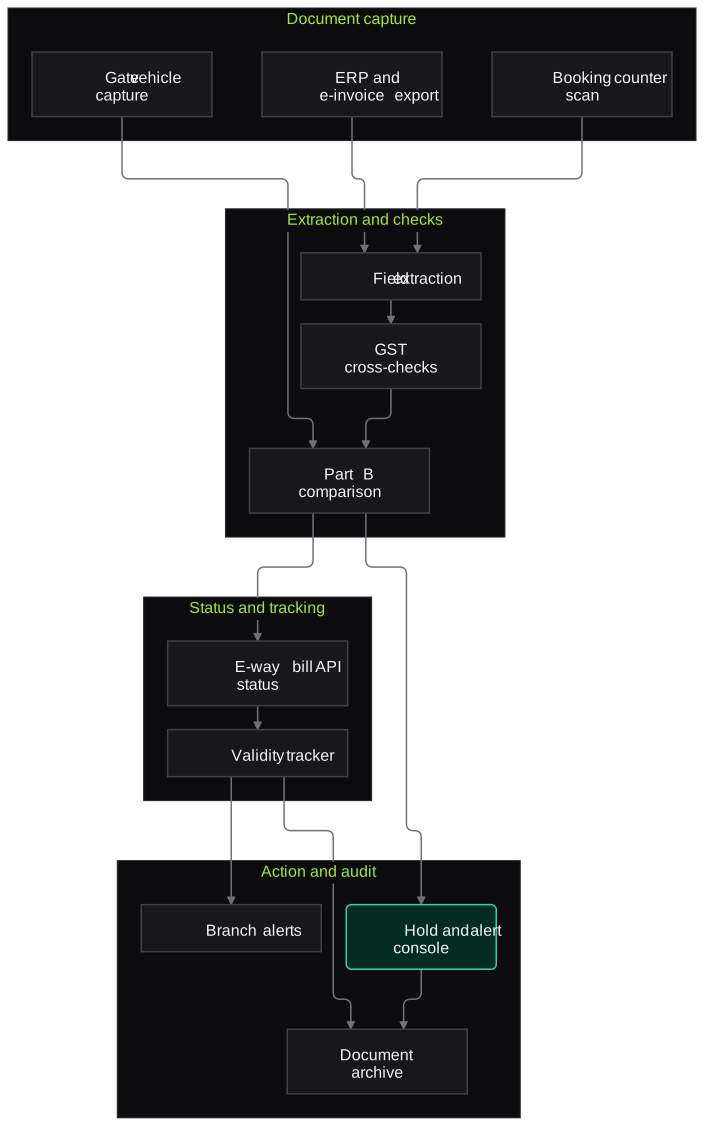
Architecture
- Document capture
- ERP and e-invoice system export
- Scan and photo capture at booking counters
- Vehicle number capture at the gate
- Extraction and checks
- OCR and LLM field extraction
- Cross-document GST rules
- Vehicle and Part B comparison
- Status and tracking
- GSP or e-way bill API status check
- Validity tracker linked to shipment ETA
- Transhipment events from the TMS
- Action and audit
- Hold and alert console
- WhatsApp or SMS alerts to branch staff
- Consignment document archive
Inputs and outputs
Inputs
- Tax invoices and e-invoice IRN details
- Delivery challans for stock transfers and job work
- E-way bills with Part A and Part B
- Booking and vehicle data from the TMS
- Vehicle numbers captured at the gate or loading bay
Outputs
- Consignment-level validation result
- Mismatch list for correction before dispatch
- Validity and Part B alerts in transit
- Document archive linked to each consignment
- Branch-wise exception reports
Where people stay in control
Dispatch and branch teams correct every mismatch and decide whether a consignment can move. E-way bill generation, cancellation and extension are done by authorised staff on the portal or through your GST system, not by the AI.
Integrations
- ERP and e-invoicing system
- GST Suvidha Provider or e-way bill API access
- TMS for bookings, vehicles and ETAs
- Gate or yard management system
- WhatsApp Business API or SMS for alerts
Guardrails
- No generation, cancellation or extension of e-way bills by the AI
- Holds released only on human correction or confirmation
- Rules version-controlled and updated when notifications change
- Low-confidence reads of GSTIN or vehicle number always shown for confirmation
- Document images retained with the consignment for inspection queries
Compliance notes
- Designed to support e-way bill requirements under India's GST rules; thresholds, validity and exemptions are configured with your tax team and updated when notifications change.
- Does not replace your GST compliance process or professional tax advice.
A typical pilot
Duration: 3 weeks
One dispatch location or transporter hub, checking outbound consignments in parallel with the existing process.
Deliverables
- 01Validation rules agreed with your tax and transport teams
- 02Working document checks at the pilot location
- 03Hold and alert console
- 04Exception report on pilot consignments
- 05Roll-out plan for other branches
What we measure
- Field extraction accuracy
- Extracted GSTINs, numbers, values and vehicle details compared with source documents on a sample.
- Mismatches caught before dispatch
- Confirmed mismatches the system flagged, recorded by the dispatch team.
- Timeliness of validity alerts
- Alerts raised before expiry compared with consignments that crossed validity during the pilot.
- Check time per consignment
- Time to clear a consignment at the dispatch desk with and without the system.
FAQs
01Can it generate or extend e-way bills for us?
We keep generation, cancellation and extension with authorised staff and your GST system. The AI checks documents, tracks validity and raises alerts; it does not take portal actions on its own.
02We are a transporter. Can we get e-way bill status by API?
Transporters can update Part B for e-way bills assigned to them, and API access may be available through a GST Suvidha Provider depending on your registration. Where it is not, the system works from documents and photos.
03How do you keep up with GST rule changes?
Rules such as validity periods and thresholds are configuration, not code. Your tax team approves changes, and we update and retest the rules when notifications change.
04Will this work with handwritten delivery challans?
Printed challans are the easier case. Handwritten ones are read with confidence scores, and uncertain fields are shown to staff for confirmation.
Related use cases
- Logistics & Supply Chain
Customs and Shipping Document Extraction
Extract and cross-check data from commercial invoices, packing lists, bills of lading, airway bills and certificates of origin, and prepare checked job data for bill of entry or shipping bill filing.
- Logistics & Supply Chain
Proof of Delivery Capture and Verification
Check every POD photo or scan for consignment number, date, signature, stamp and remarks, match it to the shipment in your TMS, and flag short, damaged or doubtful deliveries before billing.
- Logistics & Supply Chain
Freight Invoice Audit Against Rate Contracts
Audit every carrier or transporter freight bill against your rate contracts, shipment data and PODs, recalculate each charge and flag overbilling, duplicates and unsupported surcharges.
- Accounting, Audit & Consulting
GST Return Reconciliation (GSTR-2B vs Books)
Match GSTR-2B and 2A data against the purchase register invoice by invoice, find ITC at risk before GSTR-3B is filed, and draft supplier follow-ups for approval.

Founded by Akhilesh Mittal. 8 years building a security platform for a New Zealand company. IIT ISM Dhanbad and IMT Ghaziabad. Builds production agentic AI.
Start with one lane, one carrier or one hub
Book a discovery call to pick a narrow pilot on your own PODs, freight bills or customer calls, and compare the results with your team's current process.