Customs and Shipping Document Extraction
Extract and cross-check data from commercial invoices, packing lists, bills of lading, airway bills and certificates of origin, and prepare checked job data for bill of entry or shipping bill filing.
- Capability:
- Document Intelligence
- Industry:
- Logistics & Supply Chain
Who it is for
- Customs Broker Operations Head
- Freight Forwarding Manager
- EXIM Documentation Executive
- Import-Export Manager
The problem
Every import or export job brings a set of documents from shippers, consignees and carriers: commercial invoice, packing list, bill of lading or airway bill, certificate of origin, insurance certificate and sometimes licences or test reports. Documentation executives at customs brokers and forwarders key the same data into their operating system and the customs filing, then check documents against each other by eye.
Re-keying from many layouts
Each supplier's invoice and each carrier's bill of lading looks different, so templates break and data is typed by hand.
Inconsistencies across documents
Quantities, weights, container numbers, Incoterms and consignee details that differ between invoice, packing list and BL lead to queries and amendments.
Classification and valuation risk
Goods descriptions too vague to support the declared HS code, or invoice values that do not add up, attract customs queries.
Deadline pressure
Filing delays add demurrage and detention, so documentation teams work under constant pressure around vessel cut-offs and arrivals.
What we build
We build a document pipeline for customs brokers, forwarders and EXIM teams. Each job's documents are classified and key fields extracted: parties, invoice lines with description, quantity, unit price and value, HS codes where stated, Incoterms, container and seal numbers, weights, ports and dates. The system cross-checks documents against each other and the job record, recalculates invoice totals, and flags vague descriptions or missing documents. A documentation executive reviews the checked data on one screen before it goes to your operating system or filing software. Classification and valuation decisions stay with your licensed customs broker.
- Classifies job documents: commercial invoice, packing list, BL, AWB, certificate of origin and insurance
- Extracts parties, invoice lines, values, Incoterms, containers, seals, weights, ports and dates
- Cross-checks quantities, weights and parties across invoice, packing list and transport document
- Recalculates invoice line totals and currency values
- Flags vague goods descriptions and documents missing for the job type
- Exports checked data to your forwarding or customs filing software
How it works
- 01Collect job documentsDocuments arrive by email or customer portal and are grouped by job or shipment reference.
- 02Classify and extractEach document is classified and its fields extracted with source references.
- 03Cross-checkValues are compared across documents and with the booking or job record, and totals are recalculated.
- 04Flag issuesMismatches, vague descriptions and missing documents are listed with the documents involved.
- 05Executive reviewThe documentation executive confirms the data, resolves flags with the customer and approves the job.
- 06Export for filingApproved data goes to the forwarding system or filing software for bill of entry or shipping bill preparation.

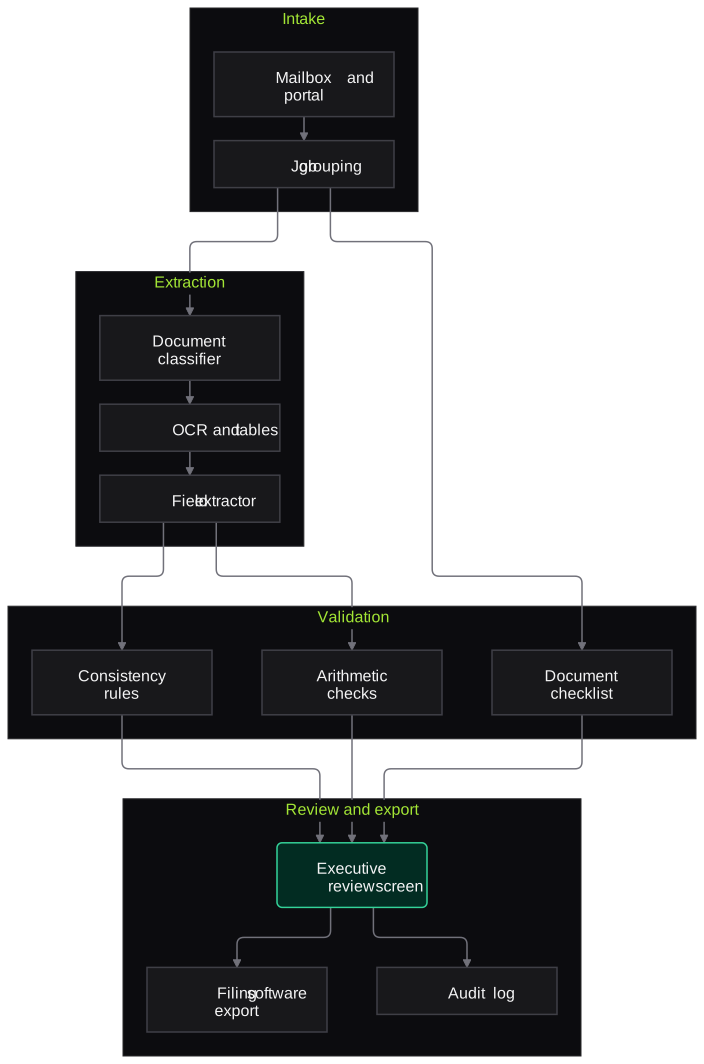
Architecture
- Intake
- Shared mailbox and customer portal connectors
- Job grouping by reference
- Extraction
- Document classifier
- OCR and table extraction
- LLM field extractor with trade document schemas
- Validation
- Cross-document consistency rules
- Invoice arithmetic and currency checks
- Job-type document checklist
- Review and export
- Single-screen review with source highlights
- Export to forwarding or filing software
- Audit log
Inputs and outputs
Inputs
- Commercial invoices and packing lists
- Bills of lading, sea waybills and airway bills
- Certificates of origin and insurance certificates
- Booking or job details from the forwarding system
- Customer product master with past descriptions and HS codes where available
Outputs
- Structured job data with source links
- Cross-document mismatch list
- Missing-document checklist per job
- Data export for bill of entry or shipping bill preparation
- Audit trail of edits and approvals
Where people stay in control
Documentation executives approve all job data before export and resolve mismatches with the shipper or consignee. HS classification, valuation and filing decisions remain with your licensed customs broker.
Integrations
- Freight forwarding or customs brokerage software (via API or file import)
- ICEGATE filing through your existing filing software
- Email and customer portals
- ERP for importer or exporter master data
- Document management system
Guardrails
- The system never sets a final HS code; any suggestion is labelled for the broker to decide
- Every field linked to its source document and page
- Export only after executive approval
- Customer documents segregated by account
- Extraction schema changes versioned and tested
Compliance notes
- Supports accurate declarations under the Customs Act 1962 by checking consistency between commercial and transport documents before filing.
- Customer commercial data is kept confidential and processed in your chosen cloud region.
A typical pilot
Duration: 4 weeks
One trade lane or customer group, for imports or exports, using recently filed jobs plus a live parallel run.
Deliverables
- 01Field schemas for the pilot document types
- 02Working extraction and cross-check pipeline
- 03Review screen for documentation executives
- 04Accuracy report against filed job data
- 05Integration and roll-out plan
What we measure
- Field extraction accuracy
- Extracted values compared with the data in filed jobs for the same documents.
- Mismatch flags confirmed
- Flags the documentation executive confirms as genuine discrepancies.
- Preparation time per job
- Time to prepare job data with and without the pipeline on comparable jobs.
- Amendments on pilot jobs
- Post-filing amendments needed on pilot jobs, tracked with their reasons.
FAQs
01Can the system classify goods under HS codes?
It can suggest candidate codes from descriptions and your past classifications for a broker to consider, but it does not decide classification. Final HS codes and valuation stay with your licensed customs broker.
02Which document formats work?
Digital PDFs, scans, photos and Excel packing lists. Documents in other languages from your regular trading partners can be tested during the pilot.
03Does it file directly on ICEGATE?
No. It exports checked data to the filing software your team already uses, which handles submission.
04Can it work for EU or other customs regimes?
Yes. Extraction and cross-checks work the same way, and the export format is mapped to the target system. Regime-specific rules are configured with your team.
Related use cases
- Logistics & Supply Chain
E-Way Bill and GST Document Validation
Check that each consignment's tax invoice or delivery challan, e-way bill and vehicle details agree before dispatch, then track validity and Part B updates while goods are in transit.
- Logistics & Supply Chain
Freight Invoice Audit Against Rate Contracts
Audit every carrier or transporter freight bill against your rate contracts, shipment data and PODs, recalculate each charge and flag overbilling, duplicates and unsupported surcharges.
- Banking
Trade Finance Document Checking (LCs, Bills of Lading)
Examine LC presentations against the credit terms, UCP 600 and ISBP, and give trade operations a draft discrepancy list with every finding tied to a document and clause.
- Fintech & Payments
Invoice and GST Data Extraction for B2B Payments
Extract GSTINs, HSN lines, tax splits and IRN data from supplier invoices before a B2B payment or invoice financing is released, with tax-logic and duplicate checks.

Founded by Akhilesh Mittal. 8 years building a security platform for a New Zealand company. IIT ISM Dhanbad and IMT Ghaziabad. Builds production agentic AI.
Start with one lane, one carrier or one hub
Book a discovery call to pick a narrow pilot on your own PODs, freight bills or customer calls, and compare the results with your team's current process.