Pre-Authorisation Request Triage for TPAs
Read incoming cashless requests, check completeness, policy terms and tariffs, and put a prioritised, source-linked summary in front of the TPA medical officer.
- Capability:
- Document Intelligence
- Industry:
- Insurance
Who it is for
- Head of Cashless Operations
- TPA Medical Officer
- TPA Operations Manager
- Provider Network Manager
The problem
Network hospitals send cashless requests at all hours: the pre-authorisation form, the treating doctor's notes, investigation reports and a cost estimate, sometimes as a fax turned into a PDF. The medical officer has to work out what is being asked, whether the file is complete and what the policy allows, against a clock that patients, hospitals and IRDAI all watch.
Incomplete requests cause back-and-forth
Missing investigation reports, unsigned forms or an absent cost break-up trigger query letters, and every query keeps the patient waiting at the admission desk.
Policy terms checked from memory
Waiting periods, pre-existing disease declarations, room-rent eligibility and procedure sub-limits sit on different screens, so checks vary between medical officers.
Tariff and package mismatches
Estimates that exceed the hospital's agreed package or tariff are easy to miss when requests are read in a hurry.
Flat queues hide urgent cases
An emergency admission, an enhancement at discharge and a planned cataract surgery can sit in the same first-in, first-out queue.
What we build
We build a triage layer that sits between hospital requests and your medical officers. It reads each request, identifies whether it is an initial request, an enhancement or a final discharge approval, and extracts the clinical and cost details. It checks the file against a procedure-specific document checklist, looks up the member's policy terms and the hospital's agreed tariff or package, and builds a one-screen summary with every fact linked to its source page. Incomplete files get a drafted query for the desk team. Complete files are ranked by urgency for a medical officer, who makes the decision in your existing TPA system.
- Recognises request type: initial authorisation, enhancement or final discharge approval
- Extracts provisional diagnosis, proposed line of treatment, expected length of stay, room category and estimated cost
- Checks completeness against document checklists configured per procedure or specialty
- Looks up waiting periods, pre-existing disease declarations, sub-limits and room-rent eligibility from the policy record
- Compares the estimate with the hospital's agreed tariff or package rate and highlights differences
- Drafts query letters for missing items and ranks complete requests using urgency rules set by your medical team
How it works
- 01Receive the requestRequests arrive from the hospital portal, a shared inbox or fax-to-email and are matched to the member and the hospital.
- 02Identify and extractThe request type is identified, and clinical, cost and member fields are extracted with source-page references.
- 03Check completenessA procedure-specific checklist confirms the required documents; incomplete files go to the desk team with a drafted query.
- 04Look up policy and tariffPolicy terms and the hospital's agreed tariff or package are pulled and compared with the request.
- 05Prioritise and summariseComplete requests are ranked by urgency rules and presented as a one-screen summary with flags.
- 06Medical officer decidesThe medical officer approves, partially approves, queries or declines in the TPA system, and the decision and reasons are logged.

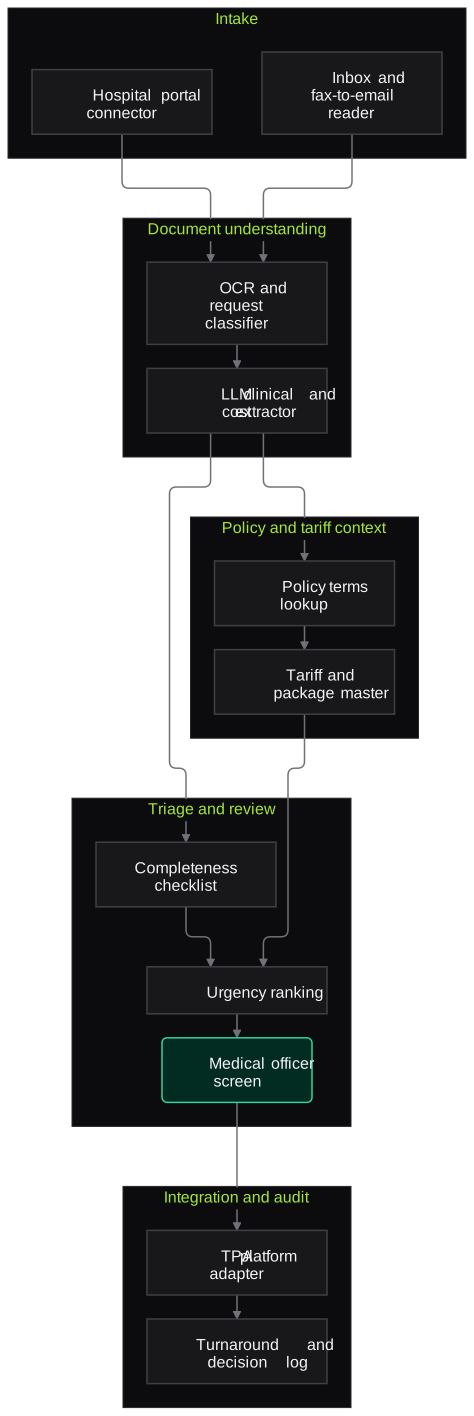
Architecture
- Intake
- Hospital portal connector
- Shared inbox and fax-to-email reader
- Member and hospital matching
- Document understanding
- OCR with handwriting support
- Request-type classifier
- LLM extractor for clinical and cost fields
- Policy and tariff context
- Policy terms lookup from the member master
- Hospital tariff and package master
- Diagnosis and procedure code suggestions for coder review
- Triage and review
- Completeness checklist engine
- Urgency ranking rules
- Medical officer summary screen
- Query letter drafts
- Integration and audit
- TPA platform adapter
- Decision and turnaround log
Inputs and outputs
Inputs
- Cashless pre-authorisation request form
- Treating doctor's notes and provisional diagnosis
- Investigation reports supporting the admission
- Hospital cost estimate and tariff or package reference
- Member e-card, policy record and claim history
- Enhancement requests and final bills at later stages
Outputs
- Structured pre-auth record with source-page links
- Completeness status and list of missing documents
- Drafted query letter for the hospital
- Policy and tariff flags such as waiting period, sub-limit or package variance
- Urgency rank and one-screen summary for the medical officer
- Turnaround log from receipt to decision
Where people stay in control
Medical officers make every approval, partial approval, query and denial, and desk staff review each drafted query before it is sent. The system never contacts the hospital with a decision on its own and never judges medical necessity.
Integrations
- TPA or insurer cashless platform (via API or database staging)
- Hospital and provider portals
- Shared inboxes and fax-to-email gateway
- Policy administration system or member master
- Hospital tariff and package master
- MIS and data warehouse for turnaround reporting
Guardrails
- No automatic approval or denial at any stage
- Clinical fields shown only when found in the documents, with the source page; absent information is marked absent, not inferred
- Urgency rules written and versioned by the medical team
- Drafted queries reviewed by a person before sending
- Health data masked in logs and kept in your chosen cloud region
Compliance notes
- Helps TPAs and insurers work towards IRDAI expectations on time-bound cashless decisions while keeping clinical judgement with qualified medical officers.
- Processes health data only for claim handling, supporting purpose limitation under India's DPDP Act 2023.
A typical pilot
Duration: 4 weeks
Planned surgical admissions from a small group of high-volume network hospitals, run in shadow mode next to your current cashless desk.
Deliverables
- 01Request-type and field schema agreed with your medical team
- 02Procedure checklists for the pilot specialties
- 03Working triage pipeline on de-identified historical and live requests
- 04Medical officer summary screen
- 05Pilot report and production plan
What we measure
- Completeness check agreement
- Pipeline completeness verdicts compared with the desk team's own assessment of the same requests.
- Time from receipt to medical officer view
- Timestamps logged for each request in shadow mode and in the current process.
- Avoidable queries
- Queries raised by medical officers that the checklist had already identified at intake.
- Extraction accuracy for diagnosis and cost fields
- Compared with the values entered by the desk team for the same requests.
FAQs
01Does it suggest ICD-10 or procedure codes?
It can suggest codes from the provisional diagnosis and proposed treatment, clearly marked as suggestions. Your coders or medical officers confirm or change them, and those corrections improve later suggestions.
02Can it handle enhancements and final discharge approvals?
Yes. It recognises enhancement requests and final bills, compares them with the amount already authorised and highlights what has changed, so the medical officer can focus on the difference.
03Will it decide whether a treatment is medically necessary?
No. It organises the facts and flags gaps or policy issues. Medical necessity and every authorisation decision stay with your medical officers.
04Where does tariff and package data come from?
From your existing provider tariff and package master, through an export or API. If agreed rates live in PDFs or spreadsheets, we extract them into a structured table during the pilot.
Related use cases
- Insurance
Health Claim Document Extraction
Turn hospital bills, discharge summaries and investigation reports into structured, checked claim data, with uncertain fields routed to an assessor instead of guessed.
- Healthcare & Hospitals
Insurance Pre-Auth and Claim File Preparation for Hospitals
Assemble cashless pre-auth, enhancement and final claim files for TPAs, insurers and government schemes, and check each against the payer's checklist before submission.
- Insurance
Claim Status Voice Helpline for Policyholders
An inbound voice agent that verifies callers, explains live claim status in plain language, sends pending-document lists on WhatsApp and transfers complaints and sensitive cases to people.
- Insurance
Tampered and Fraudulent Document Detection
Score claim documents for signs of editing, fabrication and reuse, explain each signal, and route high-risk files to your investigation team instead of labelling anyone a fraudster.

Founded by Akhilesh Mittal. 8 years building a security platform for a New Zealand company. IIT ISM Dhanbad and IMT Ghaziabad. Builds production agentic AI.
Pick one claim type, product line or bot to start
Book a discovery call and we will scope a short pilot on your own de-identified documents or staging bot, with clear measures agreed up front.