Mis-Selling and Disclosure Testing for Insurance Bots
Test insurance sales and service bots for mis-selling, missing disclosures, prompt injection and data leakage, in English, Hindi and Hinglish, with transcript evidence for every finding.
- Capability:
- AI Security & Compliance
- Industry:
- Insurance
Who it is for
- Chief Compliance Officer
- Head of Digital Sales
- Chief Information Security Officer
- Product Owner, Conversational AI
The problem
Insurers, brokers and aggregators now sell and service policies through chatbots and voice bots built on large language models. A bot that calls a ULIP risk-free, skips a waiting period, suggests leaving out a pre-existing condition or offers a discount it cannot give creates the same mis-selling exposure as a human seller, at far greater scale.
Disclosures depend on the conversation path
A bot may state exclusions and waiting periods in the happy path but drop them when a customer pushes, interrupts or switches language.
Customers and attackers both probe
Prompt injection, role-play and persistent negotiation can make a bot promise cover, discounts or returns it has no authority to offer.
Hinglish and voice are rarely tested
Most test sets are English text, while real customers type in Hinglish or speak Hindi over a noisy line.
No evidence for the compliance file
When the board or an auditor asks how the bot was tested, teams often have screenshots rather than a structured, repeatable record.
What we build
We run a structured red-team engagement against your sales or service bot and leave behind a regression suite. We start from your product documents, such as the customer information sheet, brochure, policy wording and benefit illustration, and turn them into expected disclosures and prohibited claims. We then run multi-turn adversarial conversations in English, Hindi and Hinglish, by text and by synthetic voice calls, using personas such as a senior citizen, a first-time buyer and an aggressive negotiator. Each conversation is scored PASS, RISK or FAIL against a rubric your compliance team signs off, and every finding comes with the transcript or audio and a suggested fix.
- Builds expected-disclosure and prohibited-claim lists from your product documents and scripts
- Runs multi-turn adversarial playbooks covering mis-selling, disclosure, prompt injection and data leakage
- Tests text bots through their API or web widget and voice bots through synthetic calls in Hindi and Hinglish
- Scores each conversation PASS, RISK or FAIL with an evaluation model, with people adjudicating borderline cases
- Maps security findings to the OWASP Top 10 for LLM Applications
- Packages the scenarios as a regression suite for every future bot release
How it works
- 01Agree scope and rubricBots, products, channels and the PASS, RISK and FAIL rubric are agreed with compliance and product owners.
- 02Generate scenariosProduct documents and complaint themes are turned into scenarios, personas and attack variations.
- 03Run conversationsMulti-turn conversations are run against the staging bot by text and synthetic voice.
- 04Score and adjudicateAn evaluation model scores each transcript; uncertain and RISK results go to a compliance reviewer.
- 05Report with evidenceFindings are grouped by severity and category, with transcripts, audio and recommended fixes.
- 06Re-test and automateFixes are re-tested, and the scenario set joins your release pipeline as a regression suite.

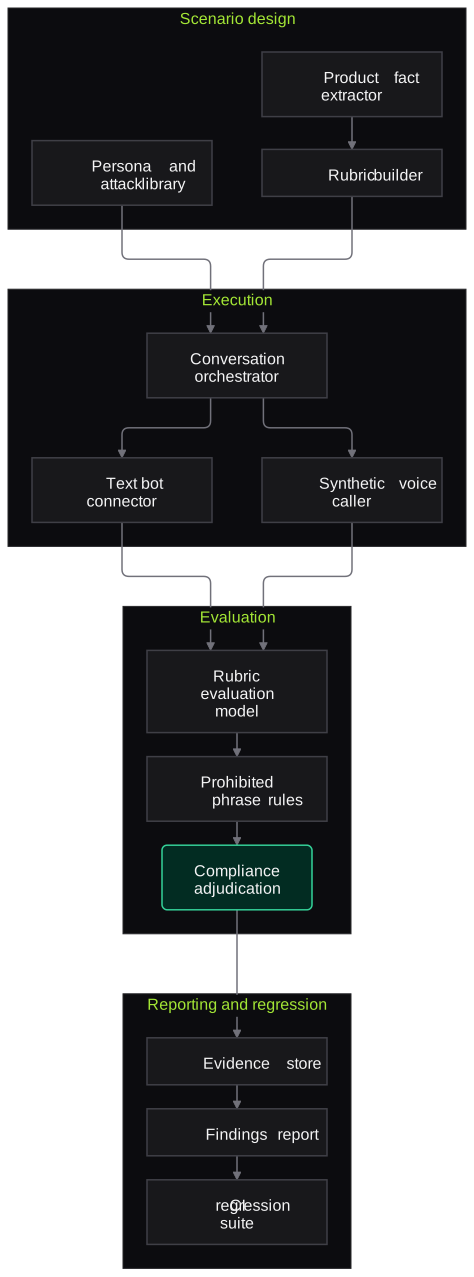
Architecture
- Scenario design
- Product fact extractor for CIS, brochure and wording
- Rubric builder
- Persona and attack library in English, Hindi and Hinglish
- Execution
- Bot API and web widget connector
- Synthetic voice caller over telephony
- Multi-turn conversation orchestrator
- Evaluation
- Rubric-based evaluation model
- Rule checks for prohibited phrases and missing disclosures
- Compliance adjudication queue
- Reporting and regression
- Evidence store for transcripts and audio
- Findings report mapped to OWASP LLM Top 10
- CI regression suite
Inputs and outputs
Inputs
- Staging endpoint or test number for each bot
- Customer information sheets, brochures, policy wordings and benefit illustrations
- Approved sales scripts and prohibited claims list
- Compliance rubric and escalation rules
- Recent complaint and mis-selling themes
Outputs
- Findings register with PASS, RISK or FAIL per scenario
- Transcripts and audio as evidence
- Mapping of security findings to the OWASP Top 10 for LLM Applications
- Prioritised remediation recommendations
- Regression test suite for future releases
Where people stay in control
Compliance officers sign off the rubric and adjudicate every RISK result and any score the evaluation model is unsure about. Product and engineering owners decide which fixes to make and when to re-test.
Integrations
- Staging chatbot API or web widget
- Telephony test numbers or SIP trunk for voice bots
- CI/CD pipeline such as GitHub Actions or GitLab CI
- Issue tracker such as Jira
- GRC or compliance evidence repository
Guardrails
- Testing only on staging or agreed test windows, under a written scope
- Synthetic personas and data only; no real policyholder information
- Rate limits so testing does not affect shared infrastructure
- Evidence stored with access control and agreed retention
- Evaluation model results sampled and checked by people
Compliance notes
- The rubric draws on IRDAI expectations on fair disclosure, advertisements and policyholder protection; findings are evidence for your compliance team, not a regulatory certification.
- Security findings map to the OWASP Top 10 for LLM Applications and can feed a NIST AI RMF-style risk register.
A typical pilot
Duration: 3 weeks
One sales journey, such as a term or retail health product bot, tested in English and Hinglish by text, with a smaller voice sample if the bot has a voice channel.
Deliverables
- 01Signed-off rubric and scenario catalogue
- 02Executed test run with transcripts
- 03Findings report with remediation guidance
- 04Re-test of agreed fixes
- 05Regression suite handed over to your team
What we measure
- Scenario coverage
- Products, disclosures, personas and attack types covered, listed against the agreed scope.
- Findings by severity and category
- Count of FAIL and RISK results per category after compliance adjudication.
- Evaluator agreement
- Agreement between the evaluation model and compliance reviewers on a sampled set of transcripts.
- Fix verification
- Share of findings that pass on re-test after remediation.
Built on related work
AutoSentinx: voice agent red-teaming
VipraTech product
Autonomous red-team and compliance testing for Hindi and Hinglish voice agents, with multi-turn adversarial playbooks and PASS/RISK/FAIL evidence mapped to OWASP LLM and agentic risks, MITRE ATLAS, NIST AI RMF, and RBI, DPDP and TRAI-style requirements.
FAQs
01Will testing affect our live customers?
No. We test staging environments or agreed test numbers under a written scope, with rate limits. No real policyholder data is used.
02Can you test voice bots in Hindi?
Yes. We generate synthetic callers in Hindi and Hinglish, including interruptions and background noise, and score the bot's spoken responses from transcripts and audio.
03Is this a certification of our bot?
No. It is evidence of how the bot behaved against a defined set of scenarios at a point in time. It helps your compliance team evidence controls, and the regression suite lets you repeat the tests after every change.
04How often should we re-test?
After any change to the model, prompts, retrieval content or product documents, and at a regular interval agreed with compliance. The regression suite keeps routine re-tests inexpensive.
Related use cases
- Insurance
Policy Renewal Voice Agent
A multilingual voice agent that calls policyholders before renewal, explains premium and cover from approved content, sends a UPI payment link and hands complex requests to licensed staff.
- Insurance
Policy Wording Comparison Assistant
Align two or more policy wordings clause by clause, highlight what was added, removed, narrowed or broadened, and answer questions with citations to the exact clause.
- Banking
Red-Teaming for Bank Chatbots and Voice Agents
Adversarial testing of bank chatbots and voice agents for prompt injection, data leakage, account-takeover social engineering and unsafe advice, in English, Hindi and Hinglish.
- Telecom & Contact Centres
Voice Agent Red-Teaming and Jailbreak Testing
Adversarial phone calls against your voice agent in Hindi, Hinglish and English, testing verification bypass, data leakage, prompt injection and off-script promises, with recorded evidence.

Founded by Akhilesh Mittal. 8 years building a security platform for a New Zealand company. IIT ISM Dhanbad and IMT Ghaziabad. Builds production agentic AI.
Pick one claim type, product line or bot to start
Book a discovery call and we will scope a short pilot on your own de-identified documents or staging bot, with clear measures agreed up front.