Discharge Summary and Medical Record Structuring
Draft discharge summaries from the inpatient file and turn past records into structured diagnoses, procedures, medicines and allergies, each linked to its source for the doctor to verify.
- Capability:
- Document Intelligence
- Industry:
- Healthcare & Hospitals
Who it is for
- Medical Superintendent
- Head of Medical Records (MRD)
- Consultants and resident doctors
- Chief Information Officer
The problem
A discharge summary should bring together the admission diagnosis, course in hospital, procedures, key investigations, medicines on discharge and follow-up advice. In practice a resident assembles it from handwritten progress notes, OT notes, the drug chart and lab printouts, often late in the day while the patient waits to leave. Old discharge summaries and referral letters that patients bring in stay as scanned images nobody can search.
Discharge delays
Summaries written at the end of a busy shift hold up discharge, bed turnover and the insurance final bill.
Inconsistent content
Different doctors include different sections, and medicines on discharge sometimes differ from the final drug chart.
Unsearchable history
Scanned previous records sit as images in the HIS, so allergies and prior procedures are missed or asked again.
Coding backlog
Medical records teams code diagnoses and procedures from free text, which is slow and varies between coders.
What we build
We build a record structuring service that reads the inpatient file and incoming past records. For discharge, it assembles a draft summary in your hospital's template: diagnosis, history, course in hospital, procedures with dates, key investigation results, condition at discharge, medicines on discharge checked against the final drug chart, and follow-up advice as the team wrote it. Each sentence links to the note or report it came from. The treating doctor edits and signs, and nothing is released unsigned. For past records, it extracts diagnoses, procedures, medicines and allergies into structured fields and suggests ICD-10 codes for the medical records team to confirm.
- Reads typed and handwritten progress notes, OT notes, drug charts and investigation reports
- Drafts the discharge summary in your template with a source link on every sentence
- Compares medicines on discharge with the final drug chart and flags differences for the doctor
- Extracts diagnoses, procedures, medicines and allergies from past discharge summaries and referral letters
- Suggests ICD-10 codes for medical records coders to confirm or change
- Exports structured data to your HIS, and to FHIR-based formats where ABDM integration is in place
How it works
- 01Collect the inpatient fileWhen discharge is planned, notes, OT records, the drug chart and reports are pulled from the HIS or scanned from the paper file.
- 02Extract and organiseEach document is classified and its clinical facts extracted with dates and source references.
- 03Draft the summaryA draft is assembled in the hospital template using only facts found in the record.
- 04Check consistencyMedicines, procedure dates and diagnoses are cross-checked across documents, and mismatches and gaps are highlighted.
- 05Doctor review and sign-offThe treating doctor edits the draft, resolves each flag and signs the summary in the HIS.
- 06Code and storeCoders confirm suggested ICD-10 codes, and the structured record is saved for future visits.

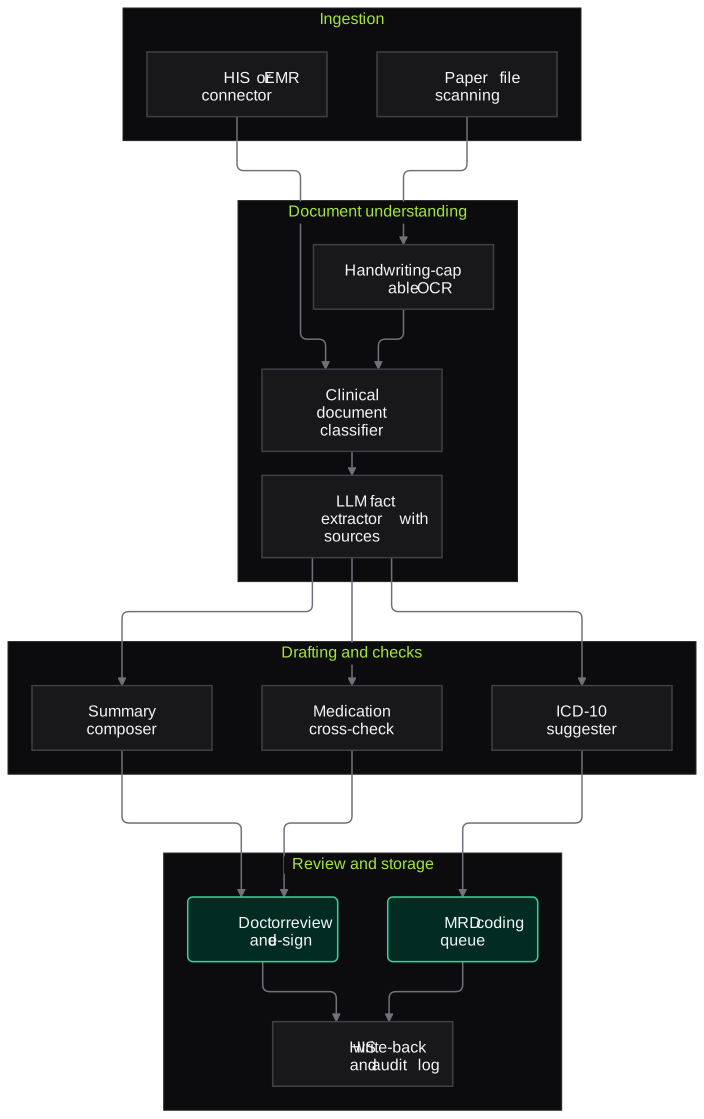
Architecture
- Ingestion
- HIS or EMR connector
- Scanner and paper file upload
- Patient episode grouping by UHID and IP number
- Document understanding
- Handwriting-capable OCR
- Clinical document classifier
- LLM fact extractor with source spans
- Drafting and checks
- Template-based summary composer
- Medication cross-check against drug chart
- ICD-10 code suggester
- Clinical review
- Doctor review and e-sign screen
- MRD coding queue
- Storage and audit
- HIS write-back and FHIR export
- Audit log of drafts, edits and signatures
Inputs and outputs
Inputs
- Admission notes and case sheet
- Progress notes and OT or procedure notes
- Drug chart and medication administration record
- Investigation and imaging reports
- Previous discharge summaries and referral letters
- Hospital discharge summary template
Outputs
- Draft discharge summary with source links
- Medication and date mismatch flags
- Structured diagnoses, procedures, medicines and allergies
- Suggested ICD-10 codes for coder confirmation
- Signed summary and audit trail in the HIS
Where people stay in control
The treating doctor reviews, edits and signs every discharge summary; no draft reaches the patient, insurer or record unsigned. Medical records coders confirm every suggested code.
Integrations
- Hospital information system or EMR (HL7, FHIR, API or database views)
- Document scanners and DMS
- ABDM-integrated health record systems where applicable
- Insurance desk and billing module
- Single sign-on for clinician access
Guardrails
- Drafts use only facts present in the record, with no inferred diagnoses or advice
- Every sentence carries a link to its source document and page
- Unsigned drafts are watermarked and cannot be printed or shared
- Role-based access aligned with HIS permissions, with patient data masked in logs
- Regular MRD audit of signed summaries against source records
Compliance notes
- Health data handled with consent, purpose limitation and security safeguards under the DPDP Act 2023.
- Designed as a documentation aid; clinical content remains the responsibility of the treating doctor.
- For US deployments, built to operate under HIPAA safeguards and a business associate agreement.
A typical pilot
Duration: 4 weeks
Discharge summaries for one department, such as general surgery or internal medicine, drafted in parallel with the current process on de-identified or consented records.
Deliverables
- 01Template and section rules agreed with the department
- 02Working drafting pipeline on past inpatient files
- 03Doctor review screen
- 04Accuracy and edit report
- 05Plan for HIS integration and roll-out
What we measure
- Doctor edit effort
- Extent of changes between the draft and the signed summary, measured on every pilot case.
- Source accuracy
- Clinician review of a sample of statements against their linked sources.
- Medication mismatch detection
- Flags raised compared with discrepancies found by pharmacist or doctor review.
- Time to signed summary
- Time from discharge order to signed summary, compared with recent cases in the same department.
FAQs
01Will the AI write clinical opinions?
No. It assembles facts already in the record into your template. Clinical judgement, advice and final wording belong to the treating doctor, who signs the summary.
02Can it read doctors' handwriting?
It handles legible handwriting in progress notes and drug charts and marks anything uncertain for the doctor instead of guessing. The pilot reports accuracy separately for handwritten and typed notes.
03Does it work with our HIS?
We connect through HL7, FHIR, APIs, database views or scanned exports, depending on what your HIS vendor supports. We agree the approach with your IT team early in the pilot.
04Where is patient data processed?
Within your infrastructure or your cloud account in an India region, using models that do not retain or train on your data. Access follows your HIS roles and is fully logged.
Related use cases
- Healthcare & Hospitals
Clinical Documentation from Doctor Dictation
Doctors dictate in English or Hinglish after a consultation, round or procedure, and the system drafts a structured note or prescription in your EMR template for the doctor to check and sign.
- Healthcare & Hospitals
Lab Report Digitisation and Trend Extraction
Turn external lab reports, PDFs and phone photos into structured results mapped to standard test codes, and show trends over time to the treating doctor with every value linked to its source.
- Healthcare & Hospitals
Insurance Pre-Auth and Claim File Preparation for Hospitals
Assemble cashless pre-auth, enhancement and final claim files for TPAs, insurers and government schemes, and check each against the payer's checklist before submission.
- Insurance
Health Claim Document Extraction
Turn hospital bills, discharge summaries and investigation reports into structured, checked claim data, with uncertain fields routed to an assessor instead of guessed.

Founded by Akhilesh Mittal. 8 years building a security platform for a New Zealand company. IIT ISM Dhanbad and IMT Ghaziabad. Builds production agentic AI.
Start with one department and one document type
Book a discovery call. We will pick one workflow, such as discharge summaries in one department or pre-auth files for one TPA, and scope a short pilot with your team.