Settlement Report and Bank Statement Reconciliation
Match gateway transaction logs, acquirer and UPI settlement files and escrow bank statements, explain the breaks and send only the unexplained ones to your reconciliation team.
- Capability:
- Document Intelligence
- Industry:
- Fintech & Payments
Who it is for
- Head of Reconciliation
- Settlement Operations Manager
- Financial Controller
- Treasury Manager
The problem
A payment aggregator reconciles at least three views of the same money: its own transaction log, settlement reports from acquiring and UPI partner banks, and credits in the escrow account statement. Fees, GST on fees, refunds, chargebacks and net settlement mean the numbers rarely match line for line, and every source uses its own formats and references.
Many-to-one matching
One bank credit can cover thousands of transactions net of MDR, GST and refunds, which spreadsheet lookups cannot explain.
Format drift
Acquirers change column names, layouts and reference formats without notice, and reconciliation scripts quietly break.
Suspense and ageing
Unexplained differences sit in suspense, and by the time someone investigates, the context has gone.
Escrow scrutiny
Merchant payouts must tie back to escrow credits, and auditors and partner banks expect a clear trail.
What we build
We build a reconciliation engine that ingests your transaction log, settlement files and bank statements in whatever format they arrive, normalises them and matches them at the right level: one-to-one, one-to-many and net batch. Deterministic rules handle known patterns such as MDR, GST on fees, refunds, chargeback debits and reserves. Where rules run out, a language model reads the remaining context, such as statement narrations, file headers and emailed advices from the bank, and proposes an explanation with the supporting lines. Your reconciliation analyst accepts or rejects each proposal. Every break has an age, an owner and an audit trail, and approved matches feed your merchant payout and GL posting.
- Parses CSV, Excel, fixed-width and PDF settlement reports and bank statements, and detects layout changes
- Matches one-to-one, one-to-many and net batches using UTR, RRN, ARN and amount-date windows
- Applies rules for MDR, GST on fees, refunds, chargeback debits, reserves and holds
- Proposes explanations for unmatched items from narrations and bank emails, with evidence
- Tracks break ageing, ownership and resolution notes
- Produces payout-ready and GL-ready files from approved matches
How it works
- 01Ingest the sourcesTransaction logs, acquirer and UPI settlement files and escrow statements are pulled daily by SFTP, API or mailbox.
- 02NormaliseEach file is mapped to a common schema, and layout changes are held for confirmation rather than silently misread.
- 03Match with rulesDeterministic rules match transactions to settlements and settlements to bank credits, including net batches.
- 04Explain the remainderFor unmatched items, the model proposes a likely explanation with the supporting lines and documents.
- 05Analyst reviewReconciliation analysts accept, correct or reject each proposal and assign open breaks to an owner.
- 06Post and reportApproved matches feed merchant payouts and GL entries, and open breaks appear in an ageing report.

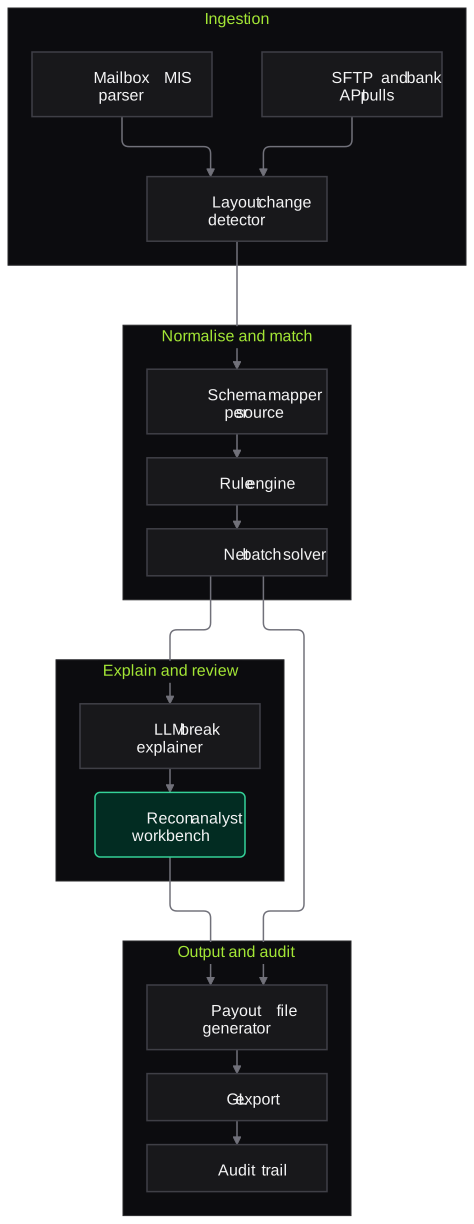
Architecture
- Ingestion
- SFTP and bank API pulls
- Mailbox parser for emailed MIS
- File layout change detector
- Normalisation
- Schema mapper per source
- Reference cleaner for UTR, RRN and ARN
- Matching
- Rule engine for one-to-one and one-to-many
- Net batch solver
- LLM break explainer
- Review
- Break workbench with ageing and owners
- Maker-checker approval for adjustments
- Output and audit
- Payout file generator
- GL posting export
- Audit trail
Inputs and outputs
Inputs
- Gateway or switch transaction logs
- Acquirer settlement reports and UPI settlement files
- Escrow account bank statements in MT940, CSV or PDF
- MDR and pricing schedule per merchant
- Refund and chargeback registers
- Emails and advices from partner banks
Outputs
- Matched transaction-to-settlement-to-credit records
- Explained and unexplained break lists with ageing
- Payout-ready merchant settlement file
- GL posting file
- Daily reconciliation summary for finance
Where people stay in control
Analysts approve every model-proposed explanation and every manual match, with maker-checker on write-offs and adjustments. Rule-based matches are sampled daily, and payouts are released by your treasury team, not by the engine.
Integrations
- Payment gateway or switch database
- Acquiring and partner bank SFTP or API
- Core ledger or ERP such as SAP, Oracle or Tally
- Merchant payout system
- BI tool such as Power BI or Metabase
Guardrails
- Model explanations are proposals only and never close a break without analyst approval
- Maker-checker on any adjustment or write-off
- Layout changes stop the affected file from auto-processing until a person confirms the mapping
- Every match records the rule or reviewer that made it
- Bank and merchant account numbers masked in logs
Compliance notes
- Supports the escrow reconciliation and audit trail that payment aggregators are expected to maintain under RBI directions.
- Payment data processed and stored in India, consistent with RBI's direction on storage of payment system data.
A typical pilot
Duration: 4 weeks
One acquirer and one UPI partner bank reconciled against your escrow statement for a recent historical month, followed by a short period of daily live runs.
Deliverables
- 01Source mappings for the pilot files
- 02Rule set for known fee, refund and chargeback patterns
- 03Break workbench with model explanations
- 04Comparison against your existing reconciliation output
- 05Production plan covering the remaining sources
What we measure
- Rule-based match coverage
- Transactions and credits matched by rules, compared with your current reconciliation for the same period.
- Explanation acceptance
- Model-proposed explanations accepted by analysts without changes.
- Break ageing
- Age profile of open breaks during the live period compared with the prior month.
- Analyst effort per day
- Timed effort to close the daily reconciliation, with and without the engine.
Built on related work
Claims reconciliation platform
Packaged-food brand (anonymised)
OCR and LLM platform that matches distributor claims spreadsheets against invoices and proofs, applies policy rules, detects duplicates, recalculates amounts, routes uncertain lines to an exception queue and keeps an audit trail. Finance keeps final approval.
FAQs
01Can it handle net settlements where fees are already deducted?
Yes. Net batch matching is central to the design. The engine rebuilds the expected net amount from transactions, MDR, GST and adjustments and compares it with the bank credit.
02What happens when an acquirer changes its file format?
The layout detector notices new, renamed or missing columns and holds that file until a person confirms the mapping. It does not guess silently.
03Is the language model making accounting entries?
No. Rules make deterministic matches, the model only proposes explanations for what remains, and an analyst approves them. GL and payout files are generated from approved matches only.
04Does this replace our existing reconciliation tool?
Not necessarily. It can run as a layer that works the breaks your current tool leaves, or as the primary engine for new sources. The pilot compares both options on your data.
Related use cases
- Fintech & Payments
Chargeback and Dispute Evidence Pack Assembly
Gather order, delivery, authentication and refund records for each chargeback, check them against the reason code and draft a representment pack for your disputes analyst.
- Fintech & Payments
Invoice and GST Data Extraction for B2B Payments
Extract GSTINs, HSN lines, tax splits and IRN data from supplier invoices before a B2B payment or invoice financing is released, with tax-logic and duplicate checks.
- Accounting, Audit & Consulting
Bank and Ledger Reconciliation
Match bank statements in any format against the cash book or ledger, explain unmatched items and produce a BRS the reviewer can tick through, with ambiguous matches held for a person.
- Retail, D2C & Quick Commerce
Vendor Invoice and Credit Note Reconciliation
Match vendor invoices, GRNs, RTVs and credit notes, recalculate what each vendor owes you from the agreements, and chase missing or short credit notes with evidence.

Founded by Akhilesh Mittal. 8 years building a security platform for a New Zealand company. IIT ISM Dhanbad and IMT Ghaziabad. Builds production agentic AI.
Pick one queue and test it on your own data
Book a discovery call. We will choose one workflow, such as merchant KYC review or dispute evidence, and scope a short pilot that runs alongside your current process.