AI Governance Evidence Pack for Banks
Inventory the bank's AI and ML systems and assemble the evidence boards, auditors and supervisors ask for: purpose, data, testing, monitoring, incidents and accountable owners.
- Industry:
- Banking
Who it is for
- Chief Risk Officer
- Chief Compliance Officer
- Head of Model Risk Management
- Head of Internal Audit
The problem
Most banks now run AI in more places than anyone has listed: credit scorecards, fraud models, chatbots, document extraction, vendor tools with embedded models and staff use of general-purpose assistants. Boards and auditors increasingly ask a question that is hard to answer: which AI systems do we run, who owns them, how were they tested and how do we know they still behave as intended.
No complete inventory
Models built by data science, bought from vendors or embedded in SaaS tools sit in different registers, and some are in none.
Evidence scattered across teams
Validation reports, data lineage, approval notes and monitoring dashboards live in separate folders and formats.
Generative AI outside existing model policy
Policies written for scorecards do not say how to test or monitor a chatbot, a retrieval system or a vendor language model.
Framework language that is hard to apply
Recommendations in RBI's FREE-AI framework, ISO/IEC 42001 and NIST AI RMF must be translated into specific controls and artefacts.
What we build
We build the evidence pack with your risk, compliance and technology teams. First we discover and inventory AI systems through questionnaires, procurement and architecture records and interviews, and classify each by use, customer impact and risk tier. A document intelligence pipeline reads existing model documentation, validation reports, vendor contracts and policies, and maps what exists to a control set drawn from FREE-AI recommendations, ISO/IEC 42001, NIST AI RMF and your model risk policy. Gaps are listed per system with an owner. Higher-risk generative AI systems receive targeted tests for leakage, bias and unsafe output, and the results join the pack. The output is a register your teams maintain.
- AI system discovery and inventory across in-house, vendor and embedded models
- Risk tiering by use case, customer impact, autonomy and data sensitivity
- Automated reading of model documents, validation reports and contracts against a control set
- Control mapping to FREE-AI recommendations, ISO/IEC 42001, NIST AI RMF and the bank's own policy
- Targeted testing of higher-risk generative AI systems for leakage, bias and unsafe output
- Gap register with owners, due dates and evidence links, exportable for audit
How it works
- 01Agree the control setWe combine your model risk policy with relevant framework recommendations into one control list approved by risk and compliance.
- 02Discover AI systemsQuestionnaires, procurement and architecture records and interviews identify AI systems and their owners.
- 03Collect and read evidenceExisting documents are ingested and mapped to controls, each mapping linked to its source passage.
- 04Tier and testSystems are risk-tiered, and higher-risk generative AI systems receive targeted tests.
- 05Review gaps with ownersModel owners and the model risk team confirm mappings and accept or dispute each gap.
- 06Publish the packThe register, evidence links and gap plan go to the risk committee and internal audit.

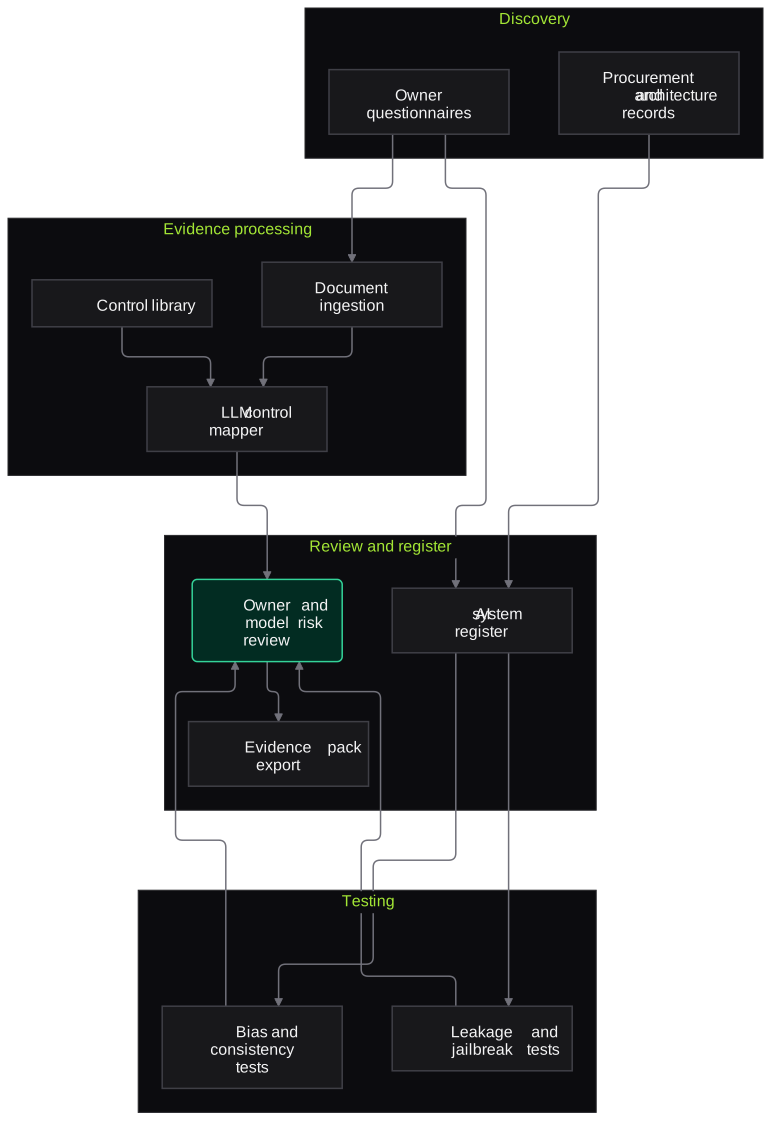
Architecture
- Discovery
- Owner questionnaires
- Procurement and architecture record review
- Interview notes capture
- Evidence processing
- Document ingestion for model documents, validations and contracts
- Control library combining frameworks and bank policy
- LLM control mapper with passage citations
- Testing
- Generative AI leakage and jailbreak tests
- Bias and output consistency tests
- Test evidence store
- Review
- Owner and model risk review workspace
- Gap acceptance and remediation tracking
- Register and reporting
- AI system register
- Committee-ready evidence pack export
Inputs and outputs
Inputs
- Model risk management policy and any existing model inventory
- Model documentation, validation and monitoring reports
- Vendor contracts and AI-related due diligence responses
- Architecture and procurement records
- Access to test environments for higher-risk generative AI systems
Outputs
- AI system register with owners, purpose and risk tier
- Control mapping with links to source evidence
- Gap register with owners and due dates
- Test reports for higher-risk generative AI systems
- Evidence pack for the board risk committee and auditors
Where people stay in control
Model owners, the model risk team and compliance confirm every mapping and gap; the pipeline proposes and people decide. The risk committee owns risk acceptance, and the pack states plainly where evidence is missing.
Integrations
- GRC platform or risk register
- Model registry or MLOps platform
- Document management and policy repositories
- Procurement and vendor management system
- Ticketing tool for remediation tracking
Guardrails
- Every control mapping linked to the exact passage it relies on
- Unsupported mappings recorded as gaps, never inferred
- Confidential documents processed in the bank's environment with role-based access
- Framework references described as alignment, not certification
- Version history for the register and evidence pack
Compliance notes
- Aligned with themes in RBI's FREE-AI framework (2025), a set of recommendations for responsible AI in financial services, and with ISO/IEC 42001 and NIST AI RMF.
- For EU-facing operations, helps prepare documentation expected under the EU AI Act, which treats credit scoring of individuals as high-risk.
- Does not certify compliance; the bank's own assessment and its auditors decide.
A typical pilot
Duration: 4 weeks
One business area, such as retail lending or digital channels, inventoried end to end, with evidence mapped for its AI systems and one generative AI system tested.
Deliverables
- 01Agreed control set
- 02AI system register for the pilot area
- 03Control mapping and gap register with evidence links
- 04Test report for one generative AI system
- 05Plan and effort estimate for bank-wide roll-out
What we measure
- Inventory completeness
- AI systems found compared with those in existing registers, confirmed with business owners.
- Mapping acceptance
- Control mappings accepted by owners and model risk as proposed, with changes or rejected.
- Evidence coverage per system
- Controls with linked evidence compared with controls applicable to each system's risk tier.
- Gap closure progress
- Gaps with an owner, due date and status, tracked through the pilot.
FAQs
01Is FREE-AI mandatory?
FREE-AI is a framework of recommendations released by RBI in 2025, not a binding regulation in itself. Many banks use it, alongside existing RBI directions on IT governance and outsourcing, to shape their AI policies and evidence.
02Will this certify us against ISO/IEC 42001?
No. Certification is carried out by accredited certification bodies. Our work organises evidence and closes gaps, which helps if you choose to pursue certification later.
03Does it cover vendor AI?
Yes. Vendor tools with embedded models are inventoried, contracts and due diligence responses are mapped to controls, and gaps such as missing testing rights are listed for procurement to address.
04How is confidential documentation protected?
Documents are processed in your environment or a tenancy you control, with role-based access. The language models we use do not retain or train on your data.
Related use cases
- Banking
Red-Teaming for Bank Chatbots and Voice Agents
Adversarial testing of bank chatbots and voice agents for prompt injection, data leakage, account-takeover social engineering and unsafe advice, in English, Hindi and Hinglish.
- Banking
Regulatory Return Preparation Assistant
Prepare RBI return workings from core banking and GL extracts, run validation and variance checks before upload, and draft explanations that reporting teams review and sign off.
- SaaS & AI Product Companies
EU AI Act and ISO/IEC 42001 Evidence Pack
Assemble testing records, risk assessments, oversight design and technical documentation for your AI features, mapped to EU AI Act and ISO/IEC 42001 requirements, ready for counsel and auditors.
- Fintech & Payments
DPDP-Aligned AI Data Handling Assessment
Map where personal data flows through your AI features, prompts, logs, vector stores and vendors, and get a gap register and evidence pack against DPDP Act duties for your DPO.

Founded by Akhilesh Mittal. 8 years building a security platform for a New Zealand company. IIT ISM Dhanbad and IMT Ghaziabad. Builds production agentic AI.
Pick one banking process and test it with evidence
Book a discovery call to choose a narrow pilot, from KYC file checks to voice-agent red-teaming, and see measured results on your own documents before any wider roll-out.