Question Bank Tagging and Generation
Turn years of DPPs, module books and past papers into a clean, syllabus-tagged question bank, remove duplicates and draft new variants that faculty check before any student sees them.
- Capability:
- Document Intelligence
- Industry:
- Education & Coaching
Who it is for
- Academic Head
- Head of Content (Edtech)
- Subject Faculty Lead
- Test Paper Setter
The problem
Most coaching institutes and edtech companies own a large question collection that is hard to use: daily practice problems in Word files, module books as PDFs, scanned previous-year papers and solutions typed by different faculty over many years. Building a balanced test means searching folders from memory, and the same question reappears under different numbering.
Untagged content
Questions lack consistent chapter, topic, difficulty and question-type tags, so test setters cannot filter by syllabus or balance a paper.
Equations and diagrams break on import
MathType objects, scanned figures and chemical structures do not survive copying into the test platform.
Hidden duplicates
The same question sits in several modules with small edits, so students see repeats and analytics double count.
New questions take faculty time
Writing fresh numericals and variants for every test series competes with teaching hours.
What we build
We build a content pipeline that ingests Word files, PDFs and scans, splits them into question, options, answer key and solution, and converts equations to LaTeX or MathML with figures kept as images. Each question is tagged against your syllabus tree, for example the published JEE Main or NEET-UG syllabus, with question type, a difficulty estimate and source. Near-duplicates are clustered for a faculty member to merge. For generation, faculty pick a question and ask for variants; the system changes values or context, re-derives the answer with a solver where possible and queues every draft for review. Nothing reaches students without faculty approval.
- Splits mixed documents into question, options, answer key and worked solution
- Converts equations to LaTeX or MathML and keeps diagrams as linked images
- Tags syllabus chapter, topic, question type, difficulty estimate and source
- Clusters near-duplicate questions across modules and years for faculty to merge
- Drafts numerical and conceptual variants, with answers re-derived by a solver where possible
- Exports to your test platform in its import format, such as Excel, QTI or API
How it works
- 01Ingest contentWord files, PDFs, scanned papers and existing platform exports are loaded subject by subject.
- 02Split and convertEach item is separated into its parts, and equations and figures are converted into a format the test platform can render.
- 03Tag and de-duplicateQuestions are tagged against your syllabus tree and near-duplicates are clustered.
- 04Verify answers and tagsLow-confidence tags, missing keys and answers the solver disagrees with are queued for faculty.
- 05Faculty reviewSubject faculty correct tags, merge duplicates and approve or reject generated variants.
- 06Publish to the bankApproved questions are pushed to the test platform with full metadata and source history.

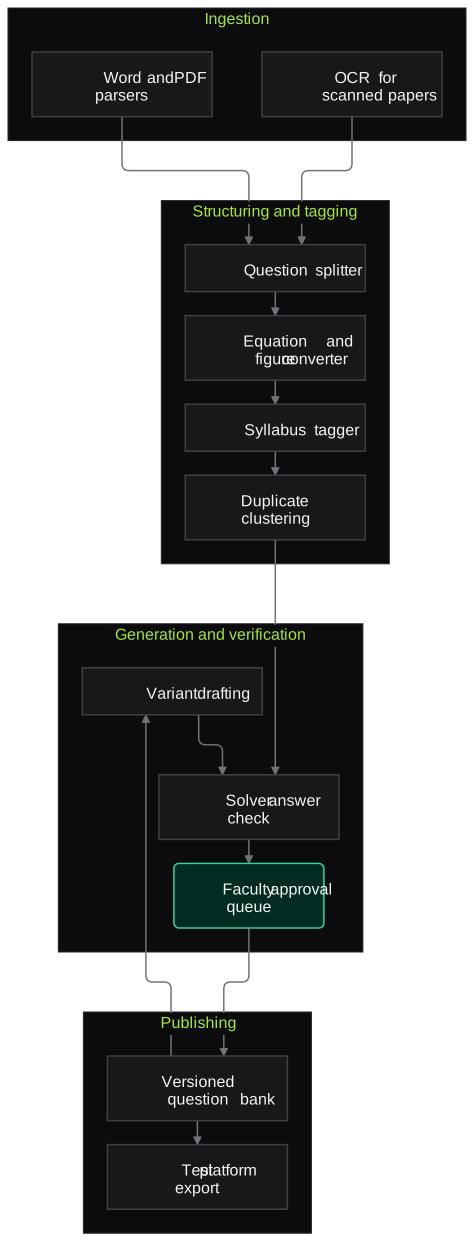
Architecture
- Ingestion
- Word and PDF parsers with MathType handling
- OCR for scanned papers
- Reader for existing test-platform exports
- Structuring
- Question, option, key and solution splitter
- Equation to LaTeX or MathML converter
- Figure extraction and linking
- Tagging and quality
- Syllabus-tree tagger
- Difficulty and question-type classifier
- Near-duplicate clustering
- Answer verification with a symbolic solver
- Generation
- Variant drafting from approved seed questions
- Solver re-derivation of answers
- Faculty approval queue
- Publishing
- Test platform export in Excel, QTI or API format
- Version history and source tracking
Inputs and outputs
Inputs
- DPPs, assignments and module books in Word or PDF
- Scanned previous-year papers and solutions
- Your syllabus tree and tagging conventions
- Existing question exports from the test platform
- Seed questions chosen by faculty for variant generation
Outputs
- Structured question bank with LaTeX or MathML and figures
- Syllabus, type, difficulty and source tags
- Duplicate clusters with merge decisions
- Faculty-approved variants with worked answers
- Import files or API pushes for your test platform
Where people stay in control
Subject faculty approve tag corrections, duplicate merges and every generated question before it enters the live bank. Difficulty tags start as estimates and are updated from real student attempt data once tests run.
Integrations
- Online test or assessment platform
- LMS or content management system
- Shared drives holding faculty Word files
- Equation editors and LaTeX rendering
- Analytics warehouse for attempt data
Guardrails
- Generated questions remain drafts until a named faculty member approves them
- Answers rechecked with a solver; disagreements go to faculty
- Source recorded for every question so third-party copyrighted material can be identified and excluded
- No student data used for generation
- Version history kept so any change can be traced and reversed
Compliance notes
- Questions drawn from published books or other institutes' material may be protected by copyright; the source tag helps your team decide what can be reused.
A typical pilot
Duration: 4 weeks
One subject for one exam, for example JEE Main physics, using one module series and its matching previous-year papers.
Deliverables
- 01Syllabus tree and tagging rules agreed with faculty
- 02Structured, tagged bank for the pilot subject
- 03Duplicate cluster report
- 04Set of generated variants with faculty review outcomes
- 05Import into your test platform and a roll-out plan
What we measure
- Tag accuracy
- Faculty review of a random sample of tagged questions per chapter.
- Duplicates found
- Clusters confirmed by faculty as true duplicates or near-duplicates.
- Variant acceptance
- Generated variants approved, edited or rejected by faculty, with reasons.
- Rendering errors on import
- Questions that display incorrectly in the test platform after import.
FAQs
01Will generated questions be accurate?
Not always, which is why none are published without faculty review. Numerical answers are re-derived with a solver where possible, and any disagreement is flagged. The pilot reports how many drafts faculty accepted, edited or rejected.
02Can it handle chemistry structures and physics diagrams?
Diagrams and structures are extracted as images linked to the question, and equations become LaTeX or MathML. Complex figures can be redrawn later, but nothing is lost in conversion.
03Do we keep ownership of our content?
Yes. The bank, tags and generated questions belong to you and are stored in your environment. We use models that do not train on your data.
04Can we use our own syllabus structure?
Yes. We map to your chapter and topic tree, whether that follows the JEE or NEET syllabus, a state board or your own module order.
Related use cases
- Education & Coaching
Handwritten Answer Digitisation
Transcribe handwritten answer booklets in English and Hindi, including equations and diagrams, into searchable text split by question, so evaluators mark on screen and students get real feedback.
- Education & Coaching
Safety Testing for Student-Facing AI Tutors
Red-team your AI tutor or doubt-solving bot before students use it: unsafe content, jailbreaks, confidently wrong answers, integrity bypasses and leaks of other students' data.
- Education & Coaching
Answer Sheet and OMR Evaluation Assistance
Read OMR sheets and the marks grid on answer-booklet covers from ordinary scans or phone photos, apply the right answer key and send every doubtful mark to the exam cell.

Founded by Akhilesh Mittal. 8 years building a security platform for a New Zealand company. IIT ISM Dhanbad and IMT Ghaziabad. Builds production agentic AI.
Start with one test cycle or one admission season
Tell us where the backlog is worst, whether that is test evaluation, admission documents or parent calls. We will scope a short pilot on your own data and walk you through what it found before any wider roll-out.