Handwritten Answer Digitisation
Transcribe handwritten answer booklets in English and Hindi, including equations and diagrams, into searchable text split by question, so evaluators mark on screen and students get real feedback.
- Industry:
- Education & Coaching
Who it is for
- Head of Evaluation
- Academic Director
- Answer-Writing Programme Lead
- University Examination Branch Officer
The problem
Subjective answers still dominate board-pattern school exams, university semester papers and civil-services answer-writing programmes. The booklets are handwritten, often in Hindi or a mix of scripts, and once marked they sit in storerooms, so evaluators cannot search them, moderators cannot sample them easily and students rarely get feedback beyond a number.
Evaluators juggle paper
Booklets move between centres, evaluators and moderators by hand, and pages get misplaced or marked out of order.
Feedback is thin
With hundreds of copies to check, evaluators write a mark and a word or two, which does little for a student preparing for the next attempt.
Handwriting and scripts vary
Cursive English, Devanagari, mixed-language answers, equations and labelled diagrams defeat generic OCR.
Answers cannot be compared
Copied or memorised template answers across students are hard to spot when every answer exists only on paper.
What we build
We build a pipeline that turns scanned or photographed answer booklets into structured, searchable transcripts. It detects question numbers and splits each booklet into answers, transcribes handwriting in English and Hindi, converts equations to LaTeX and keeps diagrams as image crops beside the text. Lines the model is unsure about are marked rather than guessed, and a transcription checker resolves them against the image. Evaluators then mark on screen with the original page and transcript side by side, can see where expected rubric points appear to be addressed, and write feedback that reaches the student through your app or LMS.
- Question-number detection that splits booklets into answers, even when students skip or reorder questions
- Handwriting recognition for English and Hindi with line-level confidence
- Equation transcription to LaTeX, with diagram crops kept alongside the answer
- Side-by-side on-screen view of the original page and transcript for evaluators
- Optional rubric hints showing where expected points appear, which evaluators can ignore
- Similarity check across answers in the same test to surface possible copying for review
How it works
- 01Scan bookletsBooklets are scanned at the centre, or photographed by students in remote answer-writing programmes, and grouped by roll number and paper.
- 02Split by questionQuestion numbers and page breaks are detected so each answer becomes its own record.
- 03TranscribeHandwriting, equations and diagrams are converted, with a confidence score for every line.
- 04Check uncertain linesLow-confidence lines are queued for a transcription checker, who corrects them against the image.
- 05Evaluate on screenThe evaluator marks each answer with the original and transcript side by side and writes feedback.
- 06Return and archiveMarks and feedback go to the student via the app or LMS, and transcripts are indexed for moderation and search.

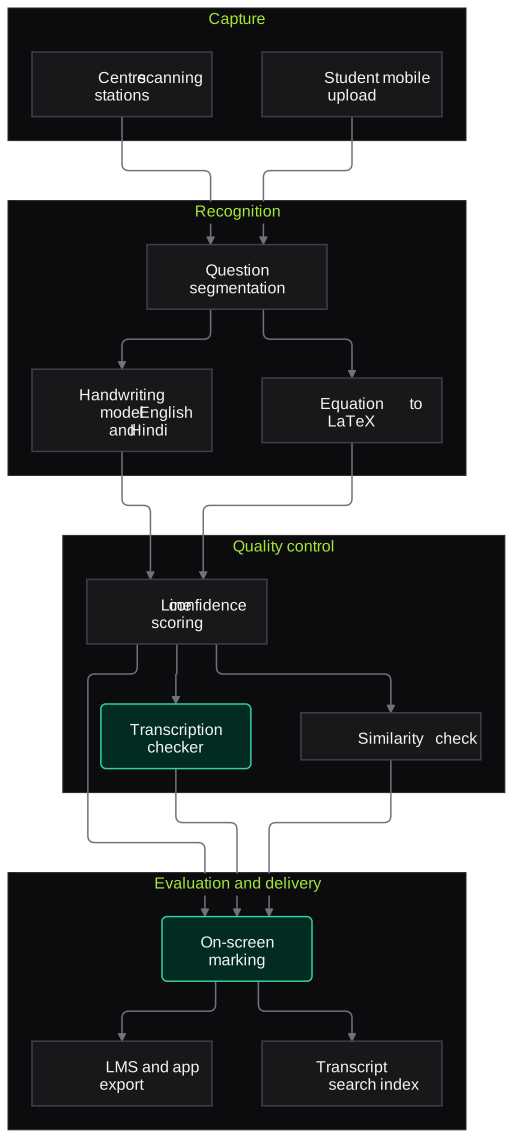
Architecture
- Capture
- Centre scanning stations
- Student mobile upload for answer-writing programmes
- Booklet grouping by roll number and paper
- Recognition
- Page and question segmentation
- Handwriting model for English and Devanagari
- Equation to LaTeX converter
- Diagram region detector
- Quality control
- Line-level confidence scoring
- Transcription checker queue
- Cross-answer similarity check
- Evaluation
- On-screen marking view
- Rubric and feedback templates
- Moderation sampling
- Delivery and storage
- LMS and student app export
- Search index over transcripts
- Retention and access controls
Inputs and outputs
Inputs
- Scanned answer booklets or student-uploaded photos
- Question paper with question numbering
- Marking scheme or model-answer rubric
- Student roster with roll numbers
- Language and script of the paper
Outputs
- Answer-wise transcripts with line confidence
- LaTeX for equations and image crops for diagrams
- Evaluator marks and written feedback
- Similarity report for possible copying
- Searchable archive for moderation and re-evaluation
Where people stay in control
Transcription checkers confirm every low-confidence line, and evaluators award all marks; rubric hints are suggestions only. Similarity flags are reviewed by the academic head before any conclusion is drawn about copying.
Integrations
- LMS such as Moodle or Google Classroom
- Institute ERP or examination management system
- Student mobile app for answer-writing programmes
- Document scanners and network storage
- Single sign-on for evaluators
Guardrails
- The system never awards or suggests a numeric mark
- Uncertain lines are flagged, never silently completed
- Evaluators see the original page next to every transcript
- Similarity flags are prompts for review, not proof of copying
- Booklet images and transcripts stored with role-based access and an agreed retention period
Compliance notes
- Answer booklets of school students are children's data under the DPDP Act 2023; processing should be limited to evaluation and feedback, with appropriate consent.
- The evidence trail supports re-evaluation and moderation processes.
A typical pilot
Duration: 4 weeks
One subject paper, or one week of an answer-writing programme, with transcripts checked against the original booklets by your evaluators.
Deliverables
- 01Segmentation and transcription set up for your booklet format
- 02Transcription checker and on-screen marking screens
- 03Accuracy report by script, handwriting quality and content type
- 04Evaluator feedback on the marking workflow
- 05Roll-out plan and cost estimate
What we measure
- Line transcription accuracy
- Character and word error rates on a sample checked against the booklets, reported separately for English, Hindi and equations.
- Share of lines sent to checkers
- Lines below the confidence threshold per booklet.
- Evaluator time per booklet
- Timed on paper and on screen for comparable booklets.
- Feedback usefulness
- Feedback captured per answer, plus a short student survey on whether it helped.
FAQs
01Can it read Hindi and mixed Hindi-English answers?
Yes. Devanagari and English are supported, including answers that switch between them. Accuracy depends on handwriting and scan quality, so the pilot reports results separately by script.
02Does AI give the marks?
No. Evaluators mark every answer. The system transcribes, organises and can point to where rubric points appear, but the evaluator decides.
03What happens to diagrams and maths?
Equations are converted to LaTeX for display and search, and diagrams are kept as image crops next to the transcript, so the evaluator always sees what the student drew.
04Can students upload photos instead of scanned booklets?
Yes. Answer-writing programmes often run on phone photos. The pipeline corrects perspective and lighting, and asks the student to re-upload any page it cannot read.
Related use cases
- Education & Coaching
Answer Sheet and OMR Evaluation Assistance
Read OMR sheets and the marks grid on answer-booklet covers from ordinary scans or phone photos, apply the right answer key and send every doubtful mark to the exam cell.
- Education & Coaching
Question Bank Tagging and Generation
Turn years of DPPs, module books and past papers into a clean, syllabus-tagged question bank, remove duplicates and draft new variants that faculty check before any student sees them.
- Education & Coaching
Parent Progress Update Automation
Send each parent a short WhatsApp update on attendance, test results and homework in their language, with mentor review for sharp drops or absences and replies routed to the right teacher.

Founded by Akhilesh Mittal. 8 years building a security platform for a New Zealand company. IIT ISM Dhanbad and IMT Ghaziabad. Builds production agentic AI.
Start with one test cycle or one admission season
Tell us where the backlog is worst, whether that is test evaluation, admission documents or parent calls. We will scope a short pilot on your own data and walk you through what it found before any wider roll-out.