Answer Sheet and OMR Evaluation Assistance
Read OMR sheets and the marks grid on answer-booklet covers from ordinary scans or phone photos, apply the right answer key and send every doubtful mark to the exam cell.
- Industry:
- Education & Coaching
Who it is for
- Controller of Examinations
- Exam Cell Head
- Academic Operations Manager (Coaching)
- Centre Director
The problem
A coaching institute running weekly tests, or a school holding term exams, may process thousands of OMR sheets and answer booklets in a few days. Dedicated OMR machines need special paper and careful handling, and the totalling of subjective marks on booklet covers is still done by hand, so errors surface only when a student asks for a re-check.
Sheets that machines reject
Sheets printed on ordinary paper, folded in transit or photographed at a satellite centre fail on hardware readers and end up being checked by hand.
Ambiguous bubbles decide ranks
Double-filled, faint, erased or ticked bubbles are scored inconsistently, and in a negative-marking test one misread answer can move a student several places in the batch rank list.
Wrong roll number or paper set
Students bubble the wrong roll number or test booklet series, so the sheet is matched to the wrong student or scored against the wrong key.
Totalling errors on subjective papers
Examiners write question-wise marks on the booklet cover, and addition or carry-forward mistakes are a common cause of re-evaluation requests and complaints.
What we build
We build an evaluation assistant that reads OMR sheets and booklet cover pages from a standard document scanner or a phone camera. It finds the sheet's anchor marks, corrects skew and reads roll number, paper set and every answer bubble, including the integer-type answer grids used in JEE-style tests. Each bubble gets a fill score, so a faint or double-filled mark is shown to the exam cell instead of being silently scored. For subjective papers it reads the handwritten question-wise marks grid, recomputes the total and flags any mismatch. Scores are calculated with your marking scheme and published only after the exam cell signs off.
- Reads custom OMR layouts printed on ordinary paper, from flatbed or ADF scans and phone photos
- Detects double-filled, faint, erased and stray marks with a fill score for every bubble
- Validates roll number and paper set against the test roster before scoring
- Supports single-correct, multiple-correct, integer and matrix-match grids with negative and partial marking
- Reads handwritten question-wise marks on booklet covers and recomputes totals
- Keeps a cropped image of every flagged mark for re-checks and answer-key challenges
How it works
- 01Scan the sheetsCentres scan OMR sheets and booklet covers in batches on a document scanner, or capture them with a phone app where no scanner is available.
- 02Align and readThe system finds anchor marks, corrects skew and reads roll number, paper set and each bubble or marks-grid cell.
- 03Match to the rosterRoll numbers and paper sets are checked against the test roster so each sheet is tied to the right student and answer key.
- 04Flag doubtful marksAmbiguous bubbles, roster mismatches and totals that do not add up are queued with image crops for the exam cell.
- 05Exam cell resolvesStaff view each flagged crop, record a decision and the reason, and the decision is logged against the sheet.
- 06Score and publishScores, section-wise marks and batch ranks are computed with your marking scheme and released to the ERP after the controller approves.

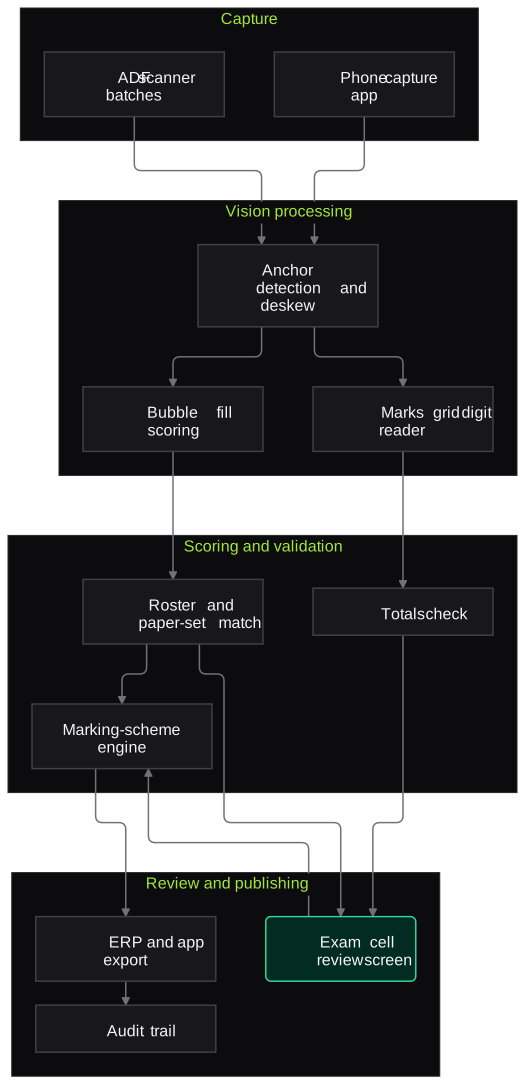
Architecture
- Capture
- Batch import from ADF scanners
- Phone capture app for satellite centres
- Sheet template registry per test format
- Vision processing
- Anchor detection and perspective correction
- Bubble fill scoring model
- Handwritten digit reader for marks grids
- Scoring and validation
- Roster and paper-set matcher
- Marking-scheme engine with negative and partial marking
- Totals and consistency checks
- Review
- Exam cell review screen with image crops
- Decision and reason log
- Publishing and audit
- ERP and student app export
- Re-check and answer-key challenge records
- Audit trail per sheet
Inputs and outputs
Inputs
- Scanned or photographed OMR sheets
- Answer-booklet cover pages with question-wise marks
- Answer keys for each paper set
- Marking scheme, including negative and partial marking rules
- Test roster with roll numbers and batches
Outputs
- Student-wise and section-wise scores
- Batch and centre rank lists for internal use
- Queue of flagged marks with image crops and decisions
- Totalling mismatch report for subjective papers
- Audit trail for re-check requests
Where people stay in control
Exam cell staff decide every ambiguous bubble, roster mismatch and totalling discrepancy by looking at the original crop. The controller of examinations approves results before they are published, and answer-key challenges are decided by subject faculty.
Integrations
- Institute ERP or student information system
- Online test or result portal (via API or CSV import)
- Student and parent mobile app
- Document scanners with network folder output
- Cloud storage for sheet images
Guardrails
- No bubble is scored when its fill score falls in the ambiguous band; it goes to a person
- Roster mismatches block scoring until resolved
- Results stay in draft until the controller approves
- Sheet images kept for an agreed period to support re-checks, then deleted
- A periodic sample of auto-read sheets is re-checked by hand
Compliance notes
- Scores and sheet images of learners under 18 are children's personal data; designed to support DPDP Act 2023 consent, purpose limitation and retention requirements.
- The audit trail helps the institution show how a disputed score was arrived at.
A typical pilot
Duration: 3 weeks
One recurring test series, for example a weekly JEE or NEET pattern test at two centres, read in parallel with your current OMR process or manual checking.
Deliverables
- 01Templates set up for your OMR and booklet cover formats
- 02Working pipeline on real sheets from the pilot tests
- 03Exam cell review screen
- 04Comparison report against your existing scores
- 05Roll-out plan with hardware and cost estimate
What we measure
- Bubble read accuracy
- Compared with manual checking on a sample of sheets from each test.
- Share of sheets needing review
- Count of sheets with at least one flagged mark, by centre and capture method.
- Totalling discrepancies found
- Mismatches flagged on booklet covers and confirmed by the exam cell.
- Time from test to result
- Measured from the last sheet scanned to controller approval, before and during the pilot.
FAQs
01Do we need special OMR paper or a dedicated OMR machine?
No. The system is designed for sheets printed on ordinary paper and captured on a document scanner or a phone. Print quality and capture conditions still matter, so the pilot reports accuracy separately for each capture method.
02How are faint or double-filled bubbles handled?
Every bubble gets a fill score. Clear marks are scored automatically; anything in the ambiguous band is shown to the exam cell with the image crop, and the decision and reason are logged.
03Can it handle our marking scheme and question types?
Yes. Single-correct, multiple-correct with partial marking, integer or numerical-value grids, matrix-match and section-wise negative marking are configured per test, not hard-coded.
04Will this replace our examiners for subjective papers?
No. Examiners still mark the answers. The system reads the marks they write on the cover page, recomputes totals and flags mismatches before results go out.
Related use cases
- Education & Coaching
Handwritten Answer Digitisation
Transcribe handwritten answer booklets in English and Hindi, including equations and diagrams, into searchable text split by question, so evaluators mark on screen and students get real feedback.
- Education & Coaching
Online Test Proctoring Assistance
Flag possible malpractice in remote tests from webcam frames and browser events, so a trained proctor reviews short evidence clips and decides, rather than software disqualifying students.
- Education & Coaching
Parent Progress Update Automation
Send each parent a short WhatsApp update on attendance, test results and homework in their language, with mentor review for sharp drops or absences and replies routed to the right teacher.

Founded by Akhilesh Mittal. 8 years building a security platform for a New Zealand company. IIT ISM Dhanbad and IMT Ghaziabad. Builds production agentic AI.
Start with one test cycle or one admission season
Tell us where the backlog is worst, whether that is test evaluation, admission documents or parent calls. We will scope a short pilot on your own data and walk you through what it found before any wider roll-out.