Warranty Claim Document Processing
Pre-check dealer warranty claims before OEM submission: extract job card, VIN, odometer, labour and parts data, test it against policy and flag gaps for the warranty desk.
- Industry:
- Automotive & Mobility
Who it is for
- Dealer Warranty Manager
- OEM Warranty Operations Head
- After-Sales Quality Engineer
- Dealer Service Manager
The problem
Every warranty repair ends in a claim pack: the repair order, technician notes, labour operation codes, causal part, failed-part photos, odometer and VIN photos and often a diagnostic report. OEMs reject or debit claims for missing photos, mismatched VINs, labour beyond standard time or coverage that had already lapsed, and dealers usually find out only after submission.
Avoidable rejections
Claims bounce for missing odometer photos, unclear failure descriptions or wrong labour codes that could have been caught at the dealer.
Debits after audit
Paid claims that are later audited can be debited back when evidence is thin, hitting dealer margins long after the repair.
Inconsistent failure narratives
Technicians describe the same fault in different words, so complaint, cause and correction rarely line up with the causal part.
Patterns hidden in volume
On the OEM side, repeat repairs on the same VIN, unusual labour times or duplicate claims are hard to spot one claim at a time.
What we build
We build a warranty claim assistant that pulls the job card and invoice from your DMS along with photos and diagnostic reports. It extracts VIN, odometer, repair dates, labour operation codes, causal and consequential parts and technician notes, and reads the VIN and odometer photos to confirm they match. Rules configured from the OEM warranty manual check coverage period, mileage, part eligibility, campaign applicability and standard labour times. The technician's notes are structured into complaint, cause and correction without adding facts. Gaps and rule failures go to the warranty manager, who approves every pack before it leaves as a portal-ready claim with an evidence index.
- Extracts VIN, odometer, repair dates, labour operation codes and parts from job cards and invoices
- Reads VIN and odometer photos and checks them against the job card
- Checks coverage period, mileage, part eligibility, campaigns and standard labour times from the OEM manual
- Structures technician notes into complaint, cause and correction, using only what the notes say
- Flags missing photos, duplicate claims and repeat repairs on the same VIN
- Prepares a portal-ready claim pack and tracks OEM responses and rejection codes
How it works
- 01Collect the claim packJob card, invoice, failed-part photos, VIN and odometer photos and diagnostic reports are pulled from the DMS and upload folders.
- 02Extract and readFields are extracted from documents, and VIN and odometer values are read from photos.
- 03Check policy and consistencyRules test coverage, mileage, part eligibility, campaign status and labour times, and cross-check documents against each other.
- 04Warranty manager reviewClaims with gaps go to the warranty manager to fix, justify or hold, and every pack is approved before submission.
- 05Submit to the OEMApproved claims are submitted through the OEM warranty portal, by API where available.
- 06Learn from responsesApprovals, rejections and debit reasons are tracked and used to tune the pre-checks.

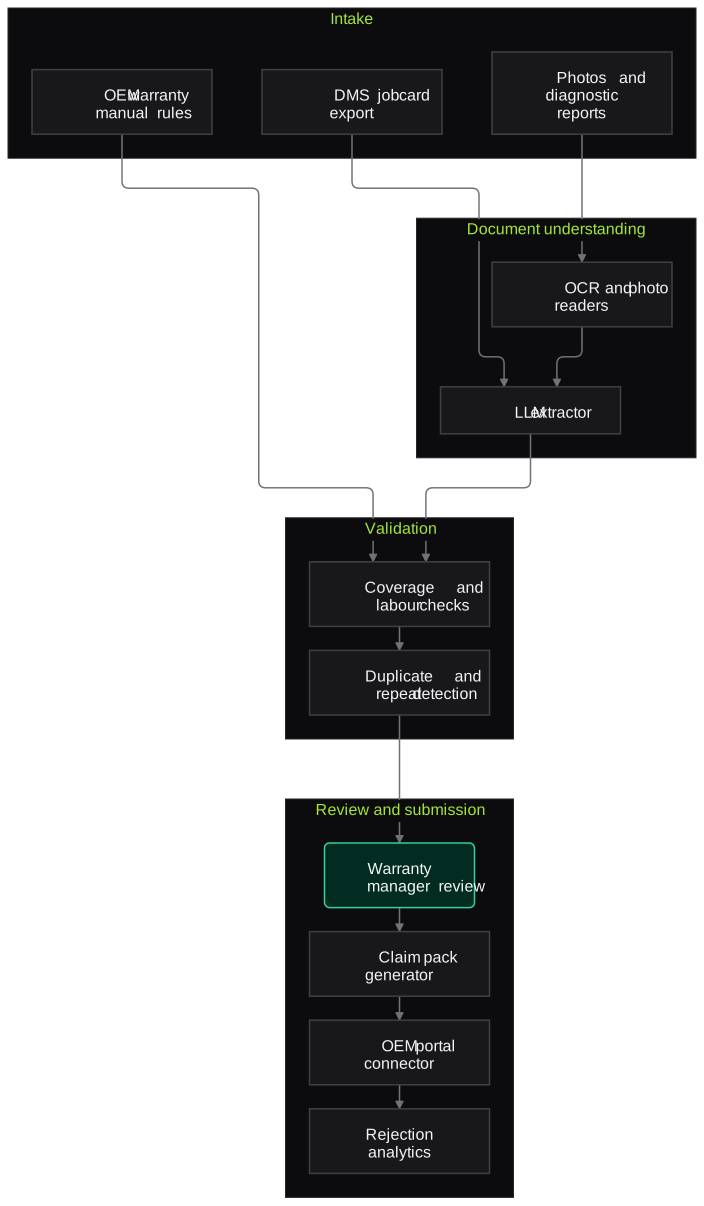
Architecture
- Intake
- DMS job card and invoice export
- Photo and diagnostic report upload
- OEM warranty manual and labour time standards
- Document understanding
- OCR and layout parsing
- VIN and odometer photo readers
- LLM extractor and narrative structurer
- Validation
- Coverage and mileage rules
- Labour time and campaign checks
- Duplicate and repeat repair detection
- Review and submission
- Warranty desk review screen
- Claim pack generator
- OEM portal connector
- Rejection analytics
Inputs and outputs
Inputs
- Repair order or job card with technician notes
- Tax invoice for parts and labour
- Failed-part photos and part tags
- VIN and odometer photos
- Diagnostic tool reports with fault codes
- OEM warranty manual, labour time standards and campaign lists
Outputs
- Portal-ready claim pack with evidence index
- Pre-submission flags and reasons
- Structured complaint, cause and correction
- Rejection and debit reason analytics
- Audit trail of checks and edits
Where people stay in control
The warranty manager reviews every flagged claim and approves each pack before submission. On the OEM side, warranty analysts make every approval and rejection decision; the system prepares and flags.
Integrations
- Dealer management system
- OEM warranty portal, by API or controlled browser automation where the OEM permits
- Diagnostic tool report exports
- Parts return and logistics tracking
- BI or reporting tools
Guardrails
- Policy rules taken from the current OEM manual and version-controlled
- Narratives structured only from technician notes, with no facts added
- Photo reuse and tamper checks across claims
- Nothing submitted without warranty manager approval
- Full audit trail for OEM warranty audits
Compliance notes
- Customer names and contact details on job cards handled under the DPDP Act 2023.
- Keeps the evidence trail dealers need when OEM warranty audits review paid claims.
A typical pilot
Duration: 4 weeks
One dealer group's warranty claims for one brand, including a backtest on recently rejected claims and live pre-checks on new claims.
Deliverables
- 01Rule set built from the OEM warranty manual
- 02Extraction and pre-check pipeline on your claims
- 03Warranty desk review screen
- 04Backtest report comparing flags with actual OEM rejection reasons
- 05Roll-out plan for other brands and branches
What we measure
- Flag agreement with OEM outcomes
- Backtest of pre-check flags against the rejection and debit reasons the OEM actually gave.
- Claim preparation time
- Time per claim at the warranty desk with and without the assistant.
- First-time acceptance
- Acceptance of pilot claims at first submission, tracked against the dealer's recent history.
- Reviewer edits
- Changes the warranty manager makes to extracted fields and narratives.
Built on related work
Claims reconciliation platform
Packaged-food brand (anonymised)
OCR and LLM platform that matches distributor claims spreadsheets against invoices and proofs, applies policy rules, detects duplicates, recalculates amounts, routes uncertain lines to an exception queue and keeps an audit trail. Finance keeps final approval.
FAQs
01Can it submit claims to our OEM's portal?
Where the OEM provides an API we use it. Otherwise the assistant prepares a portal-ready pack and, only where the OEM allows it, a controlled browser automation step enters the claim after approval.
02Can OEMs use this too?
Yes. On the OEM side, the same extraction and rules support warranty analysts reviewing incoming claims, with extra checks for duplicates, repeat repairs and unusual labour across the dealer network.
03Does it write the failure description for the technician?
It structures what the technician wrote into complaint, cause and correction and points out missing elements. It does not invent symptoms, causes or tests that are not in the notes.
04Our group handles several brands. Is that a problem?
No. Each brand's warranty manual becomes its own rule set, and the review screen shows which rules applied to each claim.
Related use cases
- Automotive & Mobility
Number Plate and Document Capture at Service Centres
Read number plates at the workshop gate, pull up the appointment and history from the DMS, and capture walk-around, dashboard and document photos into a pre-filled job card.
- Automotive & Mobility
Spare Parts Catalogue Matching from Photos
Identify spare parts from customer or mechanic photos by reading part numbers, matching catalogue images and filtering by vehicle fitment, then confirm stock and price before quoting.
- Automotive & Mobility
RC, Insurance and PUC Document Extraction
Extract and cross-check registration, chassis, owner, hypothecation and validity details from RC, insurance, PUC and fitness documents for used-car, fleet and onboarding teams.
- Retail, D2C & Quick Commerce
Distributor Trade Claims and Scheme Settlement
Read distributor claim sheets and proofs, apply scheme rules from your circulars, recalculate eligible amounts, catch duplicates and give finance a clean credit note sheet to approve.

Founded by Akhilesh Mittal. 8 years building a security platform for a New Zealand company. IIT ISM Dhanbad and IMT Ghaziabad. Builds production agentic AI.
Pick one showroom, workshop or claim queue to start
Book a discovery call and we will scope a short pilot on your own photos, documents or call recordings, with the measures agreed up front.