Produce Grading and Sorting
Grade fruit, vegetable and grain lots from camera images at collection centres and packhouses, with defect breakdowns and photo evidence that buyers, FPOs and farmers can all check.
- Capability:
- Computer Vision
- Industry:
- Agriculture & Agritech
Who it is for
- Packhouse Operations Manager
- FPO Procurement Head
- Quality Assurance Lead, Agri Sourcing
- Head of Supply, Agri Marketplace
The problem
At a collection centre or packhouse, grading decides what the farmer is paid and what the buyer accepts. It is often done by eye on a sample, by a grader who may be tired by the afternoon, and disputes over grade are settled by argument rather than evidence.
Inconsistent manual grading
Two graders can place the same lot of tomatoes or pomegranates in different grades, and the same grader drifts over a long shift.
Disputes with farmers and buyers
When a farmer questions a deduction or a buyer rejects a consignment, there is no record of what the lot actually looked like.
Slow sample analysis for grain
Counting broken, shrivelled, discoloured and foreign-matter grains in a wheat or chana sample by hand takes time at peak arrivals.
Grade specs that vary by buyer
Exporters, modern retail and processors each set their own size, colour and defect limits, which graders must remember.
What we build
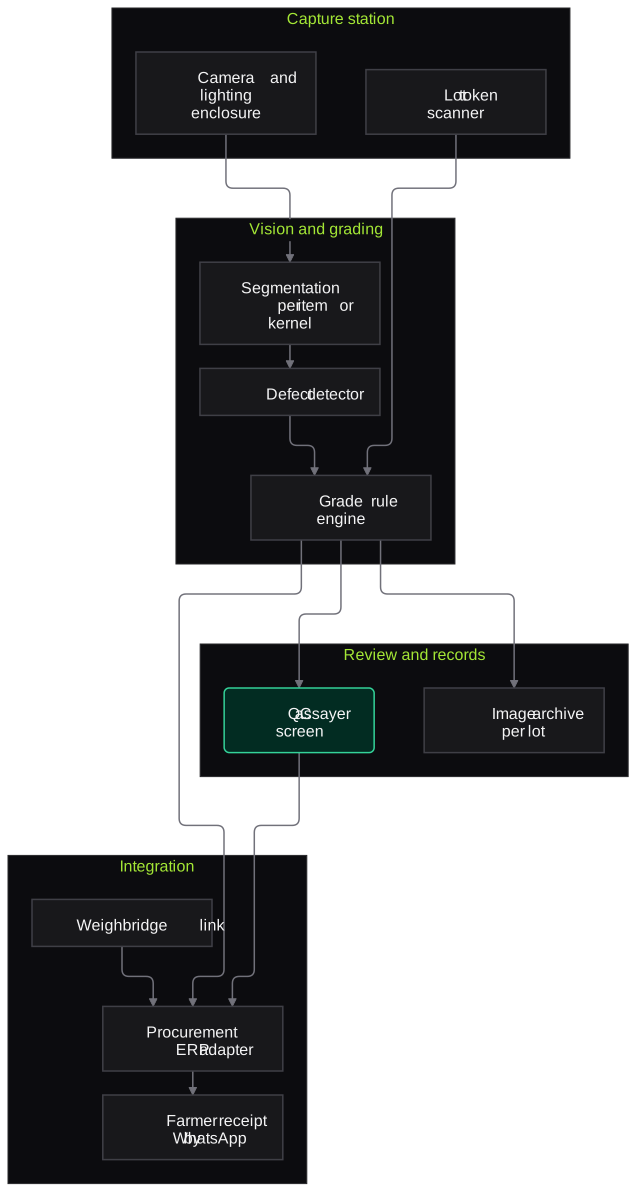
We build a vision-based grading station for sample trays or conveyor lines. A fixed camera under controlled lighting captures each sample or piece, and models measure size, shape, colour and surface defects such as bruises, cracks, rot and pest damage. For grain, the system counts and classifies kernels on a tray image, including broken, damaged and foreign matter. Grade rules are configured per commodity and buyer specification. Each lot gets a grade, a defect breakdown and stored images, linked to the farmer and weighbridge record. Borderline lots and disputes go to a QC assayer, who views the same images and can override the grade with a reason.
- Size, shape and colour measurement for fruit and vegetables
- Surface defect detection for bruising, cracks, rot and pest damage
- Kernel-level grain sample analysis for broken, damaged and foreign matter
- Configurable grade rules per commodity and buyer specification
- Lot-level grade record with stored images
- QC override with mandatory reason capture
How it works
- 01Capture the sampleThe operator places a sample on the tray or lets produce pass the conveyor camera, and scans the lot or farmer token.
- 02Measure and detect defectsModels measure each item or kernel and mark visible defects and foreign matter.
- 03Apply grade rulesMeasurements are compared with the commodity and buyer specification to produce a grade and defect breakdown.
- 04Check borderline lotsLots near a grade boundary, or with poor image quality, are flagged instead of being auto-graded.
- 05QC assayer reviewThe assayer reviews flagged lots and any farmer or buyer dispute using the stored images, and confirms or overrides the grade.
- 06Publish the resultThe grade and images are attached to the lot in the procurement system and shared with the farmer and buyer.

Architecture
- Capture station
- Fixed camera with diffuse lighting enclosure
- Conveyor or tray trigger
- Lot token or QR scanner
- Vision models
- Segmentation per fruit or kernel
- Defect detector
- Colour and size measurement
- Grading logic
- Commodity and buyer grade rule engine
- Borderline detection
- Review and records
- QC assayer review screen
- Image archive per lot
- Override log with reasons
- Integration
- Procurement or FPO ERP adapter
- Weighbridge data link
- Farmer receipt by SMS or WhatsApp
Inputs and outputs
Inputs
- Sample tray or conveyor images per lot
- Lot or farmer token and weighbridge record
- Commodity grade specifications from buyers, or AGMARK standards where used
- Reference images of each grade and defect, labelled by your QC team
Outputs
- Grade per lot with defect breakdown
- Stored images linked to each lot
- Borderline and dispute queue for QC
- Grade history by farmer, village and season
- Data export for payment calculation
Where people stay in control
QC assayers review every borderline lot and every dispute raised by a farmer or buyer, using the same stored images. Overrides require a reason, which is used to recalibrate grade rules and models.
Integrations
- Procurement or FPO ERP
- Weighbridge software
- Farmer payment system
- WhatsApp Business API or SMS gateway for farmer receipts
- Buyer portal or dispatch system
Guardrails
- Lighting and camera calibration check at the start of each shift
- Borderline lots never auto-graded
- All grade overrides logged with user and reason
- Periodic blind re-grading of sampled lots by QC staff
- Separate model versions per commodity, released only after QC sign-off
Compliance notes
- Where produce is graded under AGMARK, grade rules can be configured to the published grade standards, with the authorised grader keeping final responsibility.
- Images and farmer identifiers are stored with access controls and retention periods agreed with you.
A typical pilot
Duration: 4 weeks
One commodity at one collection centre or packhouse line, run in parallel with manual grading on the same lots.
Deliverables
- 01Imaging enclosure specification and setup
- 02Labelled reference set agreed with your QC team
- 03Working grading station for one commodity
- 04Comparison report against manual grades
- 05Plan for further commodities and sites
What we measure
- Agreement with QC grading
- Model grade compared with the QC assayer's grade on the same lots.
- Defect detection accuracy
- Defects marked by the model checked against a QC-labelled sample.
- Time per lot
- Grading time per lot measured with and without the station during peak arrivals.
- Disputes settled with images
- Count of farmer or buyer disputes where stored images were used to settle the grade.
FAQs
01Do we need special hardware?
A good industrial camera, or a high-end phone camera, in a simple lighting enclosure is usually enough for sample-tray grading. Conveyor lines need a fixed camera and a trigger. We specify the setup for your commodity during the pilot.
02Can it handle different buyers' grade specs?
Yes. Grade rules are configured per commodity and buyer, so the same images can be graded against an exporter's spec and a processor's spec. Your QC team approves every rule set.
03What about internal defects we cannot see?
Camera-based grading sees surface and shape only. Internal browning, hollow heart or insect damage inside the grain need other methods, and we say so clearly in the scope.
04Will farmers trust a machine grade?
Trust usually comes from transparency. Each farmer can be shown the images and defect marks for their lot, and disputes go to a human assayer who can override the grade.
Related use cases
- Agriculture & Agritech
Crop Disease Detection from Farmer Photos
Suggest likely diseases, pests and nutrient problems from farmer photos sent on WhatsApp or an app, reply in the farmer's language, and route uncertain or dose questions to an agronomist.
- Agriculture & Agritech
Warehouse Receipt and Quality Certificate Extraction
Extract and cross-check warehouse receipts, e-NWRs, quality certificates and stack details for commodity finance, so credit and collateral teams catch mismatches before disbursal.
- Agriculture & Agritech
Mandi Price and Procurement Voice Updates
Outbound and inbound voice updates on nearby mandi prices, procurement windows and pickup slots in the farmer's language, with every price dated and sourced, and offers approved by procurement.
- Manufacturing
Visual Quality Inspection on Production Lines
Cameras and vision models at the inspection station flag scratches, dents, missing features and print errors, divert clear rejects and hold borderline parts for an inspector.

Founded by Akhilesh Mittal. 8 years building a security platform for a New Zealand company. IIT ISM Dhanbad and IMT Ghaziabad. Builds production agentic AI.
Start with one crop, one district or one document type
Tell us the workflow that costs your field, agronomy or credit team the most time. We will scope a short pilot on your own photos, calls or files.