Warehouse Receipt and Quality Certificate Extraction
Extract and cross-check warehouse receipts, e-NWRs, quality certificates and stack details for commodity finance, so credit and collateral teams catch mismatches before disbursal.
- Capability:
- Document Intelligence
- Industry:
- Agriculture & Agritech
Who it is for
- Head of Commodity Finance
- Collateral Manager
- Credit Operations Manager, Agri NBFC
- Operations Head, Warehouse Service Provider
The problem
Loans against stored commodities depend on documents that must agree with each other: the warehouse receipt or e-NWR, the assayer's quality certificate, stack cards, insurance cover and the loan terms. When these are checked by hand, a mismatch in quantity, grade or validity date can slip through until there is a problem with the stock.
Documents that do not agree
Bag counts, net weight, variety or grade can differ between the receipt, the quality certificate and the stack card.
Validity and tenure gaps
Receipts or insurance that expire before the loan matures create exposure that is easy to miss.
Quality parameters buried in certificates
Moisture, foreign matter, damaged grains and other parameters appear in different layouts from different assayers.
Manual re-keying across systems
The same receipt data is typed into the loan system, the collateral register and the MIS.
What we build
We build a pipeline that reads each commodity finance file: physical or electronic warehouse receipts, quality certificates, stack cards, insurance policies and the borrower's loan request. It extracts receipt number, depositor, warehouse, commodity, variety, quantity, weight, quality parameters and validity dates. The system then matches documents against each other and against the loan terms, checking quantities, grade, lien status, insurance and expiry dates. Quality parameters are compared with the lender's acceptance norms for that commodity. Each check links to its source on the page. Clean files move to the loan system; mismatches and borderline quality results go to the collateral manager's exception queue, with an audit trail of every change.
- Extracts warehouse receipt, e-NWR and stack card fields
- Reads quality certificates from different assayers into one schema
- Matches quantity, weight, commodity and grade across documents
- Checks receipt, insurance and loan tenure dates
- Compares quality parameters with commodity acceptance norms
- Exception queue and audit trail for collateral managers
How it works
- 01Receive the finance fileReceipts, certificates, stack cards and insurance documents arrive from the warehouse provider, a repository statement or the borrower.
- 02Extract fieldsEach document is classified and its fields extracted with confidence scores and page references.
- 03Cross-match documentsQuantities, commodity, grade and dates are matched across all documents in the file.
- 04Check against loan termsValidity, insurance, lien status and quality parameters are compared with the loan request and acceptance norms.
- 05Exception reviewMismatches and borderline results go to the collateral manager, who confirms, corrects or rejects.
- 06Hand over to the loan systemStructured collateral data and the audit trail move to the loan and collateral systems.

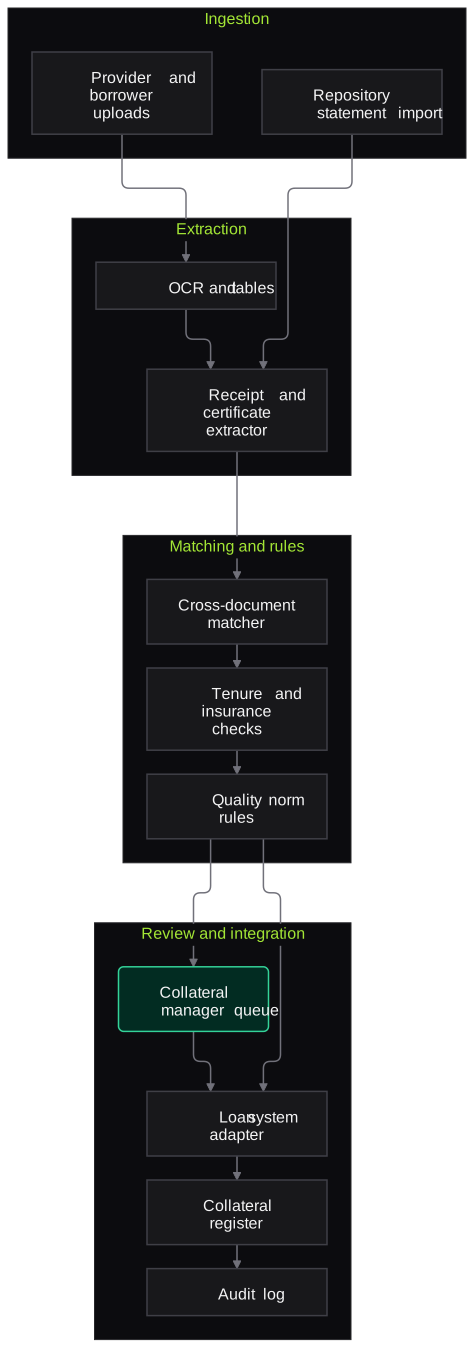
Architecture
- Ingestion
- Warehouse provider and borrower uploads
- Repository statement import, where available
- File grouping by loan request
- Extraction
- OCR with table detection
- Document classifier
- LLM extractor with receipt and certificate schemas
- Matching and rules
- Cross-document matcher
- Tenure and insurance date checks
- Commodity acceptance norm rules
- Review
- Exception queue with source highlights
- Reviewer decision capture
- Integration and audit
- Loan management system adapter
- Collateral register update
- Audit log
Inputs and outputs
Inputs
- Warehouse receipts or e-NWR details
- Assayer quality certificates
- Stack cards and deposit notes
- Insurance policies covering stored goods
- Loan request and commodity acceptance norms
Outputs
- Structured collateral record per receipt
- Cross-document match results
- Flags for tenure, insurance, lien and quality gaps
- Exception queue for collateral managers
- Audit trail of checks and edits
Where people stay in control
Collateral managers and credit officers review every mismatch, borderline quality result and expiry gap. Disbursal decisions and physical stock inspection remain with the lender and its collateral manager.
Integrations
- Loan management system
- Collateral or warehouse management system
- e-NWR repository statements, where the lender has access
- Document management system
- Insurance records
Guardrails
- No disbursal decision made by the system
- Acceptance norms configured and versioned by the credit team
- Every extracted value linked to its source page
- Alerts ahead of receipt or insurance expiry
- Sample-based review of auto-cleared files
Compliance notes
- Designed for lending against receipts issued by warehouses registered under the Warehousing (Development and Regulation) Act 2007 and regulated by WDRA.
- Keeps an audit trail that supports internal audit and RBI expectations on credit documentation.
A typical pilot
Duration: 3 weeks
Files for one or two commodities, such as wheat and chana, from a few warehouses, processed in parallel with your current checks.
Deliverables
- 01Extraction schemas for receipts and certificates
- 02Matching and norm rules agreed with credit
- 03Working pipeline and exception queue
- 04Accuracy and flag report on historic files
- 05Roll-out plan
What we measure
- Extraction accuracy
- Compared with values entered by credit operations for the same files.
- Mismatches caught
- Count of quantity, grade, date and insurance mismatches flagged and confirmed by collateral managers.
- False flags
- Flags the collateral manager marks as not an issue, tracked to tune rules.
- File processing time
- Timed on a sample of files with and without the pipeline.
Built on related work
Claims reconciliation platform
Packaged-food brand (anonymised)
OCR and LLM platform that matches distributor claims spreadsheets against invoices and proofs, applies policy rules, detects duplicates, recalculates amounts, routes uncertain lines to an exception queue and keeps an audit trail. Finance keeps final approval.
FAQs
01Does it work with electronic warehouse receipts?
Yes. It can read e-NWR details from repository statements or exports where your institution has access, and match them against the paper documents in the file.
02Can it replace physical stock inspection?
No. It checks that the documents agree and are valid. Physical verification by your collateral manager or warehouse auditor is still needed.
03How are different assayers' certificates handled?
Each certificate layout is mapped to one schema, so moisture, foreign matter and other parameters are compared the same way whichever assayer issued them. New layouts are added as they appear.
04Where does our data stay?
In your cloud account or an India region of a major cloud provider. Access is role-based, and models are configured not to retain or train on your data.
Related use cases
- Agriculture & Agritech
Land Record and KCC Loan Document Extraction
Read Khatauni, 7/12, Jamabandi and other land records plus KCC loan papers, extract holdings and crops, convert local area units, and flag mismatches before a credit officer sanctions.
- Agriculture & Agritech
Produce Grading and Sorting
Grade fruit, vegetable and grain lots from camera images at collection centres and packhouses, with defect breakdowns and photo evidence that buyers, FPOs and farmers can all check.
- Banking
Trade Finance Document Checking (LCs, Bills of Lading)
Examine LC presentations against the credit terms, UCP 600 and ISBP, and give trade operations a draft discrepancy list with every finding tied to a document and clause.
- NBFCs & Lending
Co-Lending and Portfolio File Audit
Check every loan file in a co-lending tranche, assignment pool or portfolio buyout against eligibility criteria and the loan system, listing missing documents and mismatches before money moves.

Founded by Akhilesh Mittal. 8 years building a security platform for a New Zealand company. IIT ISM Dhanbad and IMT Ghaziabad. Builds production agentic AI.
Start with one crop, one district or one document type
Tell us the workflow that costs your field, agronomy or credit team the most time. We will scope a short pilot on your own photos, calls or files.