Mandi Price and Procurement Voice Updates
Outbound and inbound voice updates on nearby mandi prices, procurement windows and pickup slots in the farmer's language, with every price dated and sourced, and offers approved by procurement.
- Industry:
- Agriculture & Agritech
Who it is for
- FPO CEO or Procurement Manager
- Head of Procurement, Agri Aggregator
- Commodity Sourcing Manager, Food Processor
- Operations Lead, Agri Marketplace
The problem
Farmers decide when and where to sell based on prices they hear from neighbours, commission agents or a trip to the mandi. FPOs and aggregators who want to buy directly spend hours on the phone confirming rates, quantities and pickup dates, and much of that information is stale by the time it reaches the farmer.
Price information arrives late or second-hand
Farmers often hear yesterday's rate, or a rate from a different mandi, and sell below what was available.
Procurement coordination by phone
Procurement staff call each farmer to confirm quantity, quality and pickup date, which does not scale in a busy week.
No-shows and missed slots
Farmers miss procurement windows or token slots because reminders never reached them in a form they understood.
Unclear offers
When the price offered depends on grade, moisture or deductions, misunderstandings turn into disputes at the gate.
What we build
We build a voice and WhatsApp agent that keeps farmers and FPO members informed about prices and procurement. Each morning it pulls modal, minimum and maximum prices for chosen commodities from public mandi data and your own buying rates, then calls or messages opted-in farmers in their language with the date and source stated. Farmers can call back and ask for the price at a named mandi. For procurement, the agent confirms expected quantity, quality and pickup or delivery slot, explains how grade and moisture affect the offer, and sends reminders. It quotes only rates the procurement manager has approved for that day, and hands disputes and negotiation to staff.
- Daily price pull from public mandi data and your own rate card
- Outbound calls and WhatsApp voice notes to opted-in farmers in their language
- Inbound price queries by commodity and mandi
- Procurement confirmation of quantity, quality and pickup slot
- Reminders for procurement windows and token slots
- Handover to procurement staff for disputes and negotiation
How it works
- 01Refresh prices and rate cardEach morning the system pulls public mandi prices and loads the draft buying rates for the day.
- 02Approve the day's offersThe procurement manager reviews the rate card and any unusual price movements before outreach starts.
- 03Call or message farmersOpted-in farmers receive a call or voice note with prices, dates and sources in their language.
- 04Confirm procurement detailsInterested farmers confirm expected quantity, quality and a pickup or delivery slot.
- 05Hand over exceptionsRequests for a different price, disputes and unclear answers go to procurement staff.
- 06Remind and recordFarmers get reminders before their slot, and every interaction updates the procurement plan.

Architecture
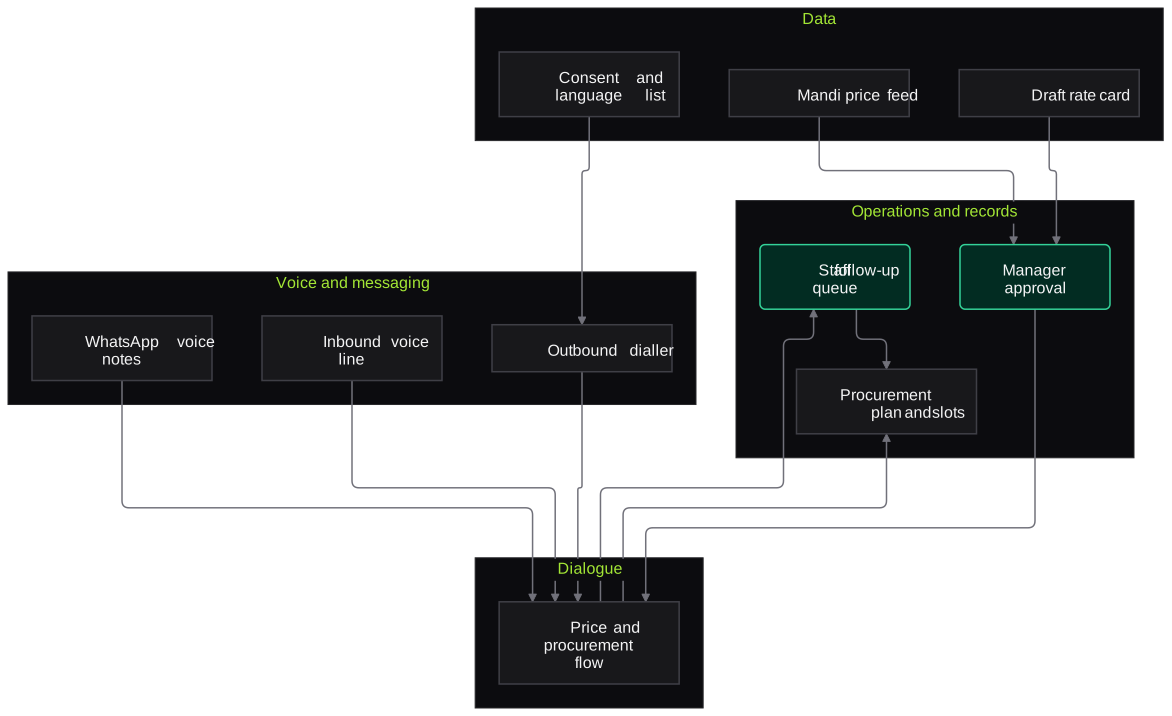
- Data
- Public mandi price feed connector
- Your buying rate card
- Farmer consent and language preferences
- Voice and messaging
- Outbound dialler with calling-window rules
- Inbound voice line
- WhatsApp voice notes and templates
- Dialogue
- Price lookup by commodity and mandi
- Procurement confirmation flow
- Grade and deduction explanations from approved text
- Operations
- Procurement manager approval screen
- Staff follow-up queue
- Records
- Procurement plan and slot calendar
- Interaction log per farmer
Inputs and outputs
Inputs
- Public mandi price data for chosen commodities and markets
- Daily buying rate card for procurement approval
- Farmer list with consent, language and location
- Procurement calendar and pickup capacity
- Grade and deduction rules in approved wording
Outputs
- Daily price calls and voice notes with date and source
- Confirmed quantities and pickup slots
- Reminders and no-show follow-ups
- Exception queue for procurement staff
- Interaction log per farmer
Where people stay in control
The procurement manager approves the day's buying rates before any outreach, and procurement staff handle every price negotiation, dispute or unclear confirmation. The agent never commits to a price outside the approved rate card.
Integrations
- Public mandi price sources such as Agmarknet or e-NAM data, where available
- FPO or procurement ERP
- Cloud telephony and dialler
- WhatsApp Business API
- Pickup and logistics scheduling tool
Guardrails
- Every spoken price includes its date, mandi and source
- Only approved rate-card prices quoted as offers
- Calls only to farmers who opted in, within agreed calling hours
- Stale or missing price data blocks outreach for that commodity
- Clear way to stop calls at any time
Compliance notes
- Outbound calling follows consent and calling-time practices aligned with TRAI's commercial communication rules.
- Farmer contact details and preferences are handled with consent and purpose limits under the DPDP Act 2023.
A typical pilot
Duration: 3 weeks
One or two commodities and a few hundred opted-in FPO members in one language, during an active procurement window.
Deliverables
- 01Price data connector and rate card approval screen
- 02Working outbound and inbound voice flows
- 03WhatsApp voice note templates
- 04Interaction and confirmation report
- 05Plan for more commodities and languages
What we measure
- Reach rate
- Share of opted-in farmers who answered a call or played a voice note.
- Confirmation accuracy
- Confirmed quantities and slots compared with what arrived at the collection point.
- Price data freshness
- Time between source price publication and farmer notification, logged per run.
- Staff time on coordination
- Procurement staff hours spent on confirmation calls, compared with a previous window.
FAQs
01Where do the prices come from?
Public mandi price sources where available, plus your own buying rates. The agent always says which mandi, which date and which source, and stops outreach for a commodity if the data is stale.
02Can it negotiate prices with farmers?
No. It shares approved rates and explains how grade and moisture affect them. Any negotiation or dispute goes to your procurement staff.
03Will farmers find automated calls intrusive?
Calls go only to farmers who opted in, at times they prefer, and every call explains how to stop them. Many farmers prefer a voice note they can replay over a long call.
04Does it work for FPOs without an ERP?
Yes. The procurement plan can live in a shared sheet or a lightweight database at first, and move into an ERP later.
Related use cases
- Agriculture & Agritech
Farmer Advisory Voice Helpline in Hindi and Regional Languages
A voice helpline that answers farmers' routine questions on sowing, irrigation, weather and schemes in Hindi and regional languages, and hands crop-protection and dose questions to agronomists.
- Agriculture & Agritech
Produce Grading and Sorting
Grade fruit, vegetable and grain lots from camera images at collection centres and packhouses, with defect breakdowns and photo evidence that buyers, FPOs and farmers can all check.
- Agriculture & Agritech
Agri-Input Dealer Order and Credit Automation
Take seed, fertiliser and crop-protection orders from dealers over WhatsApp and voice in Hinglish, check credit limits, schemes and stock, and route exceptions to sales and credit teams.
- Logistics & Supply Chain
Delivery Status Agent (Voice + WhatsApp)
Answer where-is-my-shipment calls and WhatsApp messages from consignees and shippers, arrange reschedules and NDR reattempts within your rules, and hand complaints and disputes to your team.

Founded by Akhilesh Mittal. 8 years building a security platform for a New Zealand company. IIT ISM Dhanbad and IMT Ghaziabad. Builds production agentic AI.
Start with one crop, one district or one document type
Tell us the workflow that costs your field, agronomy or credit team the most time. We will scope a short pilot on your own photos, calls or files.