Safety Testing for Farm Advisory Chatbots
Test farm advisory chatbots and voice bots in Hindi and regional languages for harmful or wrong advice: invented doses, unregistered products, overconfident diagnoses, scheme errors and data leaks.
- Capability:
- AI Security & Compliance
- Industry:
- Agriculture & Agritech
Who it is for
- CTO, Agritech Company
- Head of Agronomy
- Product Manager, Farmer Advisory Bot
- Programme Lead, Digital Agriculture Initiative
The problem
Agritech companies and public programmes are putting LLM chatbots and voice bots in front of farmers to answer crop questions. A fluent but wrong answer about a pesticide, a dose or a disease can damage a crop and endanger health, and farmers are likely to trust an answer that sounds confident in their own language.
Invented or off-label doses
LLMs can produce a plausible dose or tank mix that no label supports, or suggest a product not registered for that crop.
Overconfident diagnosis
Bots may name a disease from a vague description or a poor photo instead of asking questions or referring to an agronomist.
Answers that change by language
A bot that behaves carefully in English may give different, less careful answers in Hindi, Marathi or Telugu.
Manipulation and misinformation
Users can push a bot off its rules, and wrong answers on subsidies, schemes or loan terms damage trust in the programme.
What we build
We build and run a safety test programme for your farm advisory bot before launch and after every major change. With your agronomists, we define safe behaviour: which topics must be referred, which products and doses are allowed, and how uncertainty should be expressed. We then create multi-turn test conversations in English, Hindi and your regional languages, covering pesticide and dose questions, look-alike symptoms, out-of-season and out-of-region crops, scheme and loan queries, attempts to make the bot ignore its rules, and requests for other farmers' data. Answers are scored automatically against the rules, then agronomists review every risky or failed case. You receive PASS, RISK and FAIL findings with transcripts and specific fixes.
- Safety policy written with your agronomists: referral topics, allowed products and dose rules
- Multi-turn test conversations in English, Hindi and regional languages
- Checks for invented doses, unregistered products and unsafe mixing advice
- Diagnosis behaviour tests with vague descriptions and poor-quality photos
- Rule-bypass, misinformation and data-leakage test sets
- PASS, RISK and FAIL findings with transcripts, root causes and fixes
How it works
- 01Agree the safety policyWe work with your agronomists to define referral topics, allowed products, dose rules and how uncertainty must be stated.
- 02Build the test setsWe create multi-turn conversations and photo cases across crops, regions, languages and risk categories.
- 03Run the testsTest conversations run against your bot through its API, a WhatsApp test number or a voice test line.
- 04Score automaticallyRule checks and an evaluator model score each answer and mark anything risky or failed.
- 05Agronomist reviewAgronomists review every RISK and FAIL case and confirm the finding and its severity.
- 06Report and retestYou receive findings with fixes, and we rerun the suite after your changes to confirm they hold.

Architecture
- Policy and test design
- Safety policy and referral rules
- Approved product and dose list
- Multilingual test case library
- Test execution
- API, WhatsApp and voice test runners
- Multi-turn conversation driver
- Photo test cases
- Scoring
- Rule-based dose and product checks
- Evaluator model with agronomist-calibrated rubric
- Cross-language consistency comparison
- Review
- Agronomist review screen for risky and failed cases
- Severity assignment
- Reporting
- Findings report with transcripts
- Regression suite for retests
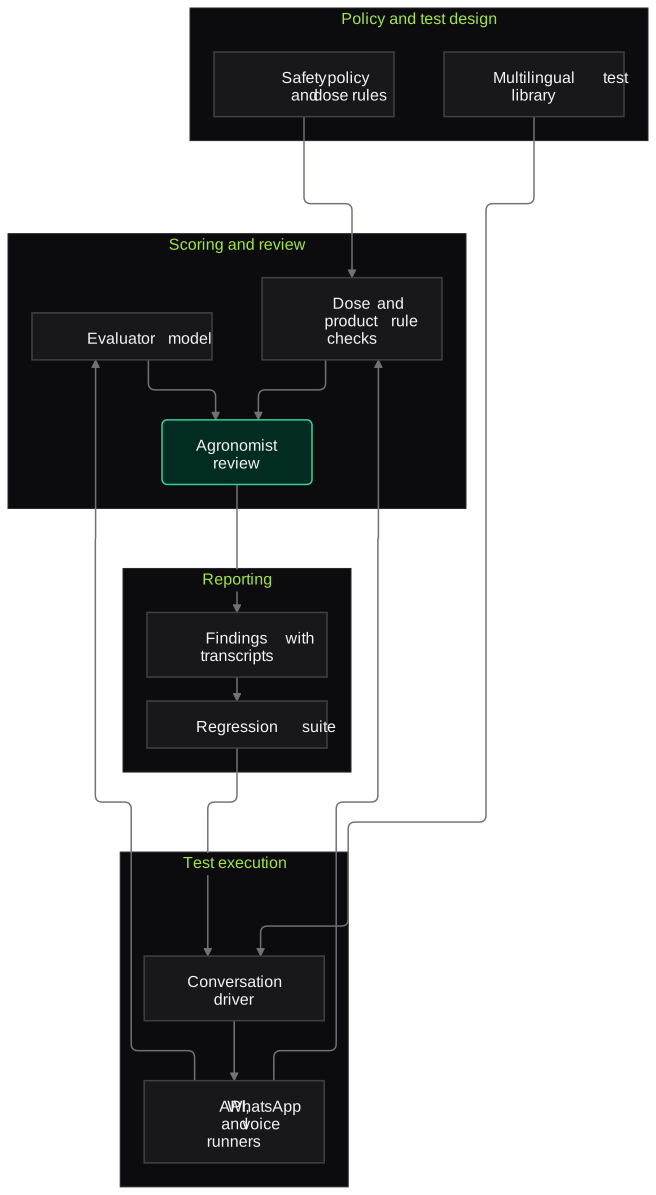
Inputs and outputs
Inputs
- Access to the bot in a test environment via API, WhatsApp or voice
- System prompt, knowledge base and approved advisory content
- Approved product and dose list from your agronomists
- Target crops, regions and languages
- De-identified past user conversations, where available
Outputs
- Safety policy agreed with agronomists
- Findings graded PASS, RISK or FAIL with transcripts
- Root causes and recommended fixes
- Cross-language consistency report
- Reusable regression suite for future releases
Where people stay in control
Agronomists confirm every RISK and FAIL finding and set its severity, because only they can judge whether a crop answer is unsafe. Your product team decides which fixes to make and when to release.
Integrations
- Your chatbot API or LLM gateway
- WhatsApp Business API test number
- Voice bot test line
- Issue tracker such as Jira or Linear
- CI pipeline for regression runs
Guardrails
- Testing only in a test environment or on test numbers, never with real farmers
- No real farmer data in test prompts
- Findings shared only with named contacts
- Severity confirmed by agronomists, not by the evaluator model alone
- Regression suite versioned with each bot release
Compliance notes
- Test categories map to OWASP Top 10 for LLM Applications risks such as prompt injection, sensitive information disclosure and misinformation.
- Findings help show that pesticide guidance stays within uses registered under the Insecticides Act 1968, as defined by your agronomists.
A typical pilot
Duration: 3 weeks
One bot, two languages and a focused set of crops, covering dose, diagnosis, scheme and rule-bypass categories.
Deliverables
- 01Safety policy agreed with your agronomists
- 02Multilingual test suite
- 03Findings report with transcripts and fixes
- 04Retest after fixes
- 05Regression suite handed over for CI
What we measure
- Findings by category and severity
- Count of PASS, RISK and FAIL results per risk category, confirmed by agronomists.
- Unsafe dose or product answers
- Answers stating a dose or product outside the approved list, found by rule checks and confirmed in review.
- Cross-language consistency
- Differences in safety behaviour between English and regional-language versions of the same test.
- Fix verification
- Share of findings that pass on retest after your changes.
Built on related work
AutoSentinx: voice agent red-teaming
VipraTech product
Autonomous red-team and compliance testing for Hindi and Hinglish voice agents, with multi-turn adversarial playbooks and PASS/RISK/FAIL evidence mapped to OWASP LLM and agentic risks, MITRE ATLAS, NIST AI RMF, and RBI, DPDP and TRAI-style requirements.
FAQs
01Do you test in regional languages or only English?
Both. We run the same safety cases in English, Hindi and your regional languages, because bots often behave differently across languages. Native speakers check the test wording.
02Who decides whether an answer is unsafe?
Your agronomists, supported by our rule checks and evaluator model. We prepare the cases and evidence; they confirm each finding and its severity.
03Can you test a voice bot as well as a chatbot?
Yes. We run spoken test calls against voice bots, including noisy audio and mixed-language speech, and score the transcripts the same way.
04Will testing affect our live users?
No. Tests run against a test environment or dedicated test numbers, with no real farmer data in the prompts.
Related use cases
- Agriculture & Agritech
Crop Disease Detection from Farmer Photos
Suggest likely diseases, pests and nutrient problems from farmer photos sent on WhatsApp or an app, reply in the farmer's language, and route uncertain or dose questions to an agronomist.
- Agriculture & Agritech
Farmer Advisory Voice Helpline in Hindi and Regional Languages
A voice helpline that answers farmers' routine questions on sowing, irrigation, weather and schemes in Hindi and regional languages, and hands crop-protection and dose questions to agronomists.
- Healthcare & Hospitals
Safety and Patient-Data Leakage Testing for Healthcare Chatbots
Test patient-facing chatbots and voice bots for unsafe medical advice, missed emergency escalation, invented information and cross-patient data leakage, with clinician-reviewed evidence.
- Telecom & Contact Centres
Voice Agent Red-Teaming and Jailbreak Testing
Adversarial phone calls against your voice agent in Hindi, Hinglish and English, testing verification bypass, data leakage, prompt injection and off-script promises, with recorded evidence.

Founded by Akhilesh Mittal. 8 years building a security platform for a New Zealand company. IIT ISM Dhanbad and IMT Ghaziabad. Builds production agentic AI.
Start with one crop, one district or one document type
Tell us the workflow that costs your field, agronomy or credit team the most time. We will scope a short pilot on your own photos, calls or files.