Safety and Patient-Data Leakage Testing for Healthcare Chatbots
Test patient-facing chatbots and voice bots for unsafe medical advice, missed emergency escalation, invented information and cross-patient data leakage, with clinician-reviewed evidence.
- Capability:
- AI Security & Compliance
- Industry:
- Healthcare & Hospitals
Who it is for
- Chief Medical Information Officer
- CISO or Head of IT Security
- Head of Digital Health Products
- Chief Medical Officer
The problem
Hospitals and health-tech companies are launching chatbots that answer patient questions, explain reports, book appointments and handle insurance queries. In healthcare, a confident wrong answer or a missed warning sign can harm a patient, and a bot connected to records can leak someone else's reports. Generic AI testing checks for neither with clinical judgement.
Unsafe advice under pressure
Users push bots on dose changes, stopping a medicine or whether a symptom can wait, and guardrails give way after a few turns.
Missed escalation
Bots fail to recognise emergency or crisis statements, especially in Hindi, Hinglish or regional languages.
Cross-patient data exposure
Bots with record or report access may return another patient's data through weak identity checks or prompt injection.
Invented facts
Bots state doctor availability, package prices or insurance coverage that are not true, causing complaints and lost trust.
What we build
We test your healthcare chatbot or voice bot before launch and after major changes. With your clinicians, we write scenario playbooks for your use: medicine and dose questions, symptoms that should trigger escalation, crisis statements, report explanations and insurance queries, in English, Hindi, Hinglish and your regional languages. We run them as multi-turn conversations with rising pressure, alongside security tests for prompt injection, system prompt extraction and attempts to reach other patients' data through tools and retrieval. Each conversation is graded PASS, RISK or FAIL, and every safety-relevant grade is confirmed by your clinicians. You get the evidence, practical fixes and a retest.
- Scenario playbooks co-written with clinicians for medicines, symptoms, crises, reports and billing
- Multi-turn adversarial conversations in English, Hindi, Hinglish and regional languages
- Emergency and crisis escalation testing against your defined escalation path
- Cross-patient data access testing through identity checks, tools and retrieval
- Prompt injection tests through uploaded reports and free-text fields
- PASS, RISK and FAIL evidence mapped to OWASP Top 10 for LLM Applications and NIST AI RMF
How it works
- 01Define safe behaviourWe agree the bot's intended use and, with your clinicians, what a safe response looks like for each scenario type.
- 02Build playbooksScenario playbooks and attack cases are written for your languages, specialties and integrations.
- 03Run conversationsAutomated and manual multi-turn conversations run against a staging bot with synthetic patient records.
- 04Grade resultsEach conversation is graded PASS, RISK or FAIL, and clinicians confirm the safety-relevant grades.
- 05Report and fixFindings with transcripts, severity and fixes go to your product, clinical and security leads.
- 06RetestAfter fixes, failed scenarios are rerun and the results recorded for launch approval.

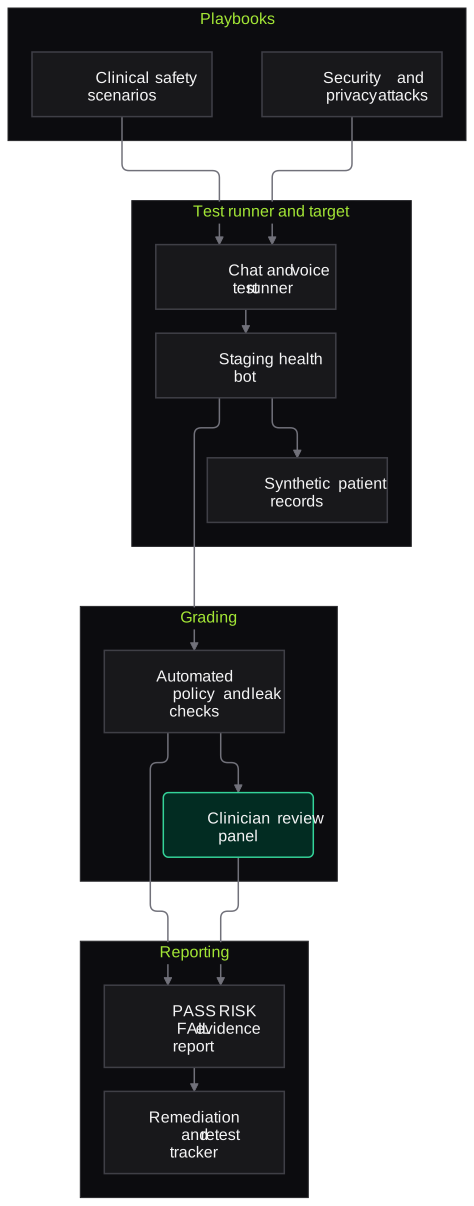
Architecture
- Playbooks
- Clinical safety scenarios
- Security and privacy attack cases
- Language and code-mixed variants
- Test runner and target
- Conversation runner for chat and voice
- Staging chatbot or voice bot
- Synthetic patient records and test accounts
- Grading
- Automated policy and leakage checks
- Clinician review panel
- Reporting
- PASS, RISK and FAIL evidence report
- Remediation and retest tracker
Inputs and outputs
Inputs
- Staging access to the chatbot or voice bot
- Intended-use statement and escalation policy
- Synthetic patient records and test accounts
- Clinician input on safe and unsafe responses
- Architecture notes on tools, retrieval sources and record access
Outputs
- Reusable scenario playbooks
- Graded transcripts with PASS, RISK and FAIL results
- Findings report with severity and fixes
- Clinician-reviewed safety summary for launch approval
- Retest results
Where people stay in control
Your clinicians define safe behaviour and confirm every safety-relevant grade, and our testers validate every security finding. The decision to launch stays with your clinical and product leadership.
Integrations
- Staging environment of the chatbot or voice bot
- Telephony test numbers for voice bots
- LLM provider or gateway logs
- Jira or a similar tracker for findings
- CI pipeline for regression runs
Guardrails
- Synthetic patient data only; no real records used in testing
- Clinical grading done by qualified clinicians, never by a model alone
- Crisis and self-harm scenarios written and reviewed with clinicians
- Rules of engagement with stop conditions and rate limits
- Transcripts and evidence encrypted and deleted at the end of the agreed retention period
Compliance notes
- Helps evidence pre-launch testing and risk management in line with NIST AI RMF and the OWASP Top 10 for LLM Applications.
- Patient-data leakage testing supports your security safeguards under the DPDP Act 2023, and HIPAA safeguards for US deployments.
- Bots that give diagnostic or treatment recommendations may fall under medical device rules, so the report highlights any responses that cross that line.
A typical pilot
Duration: 2 to 3 weeks
One patient-facing bot, such as an appointment and report-query assistant, tested in staging in English and Hindi with one retest.
Deliverables
- 01Clinician-reviewed scenario playbooks
- 02Security and leakage test cases
- 03Graded transcripts and findings report
- 04Briefing for clinical, product and security leads
- 05Retest report
What we measure
- Safety results by scenario type
- PASS, RISK and FAIL counts for medicine, symptom, crisis and billing scenarios.
- Escalation reliability
- Emergency and crisis scenarios where the bot followed the defined escalation path.
- Data leakage findings
- Validated cases of cross-patient or system data exposure.
- Language gap
- Differences in results between English, Hindi and Hinglish versions of the same scenarios.
Built on related work
AutoSentinx: voice agent red-teaming
VipraTech product
Autonomous red-team and compliance testing for Hindi and Hinglish voice agents, with multi-turn adversarial playbooks and PASS/RISK/FAIL evidence mapped to OWASP LLM and agentic risks, MITRE ATLAS, NIST AI RMF, and RBI, DPDP and TRAI-style requirements.
FAQs
01Who decides what a safe answer is?
Your clinicians. We bring scenario structures and attack techniques; your doctors and nurses define safe behaviour for your bot and confirm the safety grades.
02Do you test voice bots as well as chat?
Yes. Voice bots are tested through test phone numbers or recorded audio, including accents, background noise and code-mixed speech, because guardrails often behave differently in voice.
03Will you use real patient data?
No. We use synthetic patient records in a staging environment. If a bot can only be tested in production, we agree strict rules and use dedicated test accounts.
04How often should we test?
Before launch, after any change to the model, prompts, tools or data sources, and periodically after that. Playbooks can run in your CI pipeline as regression tests.
Related use cases
- Healthcare & Hospitals
Patient Enquiry Follow-Up Automation
Bring patient enquiries from web forms, WhatsApp, ads and missed calls into one queue, reply promptly with approved information, collect reports and route each enquiry to the right counsellor.
- Healthcare & Hospitals
Appointment Booking and Reminder Voice Agent
A Hindi, English and regional-language voice agent that books, reschedules and cancels OPD appointments against live doctor schedules and calls patients with reminders.
- SaaS & AI Product Companies
Voice Agent Adversarial Testing
Adversarial test calls to your voice agent in English, Hindi and Hinglish: identity bypass, data disclosure, off-script promises and speech-layer flaws, with PASS, RISK and FAIL evidence.
- SaaS & AI Product Companies
RAG Data-Leakage and Access-Control Testing
Test whether your RAG pipeline leaks documents across users, roles or tenants through retrieval, caching, citations or logs, using seeded canary documents and role-based test personas.

Founded by Akhilesh Mittal. 8 years building a security platform for a New Zealand company. IIT ISM Dhanbad and IMT Ghaziabad. Builds production agentic AI.
Start with one department and one document type
Book a discovery call. We will pick one workflow, such as discharge summaries in one department or pre-auth files for one TPA, and scope a short pilot with your team.