Farmer Advisory Voice Helpline in Hindi and Regional Languages
A voice helpline that answers farmers' routine questions on sowing, irrigation, weather and schemes in Hindi and regional languages, and hands crop-protection and dose questions to agronomists.
- Industry:
- Agriculture & Agritech
Who it is for
- Head of Farmer Services
- Kisan Helpline Operations Manager
- Agritech Product Head
- FPO Federation Programme Manager
The problem
Many farmers would rather call than type, and they tend to call at the same times: early morning, evening, and in the weeks around sowing and spraying. Helpline teams answer the same questions on seed rates, irrigation timing, weather and scheme status again and again, while urgent pest calls wait in the queue.
Peak-season call spikes
Calls surge around sowing, monsoon breaks and pest outbreaks, and missed calls rarely get a callback.
Language and dialect coverage
One helpline may need Hindi, Marathi, Gujarati and Telugu, and staffing every language for every hour is not practical.
Repetitive questions
Many calls ask about the same sowing windows, seed varieties, weather or PM-KISAN status, which keeps agronomists from harder cases.
No structured record
Call notes are short or missing, so the team cannot see which issues are rising in which district.
What we build
We build an inbound voice agent on your helpline number that speaks with farmers in Hindi and the regional languages you serve. It recognises speech that mixes local dialect with crop and brand names, works out the crop, location and question, and answers from a knowledge base built from your agronomists' package of practices, approved advisories and weather feeds. It can read out scheme information from approved sources and book callbacks. Questions about disease diagnosis, chemical products or doses, and any case where the agent is unsure, go to an agronomist with a summary. Every call produces a structured record by crop, district and topic.
- Speech recognition tuned for Hindi, regional languages and mixed crop and brand terms
- Answers grounded in an agronomist-approved knowledge base with source tracking
- Location-aware weather and crop calendar information
- Warm transfer or scheduled callback to agronomists with a call summary
- Structured call records by crop, district and issue
- Missed-call callbacks and peak-hour overflow handling
How it works
- 01Farmer calls the helplineThe agent greets the farmer in the language of the number dialled, or asks which language they prefer.
- 02Understand the questionIt captures crop, location and question, asking short follow-up questions when something is unclear.
- 03Check the topicRoutine topics are answered; diagnosis, chemical dose and complaint topics are routed to people.
- 04Answer from approved contentThe agent answers from the knowledge base and checks the farmer has understood.
- 05Hand over when neededAn agronomist receives a summary and takes the call live or calls back within the agreed window.
- 06Record the callA structured record and summary are saved to your CRM for follow-up and trend analysis.

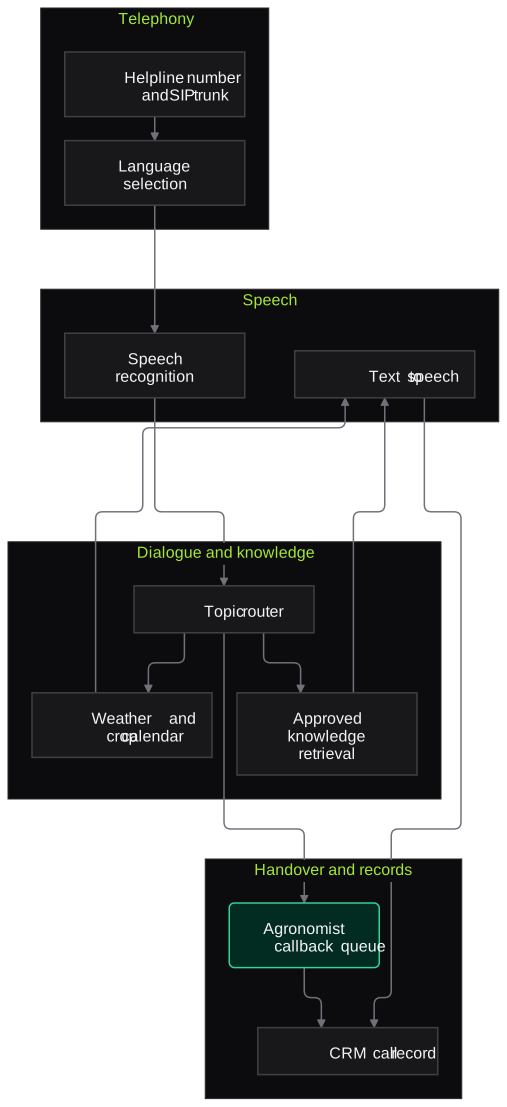
Architecture
- Telephony
- Helpline number via SIP or cloud telephony
- Language selection and recorded-call notice
- Speech
- Speech recognition for Hindi and regional languages
- Crop and brand name vocabulary
- Text-to-speech in each language
- Dialogue and knowledge
- Dialogue manager with topic routing
- Retrieval over approved package of practices and advisories
- Weather and crop calendar lookup
- Handover
- Agronomist transfer and callback queue
- Call summary generator
- Records
- CRM call records
- Topic and district trend reports
Inputs and outputs
Inputs
- Inbound farmer calls
- Agronomist-approved package of practices by crop and state
- Current advisories and weather feeds
- Scheme information from approved sources
- Farmer profile from your CRM, where available
Outputs
- Spoken answers in the farmer's language
- Agronomist transfers and callback tasks with summaries
- Structured call records by crop, district and topic
- Weekly trend report of rising issues
Where people stay in control
Agronomists take every call involving disease diagnosis, chemical products or doses, and any call the agent cannot answer confidently. They also approve every knowledge base change before the agent can use it.
Integrations
- Cloud telephony or existing IVR via SIP
- CRM or helpdesk such as Salesforce, Zoho or Freshdesk
- Weather data provider
- WhatsApp Business API for follow-up messages
- Your farmer database
Guardrails
- Answers only from approved content, with no generated product doses
- Topic router that always transfers diagnosis and dose questions
- Recorded-call notice at the start of each call
- Daily agronomist review of a sample of calls
- Farmers can ask for a person at any point in the call
Compliance notes
- Call recordings and farmer details are handled with notice, consent and retention limits aligned with the DPDP Act 2023.
- Product guidance stays within approved, registered uses as agreed with your agronomy team.
A typical pilot
Duration: 4 weeks
One language, two or three crops and a set of routine topics on an overflow or after-hours line, with agronomists available for every handover.
Deliverables
- 01Knowledge base built from your approved content
- 02Working voice agent on a test or overflow number
- 03Agronomist handover and callback flow
- 04Call review report with transcripts and outcomes
- 05Plan for more languages and topics
What we measure
- Answer quality
- Agronomists grade a sample of answered calls as correct, incomplete or wrong.
- Containment of routine topics
- Share of routine-topic calls completed without handover, reviewed for correctness.
- Speech recognition accuracy
- Transcripts compared with human transcription on a sample of calls, by dialect.
- Callback completion
- Callbacks requested compared with callbacks completed within the agreed window.
FAQs
01Which languages can it speak?
We start with the language that carries most of your calls, then add others. Hindi, Marathi, Gujarati, Telugu, Tamil, Kannada, Bengali and Punjabi are all workable, and each is tested on recordings from your own callers before go-live.
02What happens when a farmer asks about pesticides?
The agent recognises crop-protection and dose questions and transfers them to an agronomist or books a callback. It does not invent product advice.
03Can it use our existing helpline number?
Usually yes, through your telephony provider's SIP or API integration. It can take all calls, only overflow, or only after-hours calls.
04How do we keep the knowledge base current?
Your agronomists update advisories through a review screen, and nothing goes live without their approval. Each answer can be traced to the content it used.
Related use cases
- Agriculture & Agritech
Crop Disease Detection from Farmer Photos
Suggest likely diseases, pests and nutrient problems from farmer photos sent on WhatsApp or an app, reply in the farmer's language, and route uncertain or dose questions to an agronomist.
- Agriculture & Agritech
Mandi Price and Procurement Voice Updates
Outbound and inbound voice updates on nearby mandi prices, procurement windows and pickup slots in the farmer's language, with every price dated and sourced, and offers approved by procurement.
- Agriculture & Agritech
Safety Testing for Farm Advisory Chatbots
Test farm advisory chatbots and voice bots in Hindi and regional languages for harmful or wrong advice: invented doses, unregistered products, overconfident diagnoses, scheme errors and data leaks.
- Telecom & Contact Centres
Multilingual Inbound Voice Agent for L1 Support
A voice agent that answers routine L1 calls in Hindi, Hinglish and regional languages, resolves what it safely can through your systems and hands the rest to an agent with full context.

Founded by Akhilesh Mittal. 8 years building a security platform for a New Zealand company. IIT ISM Dhanbad and IMT Ghaziabad. Builds production agentic AI.
Start with one crop, one district or one document type
Tell us the workflow that costs your field, agronomy or credit team the most time. We will scope a short pilot on your own photos, calls or files.