Customer KYC Verification for SIM Onboarding
Check digital KYC submissions for new connections: read ID documents, match the live photo, catch duplicates and point-of-sale anomalies, and route doubtful CAFs to the KYC audit team.
- Industry:
- Telecom & Contact Centres
Who it is for
- Head of KYC and Compliance
- Distribution and Retail Operations Head
- Fraud Control Manager
- CAF Audit Team Lead
The problem
Every new mobile connection must be verified under DoT customer verification instructions, through Aadhaar-based e-KYC or digital KYC with a live photograph and officially valid documents captured at the point of sale. Errors and fraud concentrate where volume is high and checks are thin: blurred or photocopied IDs, a live photo that is not the document holder, the same face behind several identities, and retailers who cut corners.
CAF audit is sampled and late
Manual audit of customer acquisition forms happens after activation and covers only part of the volume.
Photo and identity mismatches
A live photo of someone else, a photo of a photo, or the same face reused under different names slips through visual checks.
Field and document errors
Address mismatches, expired passports for foreign nationals and missing local references for outstation customers create non-compliant CAFs.
Retailer-level patterns stay hidden
Clusters of doubtful activations from one point of sale are hard to see when each CAF is reviewed on its own.
What we build
We build a KYC verification layer that checks each digital KYC submission before or shortly after activation. It reads the officially valid document images, extracts name, date of birth, address and document number, masking Aadhaar per UIDAI rules, and checks them against the CAF fields the retailer entered. A face-matching step compares the live photograph with the document photo, and image checks look for screen captures, photocopies and edited images. Across submissions, it looks for the same face or document behind different identities and for unusual patterns by point of sale. Clean submissions pass; those with mismatches or low confidence are queued for the KYC audit team with reasons listed.
- Extraction from passports, voter ID, driving licences, masked Aadhaar and other officially valid documents
- Cross-checks of extracted fields against CAF entries and connection-type rules
- Live photo to document photo face match, with checks for photo-of-photo and screen captures
- Duplicate detection of faces and document numbers across connections
- Point-of-sale risk view showing mismatch and rejection patterns by retailer and distributor
- Audit queue with reasons and evidence for each flagged CAF
How it works
- 01Receive the submissionThe digital KYC submission arrives from the retailer app with the live photo, document images and CAF data.
- 02Extract document fieldsDocument type and fields are extracted, and Aadhaar numbers are masked at ingestion.
- 03Match face and check imagesThe live photo is compared with the document photo, and images are checked for tampering or re-capture.
- 04Check CAF and duplicatesFields are compared with CAF entries and connection rules, and the face and document are searched against earlier submissions.
- 05Audit flagged CAFsSubmissions with any failed or low-confidence check go to a KYC auditor, who accepts or rejects them.
- 06Update systemsResults go to the activation system, and rejections feed the point-of-sale risk view.

Architecture
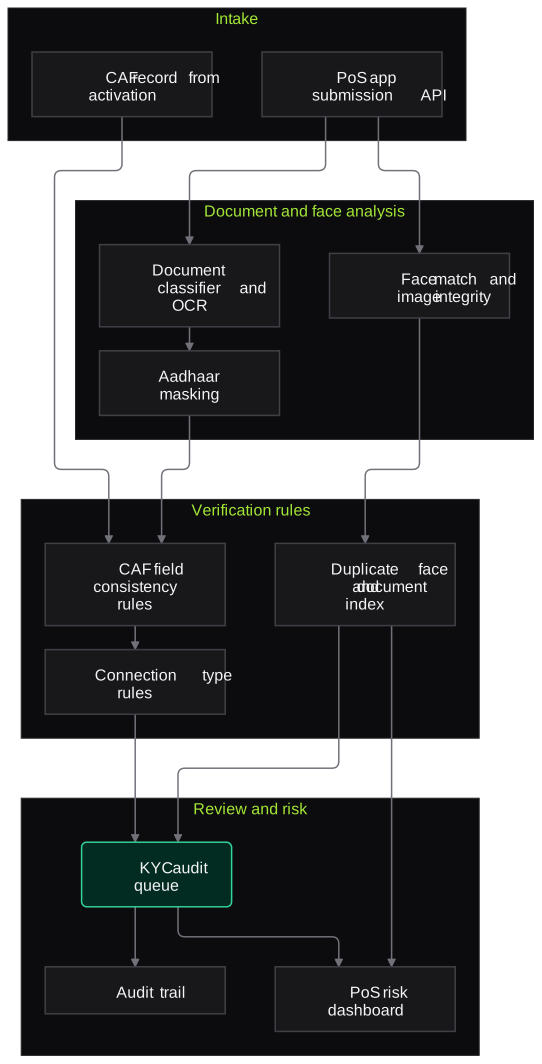
- Intake
- Retailer app submission API
- CAF record from the activation system
- Document image store
- Document and face analysis
- Document classifier and OCR
- Aadhaar masking at ingestion
- Face match and image integrity models
- Verification rules
- CAF field consistency rules
- Duplicate face and document index
- Connection-type rules for prepaid, postpaid, outstation and foreign nationals
- Review and risk
- KYC audit queue
- Point-of-sale risk dashboard
- Audit trail
Inputs and outputs
Inputs
- Digital KYC submissions with live photo and document images
- CAF data entered at the point of sale
- Retailer and distributor details
- Connection-type rules for prepaid, postpaid, outstation, foreign national and business connections
- Index of earlier submissions
Outputs
- Verification result per CAF with reasons
- Extracted document fields with Aadhaar masked
- Duplicate identity alerts
- Point-of-sale risk reports
- Audit trail of checks and auditor decisions
Where people stay in control
KYC auditors decide every flagged CAF, and no connection is deactivated or retailer penalised on the system's output alone. The compliance team reviews point-of-sale risk patterns before taking any action against a retailer or distributor.
Integrations
- Retailer onboarding and digital KYC app
- Activation, provisioning and CRM systems
- CAF audit tool
- Distributor management system
Guardrails
- Aadhaar masked at ingestion and never stored in full
- Face data used only for verification and duplicate checks, with limited retention
- Thresholds agreed with the compliance team and logged
- No automated deactivation or penalty
- Access logs on every CAF viewed
Compliance notes
- Designed to support DoT customer verification instructions for mobile connections; the operator remains responsible for verification decisions.
- Aadhaar is handled per UIDAI rules with numbers masked, and face data processing is designed to support DPDP Act 2023 purpose limitation and security safeguards.
A typical pilot
Duration: 4 weeks
Historic digital KYC submissions from one circle or sales channel, compared with completed CAF audit outcomes.
Deliverables
- 01Extraction and face-match pipeline for the pilot documents
- 02Duplicate index over the pilot data
- 03Audit queue and point-of-sale risk view
- 04Agreement report against CAF audit outcomes
- 05Roll-out plan and cost estimate
What we measure
- Field extraction accuracy
- Extracted values compared with audited CAF data.
- Face match agreement
- System decisions compared with auditor judgements, reported by photo quality.
- Flag precision
- Share of flagged CAFs that auditors confirmed as non-compliant.
- Auditor time per CAF
- Review time for flagged CAFs with reasons shown, compared with the current audit.
FAQs
01How is Aadhaar data handled?
Aadhaar numbers are masked at ingestion and never stored in full, in line with UIDAI rules. Where a connection uses Aadhaar e-KYC, we work with the response your e-KYC flow already returns rather than collecting the data again.
02Can this replace our CAF audit team?
No. It checks every submission and prioritises the doubtful ones, so auditors spend their time on CAFs that need judgement. Decisions on rejection, deactivation or action against a retailer stay with your team.
03How reliable is face matching on low-quality retail photos?
Photo quality at the point of sale varies, so the pipeline scores image quality first and sends poor captures for review instead of forcing a match decision. The pilot reports face match agreement with auditors separately by photo quality.
04Can it run in real time inside the retailer app?
Yes, as an API call before activation, or as a post-activation batch if you want to start without changing the retailer flow. Starting in batch lets you tune thresholds before moving checks earlier.
Related use cases
- Fintech & Payments
Selfie-to-ID Face Match and Document Tamper Checks
Compare a live selfie with the photo on an ID, check liveness and spot edited or replayed ID images, sending borderline cases to a reviewer with highlighted evidence.
- Banking
Account Opening Document Verification
Check OVDs, PAN, masked Aadhaar, photographs and entity documents in an account opening file against each other and against CKYC, with mismatches routed to an officer.
- Insurance
Tampered and Fraudulent Document Detection
Score claim documents for signs of editing, fabrication and reuse, explain each signal, and route high-risk files to your investigation team instead of labelling anyone a fraudster.

Founded by Akhilesh Mittal. 8 years building a security platform for a New Zealand company. IIT ISM Dhanbad and IMT Ghaziabad. Builds production agentic AI.
Start with one queue or one campaign
Bring a sample of recordings or one call flow. We will scope a pilot on your own calls, in your languages, and measure it against your current process.