Call QA and Compliance Auditing on Every Call
Score every recorded call against your QA form and compliance script, in Hindi, Hinglish and English, so QA analysts spend their time on the calls that need a human ear.
- Capability:
- Voice AI
- Industry:
- Telecom & Contact Centres
Who it is for
- Head of Quality
- Contact Centre Compliance Manager
- Operations Manager
- BPO Client Delivery Head
The problem
QA teams typically listen to a small, fixed sample of calls per agent each month and score them on a form covering opening, verification, hold etiquette, mandatory disclosures, resolution and closing. Breaches on unsampled calls, such as a skipped disclosure, a misleading promise or a rude exchange, surface only when a customer complains or a client audits the programme.
Small sample coverage
A handful of calls per agent cannot show whether a disclosure is skipped routinely or only once.
Inconsistent scoring
Two analysts score the same call differently, and calibration sessions take time away from listening.
Code-mixed audio defeats keyword spotting
Legacy speech analytics built for English keywords misses Hinglish phrasing of the same disclosure or promise.
Feedback arrives too late
Agents receive coaching weeks after the call, when they no longer remember it, and disputes are hard to settle without evidence.
What we build
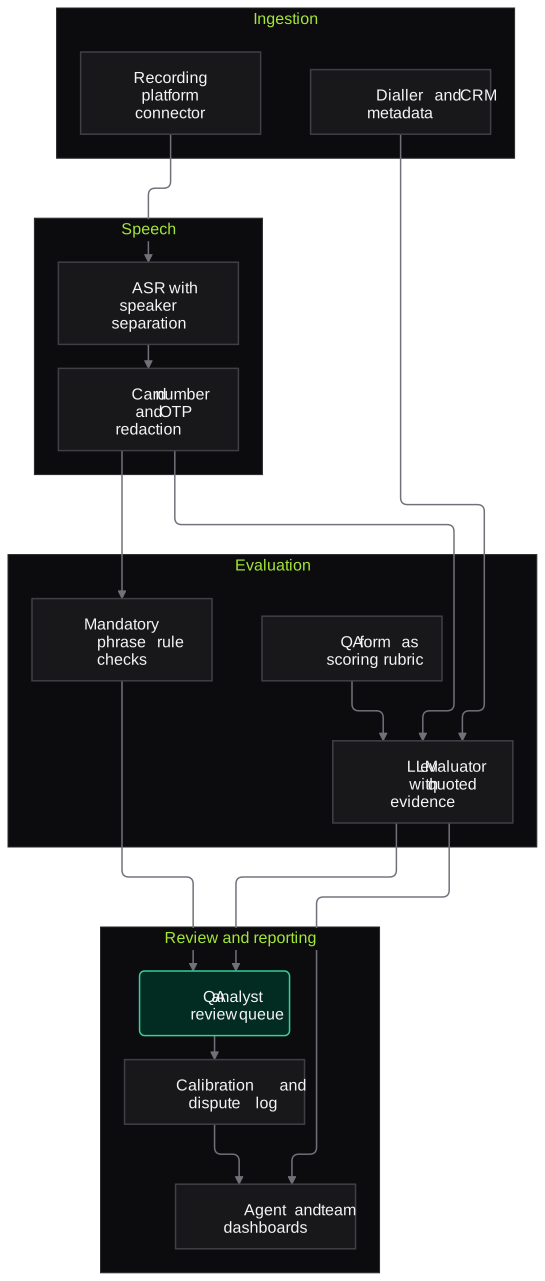
We build a call QA pipeline that picks up recordings from your dialler or recording platform after each call, transcribes them with speaker separation and evaluates the conversation against your own QA form and compliance checklist. Each parameter is scored with the transcript excerpt that justifies it: whether the agent verified identity before discussing the account, read the mandatory disclosure, avoided prohibited promises, followed hold procedure and closed correctly. Compliance-critical failures and low-confidence scores go to QA analysts, who confirm or overturn them, and their decisions are used to calibrate the evaluator. Team leaders get agent-level trends and coaching clips instead of a monthly spreadsheet.
- Transcription with agent and customer separation for Hindi, Hinglish, English and agreed regional languages
- Scoring against your QA form, parameter by parameter, with the quoted evidence behind each score
- Compliance checks for mandatory disclosures, verification steps, prohibited phrases and promises
- Detection of abusive language, escalation requests and dissatisfaction signals
- Analyst review queue for critical failures and uncertain scores, with calibration tracking
- Agent and team dashboards with coaching clips linked to the exact moment in the call
How it works
- 01Ingest recordingsRecordings and call metadata such as agent, campaign and disposition are collected after each call.
- 02Transcribe and separate speakersAudio is transcribed with agent and customer labelled, and card numbers or OTPs are redacted.
- 03Score against the QA formEach parameter is scored with the excerpt that supports it, and compliance rules are checked.
- 04Review critical resultsCompliance-critical failures and low-confidence scores go to a QA analyst to confirm or overturn.
- 05Log decisions for calibrationAnalyst decisions are recorded and used to tune the evaluator and track agreement.
- 06Publish to team leadersScores, trends and coaching clips appear on agent and team dashboards.

Architecture
- Ingestion
- Recording platform connector or SFTP pickup
- Call metadata from dialler and CRM
- Speech
- Speech recognition with speaker separation
- Redaction of card numbers and OTPs
- Evaluation
- QA form configured as a scoring rubric
- LLM evaluator that quotes evidence
- Rule checks for mandatory phrases
- Review and calibration
- QA analyst review queue
- Dispute handling
- Calibration and agreement metrics
- Reporting
- Agent and team dashboards
- Coaching clip library
- Exports to QA and WFM tools
Inputs and outputs
Inputs
- Call recordings, ideally stereo
- Call metadata such as agent ID, campaign and disposition
- QA form and scoring guide
- Compliance scripts and prohibited phrase lists
- Past QA scores for calibration
Outputs
- Per-call scorecard with quoted evidence
- Compliance breach alerts
- Analyst-reviewed results and dispute outcomes
- Agent and team trends
- Coaching clips
Where people stay in control
QA analysts confirm every compliance-critical failure before it reaches an agent's scorecard or a client report, and they handle all agent disputes. Analyst decisions are tracked so the evaluator's agreement with humans stays visible.
Integrations
- Recording and dialler platforms such as Genesys, Avaya, NICE, Ozonetel or Exotel
- CRM for call metadata
- QA and workforce management tools
- BI tools such as Power BI
Guardrails
- No score without a quoted transcript excerpt
- Compliance-critical failures confirmed by an analyst before they count
- Card numbers and OTPs redacted from transcripts
- Agent dispute path with recorded outcomes
- Data separated by programme and client in multi-client BPOs
Compliance notes
- Card details spoken on calls should be paused or redacted to support PCI DSS; the pipeline redacts card-like numbers from transcripts.
- Recordings, transcripts and QA scores are personal data of customers and agents under the DPDP Act 2023.
A typical pilot
Duration: 3 weeks
One programme or queue, using a few weeks of recordings, run in parallel with the existing manual QA.
Deliverables
- 01QA form and compliance checklist configured as a rubric
- 02Scored calls for the pilot period
- 03Analyst review queue and dashboards
- 04Agreement report against manual QA
- 05Roll-out plan and cost estimate
What we measure
- Agreement with QA analysts
- Parameter-level comparison with analyst scores on the same calls.
- Transcription accuracy
- Word error rate on sampled calls, by language and audio quality.
- Breaches outside the manual sample
- Compliance-critical failures on unsampled calls, as confirmed by analysts.
- Analyst time per reviewed call
- Time to confirm or overturn a flagged result, compared with full listening.
FAQs
01How accurate is automated scoring compared with our QA analysts?
We measure it parameter by parameter against your analysts' scores on the same calls during the pilot. Objective parameters such as verification and disclosures are easier to score consistently than subjective ones such as empathy, which is why compliance-critical failures always go to an analyst before they count.
02Our recordings are mono and noisy. Will it work?
Stereo recordings with agent and customer on separate channels give the best results, but mono recordings work with speaker separation. The pilot reports transcription quality on your actual audio so you can see the effect before committing.
03Can it handle regional languages?
Hindi, Hinglish and English are the starting point. Regional languages are added based on your programmes and tested on your own recordings first.
04Can agents see and dispute their scores?
Yes. Agents and team leaders see each score with the transcript excerpt and audio clip behind it, and disputes go to a QA analyst whose decision is recorded.
Related use cases
- Telecom & Contact Centres
Real-Time Agent Assist
Live transcription and prompts on the agent's screen: the right knowledge-base answer, the next compliance step and a drafted call summary, so new agents handle complex calls with fewer holds.
- Telecom & Contact Centres
Compliance Evidence for AI Calling (TRAI and DPDP)
Test and document how your AI calling handles consent, DND preferences, calling hours, disclosures, opt-outs and personal data, and give compliance teams and clients an evidence pack.
- Telecom & Contact Centres
Multilingual Inbound Voice Agent for L1 Support
A voice agent that answers routine L1 calls in Hindi, Hinglish and regional languages, resolves what it safely can through your systems and hands the rest to an agent with full context.

Founded by Akhilesh Mittal. 8 years building a security platform for a New Zealand company. IIT ISM Dhanbad and IMT Ghaziabad. Builds production agentic AI.
Start with one queue or one campaign
Bring a sample of recordings or one call flow. We will scope a pilot on your own calls, in your languages, and measure it against your current process.