Construction Site Safety Compliance
Use site cameras and safety walk photos to spot missing helmets, unguarded edges, people in crane and hoist zones and poor housekeeping, with each observation verified by the safety officer.
- Capability:
- Computer Vision
- Industry:
- Real Estate & Construction
Who it is for
- EHS Manager
- Site Safety Officer
- Project Manager
- Contractor Safety Supervisor
The problem
A high-rise site changes every day: new slab edges, openings, crane lifts and subcontractor crews. Safety officers cannot be on every floor, and observations from safety walks are written up later, so many unsafe acts come to light only after an incident or an inspection.
Too much site for too few eyes
One or two safety officers cover several towers, crane operations and night shifts, and rely on supervisors to report issues.
Edge and opening protection that comes and goes
Barricades, guardrails and shaft covers are removed for work and not replaced, especially on newly cast slabs.
PPE compliance that drops off
Helmets and high-visibility jackets are worn at the gate and taken off on upper floors or during breaks.
Observations that do not lead to action
Safety walk findings sit in notebooks or WhatsApp, so repeat issues by contractor or area are hard to track and close.
What we build
We build a safety monitoring system on your existing site cameras and safety walk photos. Vision models check for helmets and high-visibility jackets, people inside marked crane swing, hoist and excavation zones, missing edge protection at marked slab edges and openings, and blocked access routes or debris. Each detection becomes an observation with a snapshot, location and confidence. Urgent detections, such as a person under a suspended load, alert the safety officer immediately; the rest go into a review queue. Confirmed observations are assigned to the responsible contractor, tracked to closure and summarised daily by area and contractor.
- Helmet and high-visibility jacket detection on CCTV and photos
- Zone rules for crane swing areas, hoist landings and excavation edges
- Checks for missing guardrails or covers at marked slab edges and openings
- Housekeeping observations for debris, material blocking access and waterlogging
- Observation tracking by contractor and area, with photo evidence through to closure
- Daily and weekly safety summaries for toolbox talks and review meetings
How it works
- 01Map cameras and zonesWe map existing cameras, mark crane, hoist, edge and excavation zones and agree observation types with the EHS team.
- 02Analyse feeds and photosCamera frames and safety walk photos are analysed at agreed intervals for PPE, zone and housekeeping issues.
- 03Score severityEach detection gets a severity and confidence score, and critical zone breaches trigger an immediate alert.
- 04Safety officer reviewThe safety officer confirms or dismisses observations from the queue using the snapshot and location.
- 05Assign and closeConfirmed observations go to the responsible contractor supervisor, who closes them with a photo.
- 06Report trendsDaily and weekly summaries show repeat issues by area, shift and contractor for toolbox talks and reviews.

Architecture
- Capture
- Existing site CCTV via RTSP or NVR
- Mobile safety walk app
- Vision analysis
- PPE detector
- Zone intrusion rules per camera
- Edge protection and housekeeping checks
- Event handling
- Severity and confidence scoring
- Immediate alert service
- Observation queue
- Action tracking
- Safety officer review screen
- Contractor assignment and closure
- Trend reports
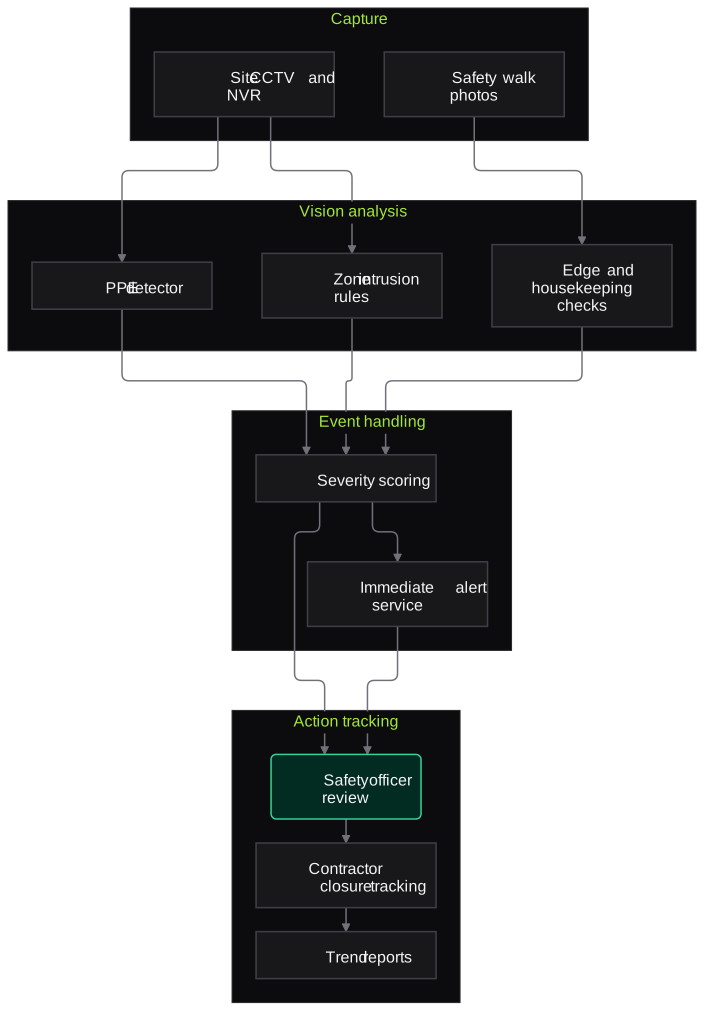
Inputs and outputs
Inputs
- Existing site CCTV feeds
- Safety walk photos from phones
- Site layout with crane, hoist and excavation zones
- Contractor and area responsibility list
- Your safety observation categories
Outputs
- Immediate alerts for critical zone breaches
- Observation records with snapshot, location and severity
- Contractor-wise open and closed observations
- Daily and weekly safety summaries
- Evidence log for safety audits
Where people stay in control
The safety officer confirms every observation before it is assigned, and decides any penalty or stop-work action under your site rules. Immediate alerts prompt a person to check; they never stop work automatically.
Integrations
- CCTV network video recorders over RTSP
- WhatsApp or SMS for alerts to site teams
- EHS or permit-to-work software
- Project management dashboards
- Email for daily summaries
Guardrails
- No face recognition; detections concern PPE and zones, not identity
- Faces blurred in reports shared outside the safety team
- Penalties and stop-work decisions stay with authorised staff
- Zone maps reviewed weekly as the site layout changes
- Alert thresholds tuned to avoid alarm fatigue
Compliance notes
- Helps evidence site safety practices expected under the BOCW Act 1996 and the OSH Code 2020; it does not replace statutory inspections.
- Worker images are handled with notice, restricted access and retention limits in line with the DPDP Act 2023.
A typical pilot
Duration: 4 weeks
One tower or work zone with three to six existing cameras plus daily safety walk photos, with detections reviewed by the site safety officer.
Deliverables
- 01Camera and zone map for the pilot area
- 02PPE, zone and housekeeping detection tuned on site footage
- 03Review queue and alert flow
- 04Pilot observation log and weekly summaries
- 05Roll-out plan and estimate
What we measure
- Detection precision by observation type
- Share of detections the safety officer confirms as genuine.
- Missed issues
- Observations the safety officer records on walks in covered areas that the system did not flag.
- Time to close observations
- Time from confirmation to closure photo, compared with the existing observation register.
- Alert volume per day
- Count of alerts and dismissals, used to tune thresholds.
FAQs
01Can we use our existing CCTV cameras?
Usually yes, if they cover the areas that matter at reasonable resolution. During setup we review each camera's view and suggest where one should be moved or added, for example to cover a hoist landing or crane loading area.
02Will workers be identified?
No. The system detects PPE and zone breaches, not who the person is. Faces can be blurred in reports, and access to raw footage stays with your safety team.
03Does it work at night?
Where lighting and cameras support it. Night footage is noisier, so thresholds are set separately and more items go to review. Poorly lit work areas are themselves worth flagging.
04Can it detect whether fall-arrest gear is being used?
Safety belts and lanyards are hard to see reliably from fixed cameras, so we treat them as a review prompt rather than a dependable detection. Edge protection and zone rules usually give stronger signals.
Related use cases
- Real Estate & Construction
Construction Progress Monitoring from Site Photos
Turn geotagged site photos, drone images and time-lapse cameras into tower-by-tower progress status against the schedule, with photo evidence a site engineer confirms.
- Real Estate & Construction
Contractor Bill Verification Against BOQ
Check every RA bill line against the work order BOQ, measurement records, previous bills and recovery rules, so billing engineers certify from a verified sheet instead of re-adding.
- Manufacturing
PPE and Safety-Zone Compliance
Vision models on existing CCTV spot missing helmets, shoes, vests and gloves, and people entering robot cells, press areas or forklift aisles, with clip-backed alerts to supervisors.
- Energy, Mining & Utilities
Mine Safety Monitoring (PPE and Zone Intrusion)
Computer vision on mine CCTV that flags missing PPE, people on foot in HEMM zones and entry into blast danger zones, so shift supervisors can act while it still matters.

Founded by Akhilesh Mittal. 8 years building a security platform for a New Zealand company. IIT ISM Dhanbad and IMT Ghaziabad. Builds production agentic AI.
Pick one project and one painful workflow
Book a discovery call and we will scope a short pilot on one project, such as RA bill checks for a single contractor or lead qualification for one launch, run in parallel with your current process.