Mine Safety Monitoring (PPE and Zone Intrusion)
Computer vision on mine CCTV that flags missing PPE, people on foot in HEMM zones and entry into blast danger zones, so shift supervisors can act while it still matters.
- Capability:
- Computer Vision
- Industry:
- Energy, Mining & Utilities
Who it is for
- Mine Manager
- Safety Officer
- Control Room Shift In-charge
- Head of Health, Safety and Environment
The problem
Opencast and underground mines already have cameras at haul road junctions, crushers, workshops and conveyor transfer points, but nobody can watch them all through a night shift. Unsafe acts such as a person walking into a dumper's blind spot or a worker without a helmet near the feeder are usually seen only during an incident review.
Footage is recorded, rarely watched
Control room staff juggle radio traffic, dispatch and many camera feeds, so coverage mostly serves post-incident investigation.
Zones move as the mine advances
HEMM operating areas, bench edges and blast danger zones shift from week to week, so fixed rules in a video management system go stale quickly.
Dust, glare and night shifts
Generic PPE detectors trained on factory images struggle with haul-road dust, cap lamps, headlight glare and rain on lenses.
Near misses go unreported
A person crossing in front of a reversing dumper rarely reaches the near-miss register unless someone chooses to report it.
What we build
We build a vision layer that runs on your existing CCTV, adding cameras only where coverage is missing and the installation is approved for that location. Models on an edge server at site detect people, vehicles and PPE items such as helmets, high-visibility vests and safety boots. Your safety officer draws zones per camera, including HEMM operating areas, crusher and feeder surroundings and blast danger zones that switch on with the blasting schedule. An event is raised only when a violation persists across frames, and a control room operator checks the clip before the shift in-charge is alerted. Every confirmed event lands in a shift-wise near-miss log.
- PPE checks per zone for helmets, high-visibility vests and other items your site rules require
- Detection of people on foot inside HEMM operating areas, haul road crossings and dump yards
- Blast danger zone mode that activates for the warning period set in your blasting procedure
- Zone polygons per camera that the safety officer updates as benches and faces advance
- Persistence filtering and de-duplication so one unsafe act produces one alert
- Camera health checks that report blocked, dusty or offline cameras as blind spots
How it works
- 01Map cameras and zonesThe safety officer marks HEMM areas, crusher surroundings, conveyor walkways and blast zones on each camera view and sets PPE rules per zone.
- 02Detect at the edgeAn edge server at site runs person, vehicle and PPE models on the camera streams, so detection continues when the WAN link is weak.
- 03Apply zone and shift rulesDetections are checked against zone polygons, the shift roster and the blasting schedule, and short-lived detections are filtered out.
- 04Operator verifies the clipA control room operator views a short clip of each candidate event and confirms or dismisses it.
- 05Alert the shift in-chargeConfirmed events reach the shift in-charge or overman by app, SMS or the control room display, with the snapshot and location.
- 06Log and reviewEvents, dismissals and actions taken feed a shift-wise near-miss log and a weekly review with the safety committee.

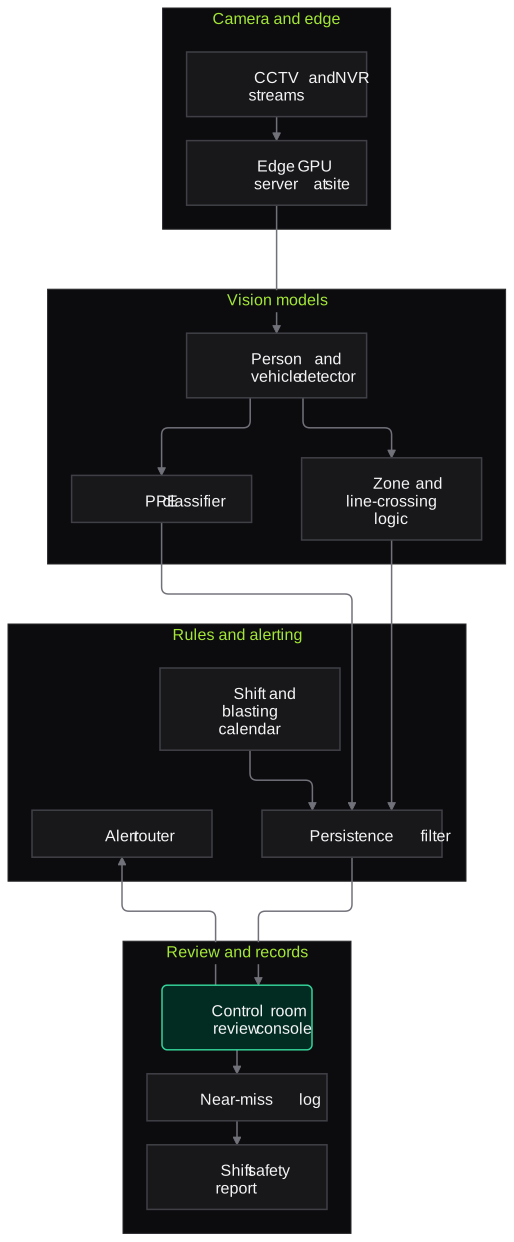
Architecture
- Camera and edge
- Existing CCTV and NVR streams over RTSP or ONVIF
- Edge GPU server at site
- Local event buffer for weak network links
- Vision models
- Person and vehicle detector tuned on site footage
- PPE classifier
- Zone and line-crossing logic
- Rules and alerting
- Zone, shift and blasting calendar rules
- Persistence and de-duplication filter
- Alert router to app, SMS and control room
- Review and records
- Control room review console
- Near-miss and violation log
- Shift and weekly safety reports
- Governance
- Role-based access to clips
- Retention and face-blurring policy for stored evidence
- Camera health monitoring
Inputs and outputs
Inputs
- RTSP streams from existing CCTV and NVRs
- Site plan with HEMM areas, crusher, conveyor walkways and blast danger zones
- Blasting schedule and shift roster
- PPE rules per zone from your safety management plan
- Sample footage from day, night and dusty conditions for tuning
Outputs
- Verified alerts with snapshot, clip and camera location
- Shift-wise near-miss and violation log by zone
- Daily summary for the mine manager and safety officer
- Camera blind-spot and downtime report
- Labelled false alarms used to retrain the models
Where people stay in control
A control room operator verifies every candidate event before anyone is alerted, and the shift in-charge decides the response on the ground. Logs inform safety talks and planning; they are not used on their own for disciplinary action.
Integrations
- Video management system or NVR (RTSP or ONVIF)
- Mine control room display and dispatch tools
- SMS gateway, push app or WhatsApp Business API for shift in-charges
- HSE incident and near-miss reporting system
- Fleet management system for HEMM position context, where available
Guardrails
- Positioned as a supervisor aid; proximity warning devices, gas monitoring, blasting procedures and statutory inspections stay in place
- Per-zone confidence and persistence thresholds agreed with the safety officer
- Blind cameras are reported as blind, never treated as an empty zone
- Stored snapshots access-controlled by role, with faces blurred where your policy requires
- No automated disciplinary action from alerts
Compliance notes
- Designed to support, not replace, the supervision, inspection and record-keeping duties set by mine safety law and enforced by DGMS.
- Worker video is personal data; notice, retention and access are set with your HR and legal teams in line with the DPDP Act 2023.
A typical pilot
Duration: 4 weeks
One haul road junction, the crusher feeder area and the HEMM workshop, using existing cameras where possible, run alongside current control room practice.
Deliverables
- 01Zone map and PPE rule set agreed with the safety officer
- 02Edge deployment on the pilot cameras
- 03Control room review console and alert flow
- 04Alert quality report with confirmed and dismissed events
- 05Roll-out plan for remaining cameras with a hardware estimate
What we measure
- Alert precision
- Share of candidate events confirmed as genuine by control room operators.
- Missed events
- Manual review of a sample of recorded footage, compared with the events the system raised.
- Time to acknowledgement
- Time from detection to acknowledgement by the shift in-charge, taken from alert logs.
- Camera blind time
- Hours per camera flagged as blocked, dusty or offline.
FAQs
01Does this replace proximity warning systems or our safety staff?
No. It gives supervisors and the control room another set of eyes on existing cameras. Collision avoidance devices, interlocks, blasting procedures and statutory inspections remain the primary controls, and people decide every response.
02How does it cope with dust, rain and night shifts?
We tune the models on footage from your own site across day, night, dust and rain, and we report accuracy separately for each condition. Where a camera's view is too degraded to judge, the system flags it as a blind spot instead of guessing.
03Can it run underground?
Where approved camera installations and network links already exist underground, such as at pit bottom, inclines or conveyor drives, the same models can run on their feeds. Any new equipment underground must meet the approvals required for that mine, which your team and the equipment supplier handle.
04How will workers and unions view this?
We recommend telling the workforce what is monitored, why and how footage is used before go-live. Stored evidence can blur faces, access is limited by role, and alerts are framed as near-miss learning rather than surveillance.
Related use cases
- Energy, Mining & Utilities
Conveyor and Equipment Anomaly Detection from Video
Video and thermal analytics on conveyor transfer points and idler runs that flag belt drift, spillage, chute blockage and hot idlers for maintenance teams to review.
- Energy, Mining & Utilities
Field Technician Voice Reporting
Linemen, fitters and plant technicians speak their job report in Hindi or a regional language, and the system turns it into a structured CMMS entry for supervisor approval.
- Manufacturing
PPE and Safety-Zone Compliance
Vision models on existing CCTV spot missing helmets, shoes, vests and gloves, and people entering robot cells, press areas or forklift aisles, with clip-backed alerts to supervisors.
- Real Estate & Construction
Construction Site Safety Compliance
Use site cameras and safety walk photos to spot missing helmets, unguarded edges, people in crane and hoist zones and poor housekeeping, with each observation verified by the safety officer.

Founded by Akhilesh Mittal. 8 years building a security platform for a New Zealand company. IIT ISM Dhanbad and IMT Ghaziabad. Builds production agentic AI.
Start with one site, one camera cluster or one call queue
Book a discovery call to choose a narrow pilot on your own footage, reports or call recordings. We agree the measures with your team before any build starts.