Vehicle and Asset Inspection from Photos for Auto Loans
Check vehicle and equipment photos for used-vehicle, tractor and commercial vehicle loans: read chassis, engine and plate numbers, match them to RC and invoice, and flag damage and reuse.
- Industry:
- NBFCs & Lending
Who it is for
- Head of Vehicle Finance
- Used Vehicle Credit Manager
- Asset Verification Team Lead
- Head of Risk Containment Unit
The problem
Vehicle loans depend on the asset being what the file says it is. For used cars, commercial vehicles and tractors, valuers and field staff photograph the vehicle, chassis and engine numbers and odometer, and after disbursement the lender needs proof that a financed vehicle was delivered and registered with its hypothecation. Checking these photos by eye against the RC, invoice and valuation report is slow and easy to game.
Identifier mismatches
Chassis, engine and registration numbers in photos may not match the RC, invoice or valuation report, and partial or blurred numbers get accepted by eye.
Reused and borrowed photos
The same vehicle photos appear across applications, or photos of a different vehicle of the same model are submitted.
Condition and odometer gaps
Damage, missing parts or odometer readings that contradict the valuation are missed when photos are reviewed quickly.
Post-disbursement follow-up
Collecting delivery photos and RC copies with hypothecation after disbursement is a long tail that operations chase by hand.
What we build
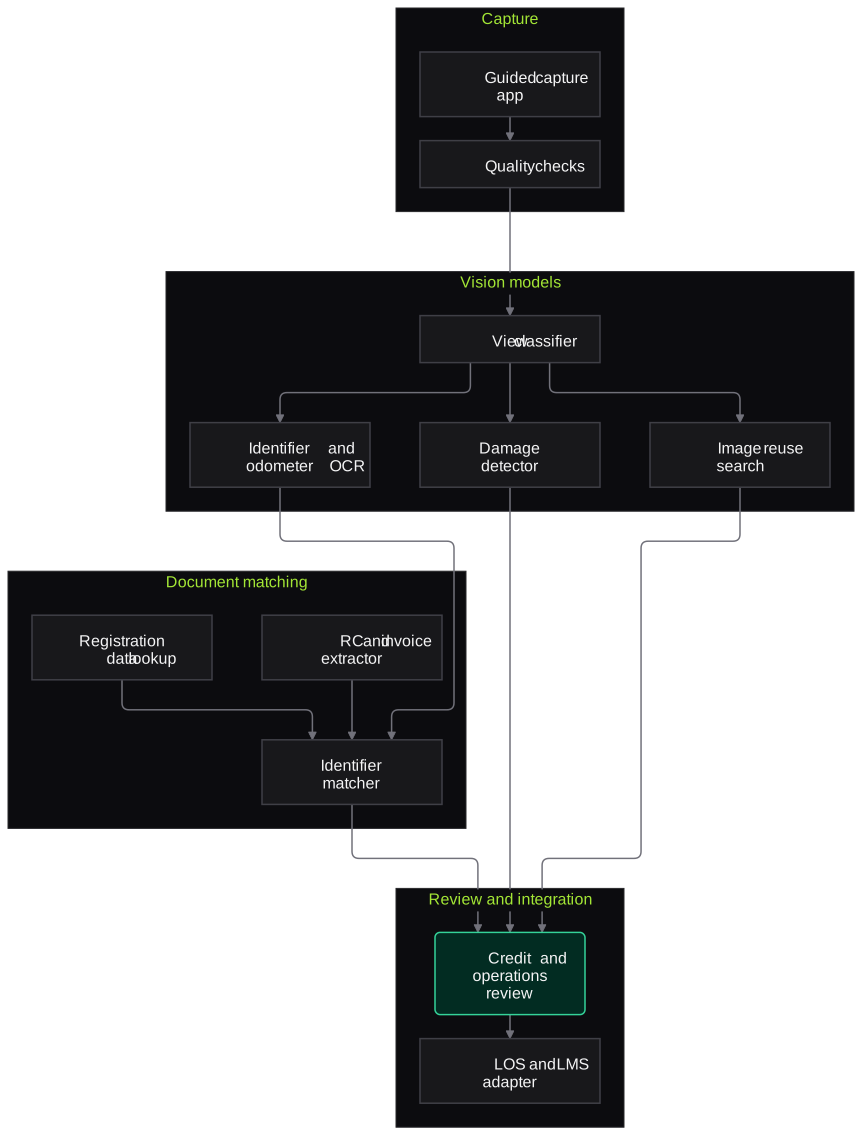
We build an inspection service for vehicle and equipment finance. Field staff or dealers capture a guided set of photos in the lender's app, including front, rear, sides, chassis plate, engine number, odometer and number plate. Models check that each required view is present and usable, read identifiers and odometer values, detect visible damage and missing parts, and search for the same images in past applications. Extracted values are compared with the RC, invoice, insurance and valuation report, and with registration details from an authorised Vahan data provider where the lender uses one. Each case gets a list of matches and mismatches, and credit or operations staff decide what to accept.
- Guided capture checks that every required view is present, sharp and well lit
- OCR of chassis, engine and registration numbers and odometer readings
- Matching against RC, tax invoice, insurance policy and valuation report
- Visible damage and missing-part detection to support the valuer
- Duplicate and near-duplicate image search across past applications
- Post-disbursement checks for delivery photos and RC hypothecation endorsement
How it works
- 01Capture photosField staff, valuers or dealers capture the guided photo set in the app, with time and location recorded.
- 02Check capture qualityMissing views, blur or glare are flagged at once so the photographer can retake them on the spot.
- 03Read and detectModels read identifiers and the odometer, detect damage and missing parts, and search for reused images.
- 04Match against documentsValues are compared with the RC, invoice, insurance, valuation report and registration data.
- 05Credit or operations reviewMismatches, damage flags and reuse alerts go to the credit manager or operations reviewer with evidence.
- 06Record in the loan fileThe verified asset record and decisions are written to the LOS or LMS.

Architecture
- Capture
- Guided capture flow in field or dealer app
- On-device checks for blur and framing
- Vision models
- View classifier
- Identifier and odometer OCR
- Damage and missing-part detector
- Image reuse search
- Document matching
- RC, invoice and insurance extractor
- Registration data lookup through an authorised provider
- Identifier and attribute matcher
- Review
- Credit and operations review screen
- Post-disbursement follow-up tracker
- Integration
- LOS and LMS adapters
- Audit log
Inputs and outputs
Inputs
- Guided vehicle photo set with time and location
- Registration certificate and tax invoice
- Insurance policy and valuation report
- Registration details from an authorised Vahan data provider, where used
- Delivery photos and RC with hypothecation after disbursement
Outputs
- Extracted chassis, engine, registration and odometer values
- Match and mismatch list against documents
- Damage and missing-part flags with images
- Image reuse alerts
- Verified asset record in the loan file
Where people stay in control
Credit managers and operations reviewers decide on every mismatch, damage flag and reuse alert. Valuation stays with your empanelled valuers; damage detection supports their report rather than replacing it.
Integrations
- Loan origination and loan management systems
- Field, valuer or dealer mobile app
- Authorised vehicle registration data provider
- Valuer and dealer portals
- Document management system
Guardrails
- Identifier matches require exact agreement; partial reads go to review
- No automatic valuation or rejection
- Image reuse checked only within the lender's own application history
- Photos and registration data retained per policy with access controls
- Models re-evaluated when new vehicle types or capture devices are added
Compliance notes
- Supports asset verification within the lender's credit policy; credit and valuation decisions stay with authorised staff.
- Personal data on RCs and invoices is handled with purpose limitation under the DPDP Act 2023.
A typical pilot
Duration: 4 weeks
Used car or tractor loans from one region, using historical photo sets with known outcomes, then live capture through the app for new applications.
Deliverables
- 01Guided capture flow and quality checks
- 02Identifier OCR and document matching on historical cases
- 03Damage and reuse detection results
- 04Review screen for credit and operations
- 05Roll-out plan covering post-disbursement checks
What we measure
- Identifier reading accuracy
- Chassis, engine and plate numbers compared with verified values from RCs.
- Mismatch detection
- Known mismatched or fraudulent cases from history flagged by the service.
- Retakes at capture
- Photo sets needing retakes, and whether the retake resolved the issue.
- Review time per case
- Time for reviewers to clear a case with and without the service.
FAQs
01Does it value the vehicle?
No. It reads identifiers, checks documents and highlights visible damage to support your valuer. The valuation and the loan amount remain decisions for your valuer and credit team.
02Will it work on tractors and commercial vehicles?
Yes, with capture guides for each asset type, since chassis plate positions and required views differ. The pilot can focus on the asset class that matters most to you.
03What if the chassis number is rusted or partly hidden?
The model reports a partial read with low confidence and sends it for review. It never fills in missing characters by guesswork.
04Can it check vehicle registration data?
Where you use an authorised provider for Vahan registration data, we compare those details with the RC and photos. We do not access government systems outside such authorised arrangements.
Related use cases
- NBFCs & Lending
Field Collection Visit Photo Verification
Check geo-tagged photos from field collection visits for location, time, live capture and reuse, so collection managers can trust visit records and spot conduct problems early.
- NBFCs & Lending
Loan Application Document Extraction
Read loan files from branches, DSAs and digital journeys, extract KYC, income and business fields into your LOS, and flag missing or inconsistent documents before credit review.
- Automotive & Mobility
Used Car Inspection and Damage Detection
Guided photo capture and damage detection for used-car evaluations, with panel-wise damage maps, odometer and chassis checks and draft refurbishment items for evaluators to confirm.
- Automotive & Mobility
RC, Insurance and PUC Document Extraction
Extract and cross-check registration, chassis, owner, hypothecation and validity details from RC, insurance, PUC and fitness documents for used-car, fleet and onboarding teams.

Founded by Akhilesh Mittal. 8 years building a security platform for a New Zealand company. IIT ISM Dhanbad and IMT Ghaziabad. Builds production agentic AI.
Test one lending workflow on your own files
Book a discovery call to scope a short pilot, from statement analysis to a conduct-safe reminder agent, and judge it on measured results before scaling.