EMI Reminder and Payment-Link Agent (Voice + WhatsApp)
Pre-due EMI reminders and bounce follow-ups by WhatsApp and voice in the borrower's language, with UPI payment links, mandate help and receipts, before accounts reach collections.
- Industry:
- NBFCs & Lending
Who it is for
- Head of Customer Service
- Head of Collections
- Digital Channels Manager
- Branch Operations Head
The problem
Many missed EMIs are not about unwillingness to pay: a low balance on the debit date, a mandate that failed to register, a changed bank account or a simple lapse of memory. A timely reminder in the borrower's language, with a way to pay at once, can stop some of these accounts from ever reaching a collector.
Generic SMS reminders
English SMS reminders are ignored or misunderstood by borrowers who prefer Hindi or a regional language.
Bounces discovered after the fact
When a NACH debit is returned, borrowers often do not know until a collector calls, and bounce charges add friction.
Mandate and account problems
Failed mandate registrations and changed bank accounts need a guided fix, which branch staff handle one call at a time.
No two-way conversation
One-way messages cannot answer simple questions about the amount due, charges or how to pay, so borrowers call or visit the branch instead.
What we build
We build a reminder agent that works on WhatsApp and by voice, chosen per borrower from consent, preference and past responses. Before the due date it sends a WhatsApp template reminder with the amount and date, and calls borrowers who do not read messages or have missed before. On a NACH or e-mandate return, it informs the borrower, explains charges from your schedule and shares a UPI payment link. It answers common questions from approved content, guides mandate re-registration through your existing link, confirms payments when the gateway reports them and sends a receipt. Anything outside its scope goes to customer service with the conversation history.
- WhatsApp template reminders and two-way chat in English, Hindi and regional languages
- Outbound reminder calls for borrowers who prefer voice or have missed before
- NACH and e-mandate bounce notices with charges taken from the lender's schedule
- UPI payment links and QR codes, with payment confirmation and receipts
- Guided mandate re-registration and bank account change through the lender's existing journey
- Channel and timing choice per borrower based on consent and response history
How it works
- 01Pick the cohortAccounts due in the coming days, or with a fresh mandate return, are selected from the LMS with consent and language preferences.
- 02Choose channel and timeThe agent selects WhatsApp, voice or both for each borrower, within permitted hours and frequency limits.
- 03Remind and informIt sends the reminder or bounce notice with amount, date and charges from the lender's records.
- 04Answer and offer paymentIt answers questions from approved content and shares a UPI payment link or a mandate fix link.
- 05Route exceptionsDisputes, hardship, complaints or unclear requests go to customer service with the conversation history.
- 06Confirm and recordPayments are confirmed from the gateway, receipts are sent and outcomes are written back to the LMS.

Architecture
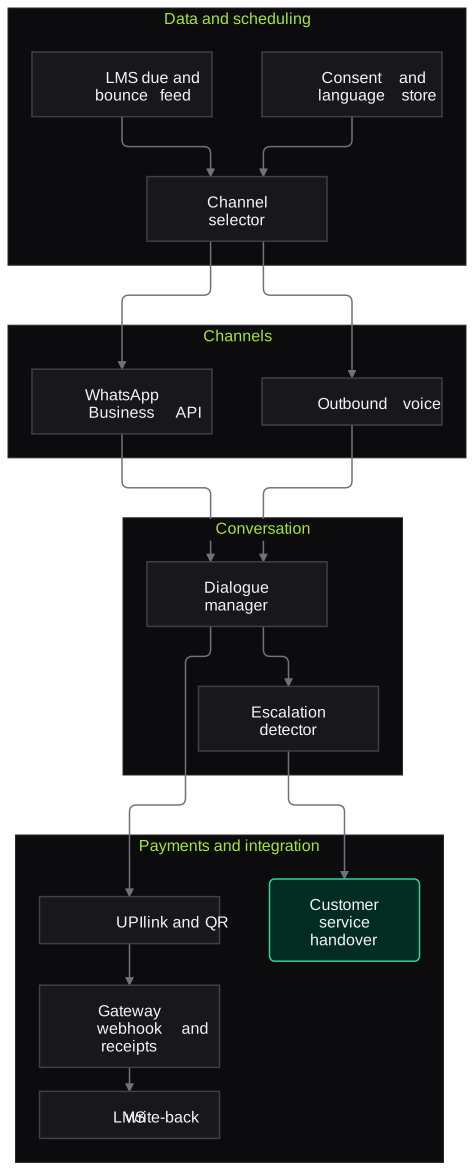
- Data and scheduling
- LMS due-date and mandate return feed
- Consent and language preference store
- Channel and timing selector
- Channels
- WhatsApp Business API with approved templates
- Outbound voice with Indian-language speech
- SMS fallback
- Conversation
- LLM dialogue manager limited to approved content
- Intent and escalation detection
- Payments
- UPI payment link and QR generator
- Payment gateway status webhook
- Receipt generator
- Integration and reporting
- LMS write-back adapter
- Customer service handover
- Reminder outcome dashboard
Inputs and outputs
Inputs
- Upcoming dues and mandate return data from the LMS
- Borrower consent, language and channel preferences
- Approved WhatsApp templates and voice scripts
- Charges schedule and approved FAQ content
- Payment gateway status events
Outputs
- Reminders and bounce notices delivered per channel
- UPI payment links, confirmations and receipts
- Mandate re-registration requests started
- Escalations to customer service with context
- Reminder outcome and payment reports
Where people stay in control
Customer service staff take disputes, hardship cases, complaints and any request outside the approved scope. Collections and compliance teams approve templates, scripts and contact rules before use.
Integrations
- Loan management system
- WhatsApp Business API through an approved provider
- Voice dialler or telephony provider
- Payment gateway or UPI payment link provider
- NACH and e-mandate management platform
Guardrails
- WhatsApp messages only to borrowers with recorded consent, using approved templates
- Amounts and charges always read from the LMS, never generated by the model
- Payment links only from the lender's gateway, never to personal accounts or third-party UPI IDs
- Frequency caps and permitted hours per borrower
- Opt-out from WhatsApp and calls honoured immediately
Compliance notes
- Designed to support the RBI digital lending requirement that repayments go directly to the lender's account without third-party pool accounts, and DPDP Act 2023 consent requirements.
- Reminder templates carry no promotional content; channel use follows WhatsApp policies and TRAI commercial communication rules.
A typical pilot
Duration: 3 weeks
Pre-due reminders and NACH bounce follow-ups for one product in two languages, compared with the current SMS reminder process on a matched group of accounts.
Deliverables
- 01Approved templates, scripts and contact rules
- 02Working WhatsApp and voice reminder agent
- 03Payment link and receipt integration
- 04Comparison report against current reminders
- 05Plan for further products and languages
What we measure
- On-time payment against control
- Payment by the due date for borrowers reached by the agent, compared with a matched group on current reminders.
- Bounce cure before collections
- Bounced accounts paid before moving to the collections queue, compared with the control group.
- Engagement by channel and language
- WhatsApp replies and call connects by language, tracked for each cohort.
- Escalations and opt-outs
- Escalations, complaints and opt-outs per contact, with reasons.
Built on related work
WhatsApp hotel booking assistant
Hotel property (anonymised)
WhatsApp Cloud API booking flow with availability checks, room, date and guest selection, rates, UPI or QR payment, confirmation and a room catalogue.
FAQs
01Why both WhatsApp and voice?
Borrowers differ. Some read and reply on WhatsApp, others need a call, and some do not use a smartphone. The agent chooses per borrower and learns from who responds where.
02Can borrowers pay from within WhatsApp?
They receive a UPI link or QR code from your payment gateway, which opens their UPI app. Payment goes directly to your collection account, and the agent confirms it when the gateway reports success.
03How is this different from a collections agent?
This agent is a service touch before and just after a missed debit, focused on information and easy payment. Accounts overdue beyond the stage you define move to the collections workflow and its stricter conduct controls.
04Do we need new WhatsApp templates?
Usually yes. We draft utility templates with your team for approval through your WhatsApp provider, in each language you need.
Related use cases
- NBFCs & Lending
Collections Voice Agent with Conduct Guardrails
A collections voice agent for early-bucket accounts that speaks Hindi, Hinglish and regional languages, captures promises to pay and disputes, and enforces conduct rules on every sentence.
- NBFCs & Lending
Loan Lead Qualification Agent for DSA and Web Leads
Contact new loan leads from DSAs, aggregators and your website within minutes by voice or WhatsApp, check serviceability and basic fit with consent, and route ready applicants to sales.
- NBFCs & Lending
Conduct Testing for Collections Voice Agents
Test collections voice agents, in-house or vendor-built, for harassment, third-party disclosure, misrepresentation and vulnerable-borrower handling in Hindi and Hinglish, with audio evidence.
- Education & Coaching
Fee Reminder Agent (Voice + WhatsApp)
Remind parents of upcoming and overdue fee instalments on WhatsApp and by voice in their language, share a UPI link, confirm payments and route hardship requests to the accounts office.

Founded by Akhilesh Mittal. 8 years building a security platform for a New Zealand company. IIT ISM Dhanbad and IMT Ghaziabad. Builds production agentic AI.
Test one lending workflow on your own files
Book a discovery call to scope a short pilot, from statement analysis to a conduct-safe reminder agent, and judge it on measured results before scaling.