Parcel Damage and Dimension Detection
Camera stations at induction, sortation and dispatch measure each parcel for volumetric weight and flag visible damage, keeping time-stamped images as evidence for claims and billing.
- Capability:
- Computer Vision
- Industry:
- Logistics & Supply Chain
Who it is for
- Hub Operations Manager
- Head of Network Operations
- Claims and Loss Prevention Manager
- Revenue Assurance Manager
The problem
Parcels pass through first-mile pickup, origin hub, line-haul, destination hub and last mile, and damage can happen at any step. When a customer raises a claim, nobody can show where it occurred. At the same time, shipper-declared dimensions are often wrong, so volumetric weight goes under-billed.
No evidence of where damage occurred
Without images at each handover, damage claims turn into disputes between hubs, line-haul vendors and the shipper.
Under-declared dimensions
Shippers declare smaller dimensions or weights than actual, and the revenue difference is lost unless parcels are measured.
Manual measurement does not scale
Tape measurement at induction is slow and inconsistent, and gets skipped during peaks.
Damaged parcels move forward
Crushed, torn or wet parcels continue to the customer and come back as refusals and returns that could have been handled at the hub.
What we build
We build camera stations for induction points, sorters and dispatch docks. Each parcel is captured from several angles as it passes; a depth or stereo camera measures length, width and height, and the system computes volumetric weight using your formula. A damage model checks for crushed corners, tears, punctures, wet patches and broken tape. The AWB or barcode is read so every image links to the shipment. Dimension differences beyond your tolerance go to revenue assurance for review, and damaged parcels are diverted to an exceptions bay for a hub supervisor to inspect.
- Measures length, width and height with depth or stereo cameras at conveyor speed
- Computes volumetric weight with your formula and compares it with declared values
- Detects visible damage such as crushed corners, tears, punctures, wet patches and broken tape
- Reads AWB and barcodes so each image links to the shipment
- Stores time-stamped images at each scan point as handover evidence
- Feeds dimension variances to billing and damage events to claims
How it works
- 01Parcel reaches the stationA sensor triggers capture as the parcel passes on the conveyor or is placed on a scan table.
- 02Read barcode and captureThe AWB is read and images plus depth data are captured from several angles.
- 03Measure and assessDimensions and volumetric weight are computed, and the damage model scores each visible face.
- 04Route by resultDamaged parcels are diverted to an exceptions bay, and dimension variances go to revenue assurance.
- 05Human inspectionA hub supervisor inspects diverted parcels and decides to repack, hold or forward; revenue assurance reviews variances.
- 06Update systemsResults, images and decisions are written to the shipment record for billing and claims.

Architecture
- Station hardware
- Area and depth cameras with lighting
- Conveyor sensor trigger
- Barcode reader
- Vision processing
- Dimension estimation from depth data
- Damage detection model
- Image quality check
- Business rules
- Volumetric formula per customer or carrier
- Variance and damage thresholds
- Divert logic to the sorter
- Records and review
- Shipment image archive
- Supervisor inspection app
- Billing and claims integration
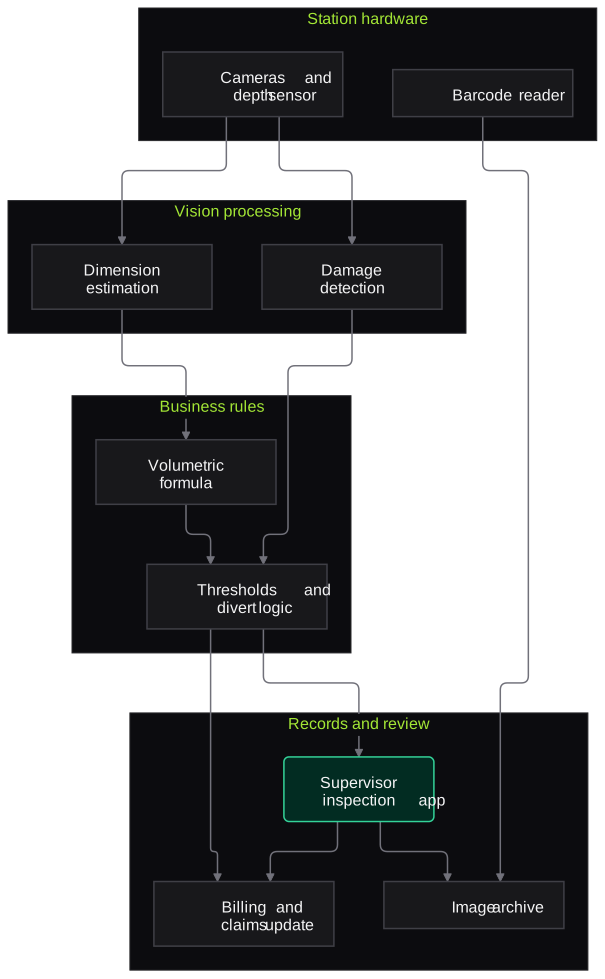
Inputs and outputs
Inputs
- Images and depth data from station cameras
- AWB or barcode scans
- Declared dimensions and weight from the booking
- Customer-specific volumetric formulas and tolerances
- Damage categories agreed with the claims team
Outputs
- Measured dimensions and volumetric weight per parcel
- Variance records for revenue assurance review
- Damage flags with images and severity
- Handover evidence per scan point
- Hub-wise damage trends
Where people stay in control
Hub supervisors confirm damage on every diverted parcel and decide whether to repack, hold or forward it. Revenue assurance reviews dimension variances before any weight adjustment is raised with the shipper.
Integrations
- Sorter and conveyor PLC
- WMS or hub management system
- TMS or shipment database
- Billing system for weight adjustments
- Claims management system
Guardrails
- Calibration checks with reference boxes at the start of each shift
- Weight adjustments only after human review of variance and images
- Damage flags never close a claim automatically
- Image retention aligned with your claim windows
- Camera fields of view set to avoid worker faces where possible
Compliance notes
- Where measurements are used for billing, check whether the measuring setup needs approval or verification under India's Legal Metrology rules or local equivalents.
- Workers captured incidentally in images are personal data under the DPDP Act 2023, so camera placement and retention are planned accordingly.
A typical pilot
Duration: 6 weeks
One induction line at one hub, with results logged alongside manual measurement and inspection for comparison.
Deliverables
- 01Camera station specification and installation on the pilot line
- 02Dimension and damage models tuned to your parcel mix
- 03Supervisor inspection app
- 04Comparison report against manual measurement and inspection
- 05Network roll-out plan
What we measure
- Dimension accuracy
- System measurements compared with manual tape measurements on a sample of parcels.
- Damage detection agreement
- System damage flags compared with supervisor inspection of the same parcels.
- Capture rate
- Parcels with a successful barcode read and full image set, out of all parcels inducted.
- Variances confirmed
- Volumetric weight differences that revenue assurance confirms during the pilot.
FAQs
01Can it run at sorter speed?
Capture and inference run on an edge device at the station, and cameras are chosen for your belt speed and parcel size range. The pilot measures capture rate at your actual throughput.
02Does it work on polybags and irregular items?
Polybags and irregular shapes are harder to measure than boxes. Each measurement carries a confidence score, and low-confidence items can be routed to manual measurement.
03Can we use our existing CCTV?
General CCTV angles and resolution are rarely enough for measurement, though they can sometimes support damage evidence. We assess your current cameras in the first week.
04How does this help with damage claims?
Each parcel has time-stamped images at every scan point. When a claim arrives, your team can see the parcel's condition at each handover and where damage first appeared.
Related use cases
- Logistics & Supply Chain
Proof of Delivery Capture and Verification
Check every POD photo or scan for consignment number, date, signature, stamp and remarks, match it to the shipment in your TMS, and flag short, damaged or doubtful deliveries before billing.
- Logistics & Supply Chain
Warehouse Safety Monitoring
Use existing or added CCTV to spot forklift and pedestrian near-misses, missing PPE, blocked fire exits and people in restricted zones, with alerts to supervisors and evidence for safety reviews.
- Logistics & Supply Chain
Freight Invoice Audit Against Rate Contracts
Audit every carrier or transporter freight bill against your rate contracts, shipment data and PODs, recalculate each charge and flag overbilling, duplicates and unsupported surcharges.
- Retail, D2C & Quick Commerce
Dark-Store Picking and Packing QC
A camera at the packing station checks each tote against the order before the bag is sealed, catching wrong variants, missing items and near-expiry stock, and keeps an image per order.

Founded by Akhilesh Mittal. 8 years building a security platform for a New Zealand company. IIT ISM Dhanbad and IMT Ghaziabad. Builds production agentic AI.
Start with one lane, one carrier or one hub
Book a discovery call to pick a narrow pilot on your own PODs, freight bills or customer calls, and compare the results with your team's current process.