Contract Clause Extraction and Risk Flags
Extract key clauses, dates and obligations from executed and incoming contracts, compare them with your playbook and flag deviations, with every item linked to the clause it came from.
- Capability:
- Document Intelligence
- Industry:
- Legal
Who it is for
- General Counsel
- Head of Legal Operations
- Contract Manager
- Law Firm Partner (Commercial)
The problem
Most organisations hold years of executed contracts as scanned PDFs on shared drives: MSAs, SOWs, leases, distribution and vendor agreements, each with amendments and side letters. Nobody can say quickly which contracts auto-renew next quarter, which carry uncapped indemnities or which need consent on a change of control.
Unknown obligations
Renewal dates, notice periods, exclusivity and minimum commitments are buried in clauses that nobody re-reads after signing.
Amendments change the picture
Addenda and side letters modify the main agreement, and a review that misses them gives the wrong answer.
Inconsistent first-pass review
Different lawyers flag different risks in incoming paper, so the business gets uneven turnaround and advice.
Scanned and stamped documents
Contracts executed on stamp paper, signed by hand and scanned at low quality defeat simple text search.
What we build
We build a contract review pipeline that reads executed and incoming contracts, including scanned and stamped copies, splits them into clauses and links amendments to the clauses they change. It extracts the terms your team cares about, such as parties, term, renewal, termination rights, notice periods, liability caps, indemnities, governing law, dispute resolution, assignment, change of control and data protection, each with a citation to clause and page. Extracted positions are compared with your playbook and fallbacks, and deviations are flagged with the reason. Lawyers review flags on one screen, and confirmed data feeds your contract repository and renewal calendar.
- Clause segmentation for scanned, stamped and signed contracts in English and Hindi
- Links amendments, addenda and side letters to the clauses they modify
- Extracts parties, dates, renewal, termination, liability, indemnity, governing law and dispute resolution
- Compares each position with your standard and fallback positions
- Flags missing clauses, such as data protection or limitation of liability
- Builds an obligation and renewal calendar from confirmed data
How it works
- 01Collect contractsContracts are loaded from shared drives, the CLM or email, and grouped with their amendments.
- 02Segment and readOCR and layout analysis split each document into numbered clauses and schedules.
- 03Extract key termsAgreed fields are extracted, each with a confidence score and a clause citation.
- 04Compare with the playbookPositions are checked against your standard and fallback positions, and gaps are flagged.
- 05Lawyer reviewA lawyer confirms, corrects or dismisses each flag and each low-confidence field.
- 06Update the repositoryConfirmed terms go to the contract repository, and renewal and notice alerts are scheduled.

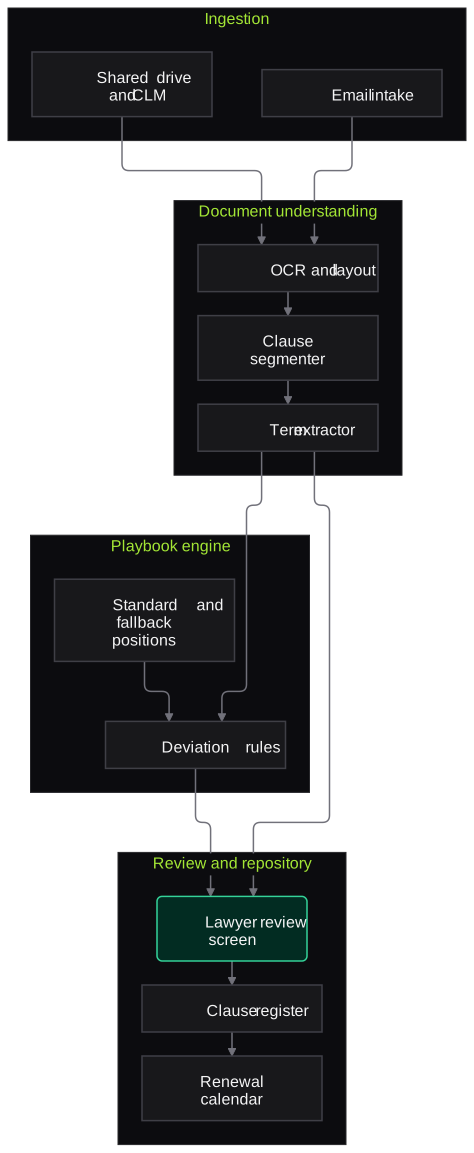
Architecture
- Ingestion
- Shared drive and CLM connectors
- Email intake for counterparty paper
- Amendment grouping by contract
- Document understanding
- OCR with layout and stamp detection
- Clause segmenter
- LLM term extractor with schemas
- Playbook engine
- Standard and fallback positions per clause
- Deviation and missing-clause rules
- Risk rating logic agreed with legal
- Review
- Lawyer review screen with clause highlights
- Decision and comment log
- Repository and alerts
- Clause register export to the CLM
- Renewal and notice calendar
- Audit trail
Inputs and outputs
Inputs
- Executed contracts, including scanned and stamped copies
- Amendments, addenda and side letters
- Incoming counterparty drafts
- Your contract playbook and fallback positions
- List of fields and risk categories to track
Outputs
- Clause register with citations to clause and page
- Deviation and missing-clause flags with reasons
- Renewal, notice and obligation calendar
- Portfolio view of risk positions across contracts
- Audit trail of lawyer confirmations
Where people stay in control
A lawyer confirms every flagged deviation and every low-confidence field before it enters the register. Risk ratings are suggestions; legal decides what is acceptable and what to renegotiate.
Integrations
- Contract lifecycle management system
- Document management system such as iManage or SharePoint
- Email for counterparty paper
- Calendar and task tools for renewal alerts
- ERP or procurement system for vendor master data
Guardrails
- Every extracted value cites the clause and page it came from
- Playbook positions owned and versioned by the legal team
- No contract marked acceptable without lawyer review
- Documents processed in your environment, and models do not train on them
- Matter or business-unit access controls carried into the tool
Compliance notes
- Contracts contain personal data of signatories and counterparties; designed to support DPDP Act 2023 security safeguards and access control.
- The tool supports lawyers' review; it does not provide legal advice.
A typical pilot
Duration: 4 weeks
One contract type, such as vendor MSAs or commercial leases, using a sample of executed agreements whose positions your team already knows.
Deliverables
- 01Field list and playbook encoded with your legal team
- 02Clause register for the pilot set
- 03Lawyer review screen
- 04Accuracy report against lawyer-reviewed answers
- 05Roll-out plan and cost estimate
What we measure
- Field extraction accuracy
- Compared with a lawyer-prepared answer sheet for the pilot contracts.
- Deviation flag precision
- Share of flags the reviewing lawyer confirmed as genuine.
- Missed issues
- Issues found by lawyers that the system did not flag, from a blind sample.
- Review time per contract
- Timed for comparable contracts with and without the tool.
FAQs
01Will it work on old scanned contracts?
Yes, within limits. OCR handles most scans and stamp-paper first pages, and fields it cannot read confidently go to a lawyer. The pilot report separates accuracy for digital and scanned documents.
02Can we use our own playbook?
Yes. The playbook is configuration owned by your legal team, with standard positions, fallbacks and escalation rules for each clause.
03Does it understand amendments?
It links amendments and side letters to the clauses they change and shows the current position with its history. Lawyers confirm the link when it is uncertain.
04Is our data used to train models?
No. We use models and settings that do not retain or train on your documents, and processing stays in your cloud account or chosen region.
Related use cases
- Legal
NDA Review and Redline Suggestions
Review incoming NDAs against your playbook, produce tracked-change redlines with comments in Word, and send only the non-standard ones for full lawyer review, so routine NDAs stop queuing.
- Legal
Due Diligence Data Room Review
Index a virtual data room against your request list, extract issues from contracts, corporate records and licences, and draft report tables and query lists for lawyers to confirm.
- Legal
Confidentiality and Privilege Leakage Testing for Legal AI
Test your legal copilot, contract tool or client chatbot for cross-matter leakage, privilege exposure, prompt injection hidden in documents and weak access controls, with evidence and fixes.
- Real Estate & Construction
Sale Agreement and Title Document Review
Check each agreement for sale against the booking form, cost sheet and RERA record, and build a title chain from land documents with gaps flagged for your advocate.

Founded by Akhilesh Mittal. 8 years building a security platform for a New Zealand company. IIT ISM Dhanbad and IMT Ghaziabad. Builds production agentic AI.
Bring one matter type or one contract stack
Pick a workflow that hurts, such as NDA review, cause list tracking or a diligence index. We will run a short pilot on de-identified or consented documents and go through the output with your lawyers line by line.