Bulk Legal Notice Drafting and Tracking
Draft demand, recall and statutory notices in bulk from advocate-approved templates, validate every field and deadline, track postal delivery and assemble filing-ready evidence packets.
- Capability:
- Document Intelligence
- Industry:
- Legal
Who it is for
- Head of Legal, Bank or NBFC
- Collections and Recovery Head
- Partner, Panel Advocate Firm
- Legal Operations Manager
The problem
Lenders, fintechs, telecom companies and developers send legal notices at volume: demand notices for dishonoured cheques under Section 138 of the Negotiable Instruments Act, loan recall notices, SARFAESI demand notices and arbitration invocation notices. Each must carry the right facts and go out within statutory or contractual time limits, and errors surface months later when a complaint or application is filed.
Copy-paste errors
Wrong amounts, cheque numbers, dates or addresses in a notice can weaken the very case it was meant to support.
Time limits
Notices tied to statutory windows, such as cheque dishonour, must go out in time, and batches slip when data arrives late.
Proof of dispatch and delivery
Postal receipts, tracking results and returned envelopes are scattered, which makes assembling a complaint file slow.
Language and tone
Notices need the right language for the recipient's state, and wording must avoid anything that could be read as coercive.
What we build
We build a notice engine that takes case data from your loan management, collections or CRM system and generates notices from templates approved by your advocates, in English, Hindi or regional languages. Each record is validated before drafting: amounts against the ledger, cheque and return memo details, dates against the applicable time limit and addresses against the latest KYC. Exceptions go to legal operations. The advocate reviews a sample and approves each batch, and notices are signed and dispatched by Speed Post, registered post or email as required. Delivery status is tracked, and the engine assembles a packet of notice, proof of dispatch and delivery for filing.
- Template library for each notice type and language, approved and versioned by advocates
- Field validation against ledgers, return memos and KYC addresses
- Deadline checks against statutory or contractual time limits for each notice type
- Batch approval workflow with advocate sampling and digital signature
- Dispatch and delivery tracking for Speed Post, registered post and email
- Filing-ready packets with notice, dispatch proof, tracking record and any reply
How it works
- 01Pull case dataRecords for the batch are pulled from the loan, collections or CRM system with supporting documents.
- 02Validate data and timelinesAmounts, dates, cheque details and addresses are checked, and any record near or past its time limit is flagged.
- 03Generate noticesNotices are drafted from approved templates in the recipient's language.
- 04Advocate approvalLegal operations clears exceptions, and the advocate reviews a sample and approves the batch.
- 05Sign and dispatchNotices are signed and sent by the required mode, and dispatch proofs are captured.
- 06Track and packageDelivery status and replies are tracked, and a filing-ready packet is assembled for each case.

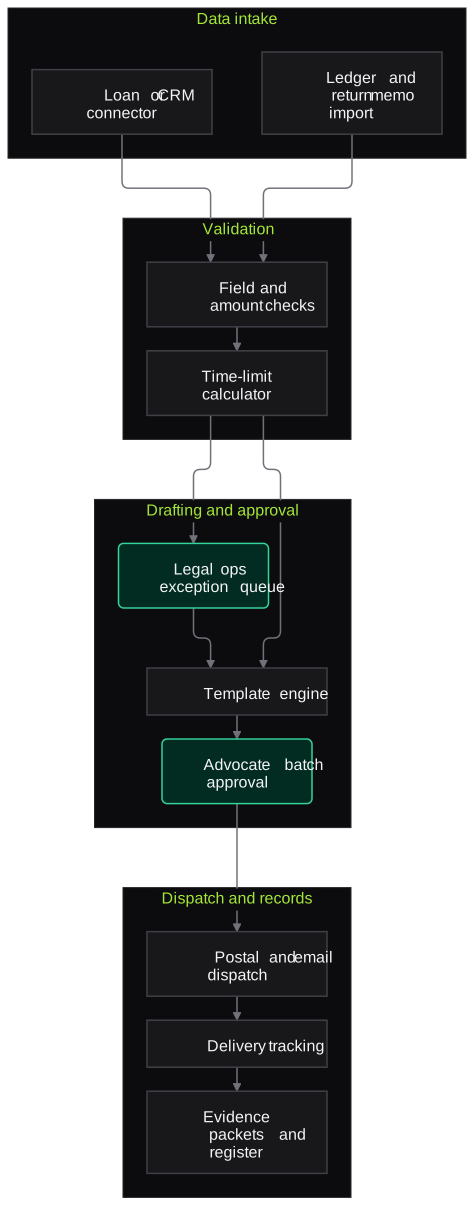
Architecture
- Data intake
- Loan management, collections or CRM connector
- Return memo and ledger import
- KYC address lookup
- Validation
- Field and amount checks
- Time-limit calculator per notice type
- Duplicate notice detection
- Drafting and approval
- Template engine with language variants
- Exception queue for legal operations
- Advocate batch approval and digital signature
- Dispatch and tracking
- Postal booking and tracking integration
- Email dispatch with delivery logs
- Capture of replies and returned envelopes
- Case records
- Evidence packet generator
- Notice register and audit trail
Inputs and outputs
Inputs
- Borrower or customer records from the loan, collections or CRM system
- Cheque return memos and ledger statements
- Latest KYC addresses and contact details
- Advocate-approved notice templates for each type and language
- Batch instructions and signing advocate details
Outputs
- Validated, signed notices for each case
- Exception list with reasons
- Dispatch proofs and delivery status
- Replies and returned envelopes logged
- Filing-ready evidence packet for each case
Where people stay in control
Legal operations resolves every data exception, and the signing advocate reviews samples and approves each batch before dispatch. Decisions to file complaints or applications after the notice period are taken by the advocate and the client.
Integrations
- Loan management or collections system
- CRM or customer master
- India Post or courier booking and tracking
- Email and digital signature service
- Document management system
Guardrails
- Templates used only in versions approved by the advocate
- Records with missing or conflicting data are never drafted automatically
- Time-limit warnings shown before batch approval
- No threatening or coercive wording; lender notices reviewed against RBI fair practices expectations
- Full audit trail from source data to dispatched notice
Compliance notes
- Lenders should align notice wording and contact with RBI fair practices and recovery conduct expectations.
- Borrower and customer data is personal data under the DPDP Act 2023, and notices use only what the purpose requires.
- Electronic signatures and records should meet the Information Technology Act 2000 requirements your advocates rely on.
A typical pilot
Duration: 3 weeks
One notice type, such as cheque dishonour demand notices for one product, run on a past batch and then on a live batch with advocate approval.
Deliverables
- 01Approved templates and validation rules for the pilot notice type
- 02Working notice engine connected to your data
- 03Exception and approval screens
- 04Delivery tracking and evidence packet output
- 05Roll-out plan and cost estimate
What we measure
- Data exceptions caught
- Records flagged before drafting and confirmed by legal operations as genuine errors.
- Corrections after approval
- Errors found after advocate approval, from the notice register.
- Dispatch within time limit
- Notices dispatched within the applicable window, from the time-limit calculator and dispatch proofs.
- Packet completeness
- Cases whose evidence packet had every required item when checked by the advocate.
FAQs
01Which notice types can it handle?
Any notice your advocates can express as an approved template with defined data fields, such as cheque dishonour demand notices, loan recall notices, SARFAESI demand notices or arbitration invocation notices. We start with one type in the pilot.
02Who signs the notices?
Your advocate. The engine prepares and validates; the advocate approves the batch and signs, digitally or physically, according to the mode required.
03How do you handle time limits?
Each notice type has its time limit encoded with your advocates, and the engine calculates the window from the source dates. Records close to or past the limit are flagged before approval.
04Can notices go by WhatsApp or email?
They can, where your advocates consider those modes appropriate for the notice type. Postal dispatch with tracking remains available and is often needed as proof.
Related use cases
- Legal
Court Order and Cause List Tracking
Track daily cause lists and new orders across the Supreme Court, High Courts, district courts and tribunals for your matters, extract next dates and directions, and alert the responsible counsel.
- Legal
Case File Summarisation and Chronology
Turn a litigation file of pleadings, affidavits, exhibits and orders into an indexed list of dates and events, a party and witness index and issue summaries, each line linked to its page.
- NBFCs & Lending
Collections Voice Agent with Conduct Guardrails
A collections voice agent for early-bucket accounts that speaks Hindi, Hinglish and regional languages, captures promises to pay and disputes, and enforces conduct rules on every sentence.

Founded by Akhilesh Mittal. 8 years building a security platform for a New Zealand company. IIT ISM Dhanbad and IMT Ghaziabad. Builds production agentic AI.
Bring one matter type or one contract stack
Pick a workflow that hurts, such as NDA review, cause list tracking or a diligence index. We will run a short pilot on de-identified or consented documents and go through the output with your lawyers line by line.