Kitchen Hygiene Monitoring
Monitor kitchen cameras for missing caps and gloves, uncovered food, open bins, spills and pests at night, with alerts and daily hygiene summaries reviewed by the chef and hygiene lead.
- Capability:
- Computer Vision
- Industry:
- Hospitality & Travel
Who it is for
- Executive Chef
- F&B Manager
- Food Safety Supervisor
- Hotel General Manager
The problem
Hotel and banquet kitchens run long shifts with permanent and temporary staff, and hygiene depends on habits: caps on, gloves at cold and garnish stations, food covered, bins closed and floors dry. During a large wedding the banquet kitchen brings in extra hands for the day, and the chef cannot watch every station.
Hygiene habits slip during the rush
Caps come off, gloves are skipped at the garnish counter and food sits uncovered when service is at its peak.
Pests seen too late
Rodent and cockroach activity happens at night when the kitchen is empty, and is found only when someone sees droppings or a guest complains.
Temporary staff for events
Extra cooks and helpers for weddings and conferences do not always know the kitchen's hygiene rules.
Audit evidence on paper
Hygiene checklists are filled in at the end of the shift from memory, which gives little assurance to management or an inspector.
What we build
We build hygiene monitoring on your kitchen cameras. Vision models check for caps or hairnets, gloves at defined cold-prep and garnish stations, aprons, food containers left uncovered on counters, open bins, spills on the floor and people in food zones without kitchen attire. At night, when the kitchen is closed, the same cameras watch for rodent and pest movement and send an alert with a short clip. Daytime observations go to a review queue for the chef or food safety supervisor, who confirms them and uses them in shift briefings. Daily summaries by station and shift support your Schedule 4 self-checks without replacing them.
- Cap or hairnet, apron and glove checks at defined stations
- Detection of uncovered food containers, open bins and floor spills
- Night-time rodent and pest movement alerts with short clips
- Kitchen attire check for people entering food zones
- Review queue for the chef and food safety supervisor, with snapshots
- Daily and weekly hygiene summaries by station, shift and event
How it works
- 01Map stations and rulesWe map cameras to stations and agree which rules apply where, for example gloves only at cold prep and garnish.
- 02Monitor during serviceCamera frames are analysed during operating hours for attire, coverings, bins and spills.
- 03Monitor at nightAfter closing, movement in food areas is checked for pests, and alerts are sent with a clip.
- 04Review observationsThe chef or food safety supervisor confirms or dismisses observations from the queue.
- 05Act and briefConfirmed issues are corrected and raised in the next shift briefing, and pest alerts go to the pest control vendor.
- 06SummariseDaily and weekly summaries by station and shift are kept as evidence for internal audits.

Architecture
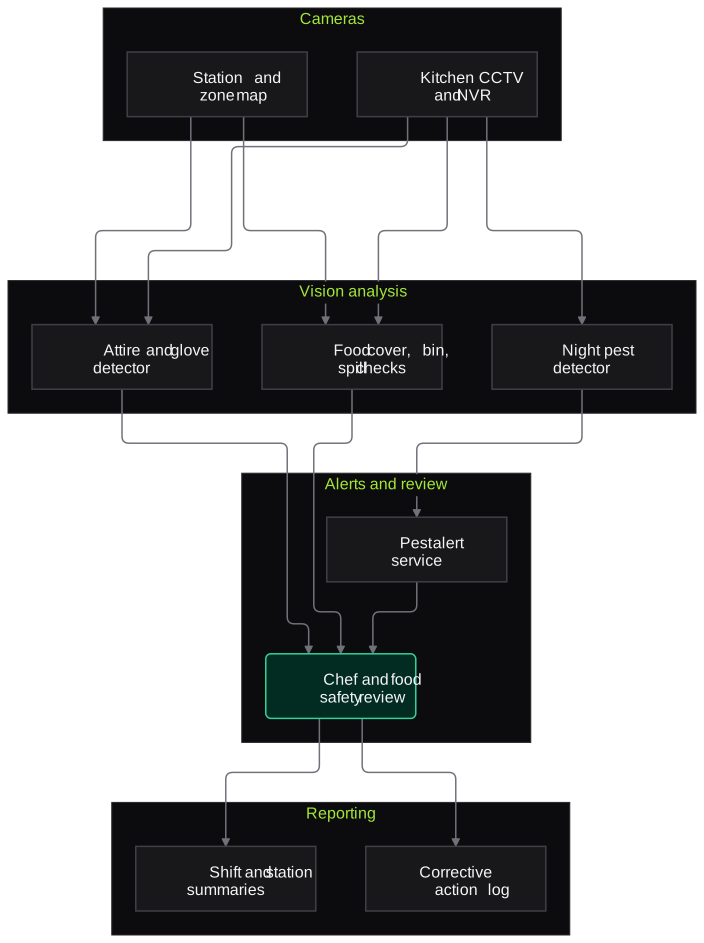
- Cameras
- Existing kitchen CCTV via NVR
- Station and zone map per camera
- Vision analysis
- Attire and glove detector
- Uncovered food, bin and spill detection
- Night pest movement detector
- Alerts and review
- Immediate pest alerts
- Review queue for the chef and food safety supervisor
- Reporting
- Shift and station summaries
- Corrective action log
- Event-day reports for banquets
Inputs and outputs
Inputs
- Existing kitchen CCTV feeds
- Kitchen layout with stations and food zones
- Hygiene rules per station
- Operating hours and event calendar
- Pest control vendor contacts
Outputs
- Observation queue with snapshots and station
- Night pest alerts with clips
- Daily and weekly hygiene summaries
- Corrective action log
- Event-day hygiene reports for banquets
Where people stay in control
The executive chef or food safety supervisor confirms every observation before it is recorded, and decides corrective actions and training. Pest alerts prompt a person to check and call the pest control vendor.
Integrations
- Kitchen CCTV network video recorders
- WhatsApp or SMS for alerts
- Pest control vendor contact workflow
- Hotel quality or audit software
- Email reports to F&B and the GM
Guardrails
- No face recognition; observations relate to stations and rules, not identities
- Footage access limited to the chef, food safety supervisor and GM
- Observations used for coaching, not automatic penalties
- Camera rules reviewed when the kitchen layout changes
- Clear notice to kitchen staff about monitoring and its purpose
Compliance notes
- Helps evidence day-to-day hygiene practices expected under FSSAI's Schedule 4 requirements; it does not replace inspections, licences or a trained food safety supervisor.
- Staff footage is handled with notice, restricted access and retention limits under the DPDP Act 2023.
A typical pilot
Duration: 4 weeks
The main kitchen or banquet kitchen of one property with existing cameras, including at least one large event day and night-time pest monitoring.
Deliverables
- 01Camera and station map with rules
- 02Detection tuned on your kitchen footage
- 03Review queue and alert flow
- 04Pilot hygiene summaries
- 05Roll-out plan and estimate
What we measure
- Observation precision
- Share of observations the chef or food safety supervisor confirms.
- Pest alerts verified
- Night alerts checked against footage review and pest control findings.
- Repeat issues by station
- Count of confirmed issues per station and shift across the pilot weeks.
- Agreement with the paper checklist
- Daily summaries compared with the paper hygiene checklist for the same shifts.
FAQs
01Can it work with our existing kitchen cameras?
Usually, if they cover the stations clearly. Steam, glare and low angles affect accuracy, so we review each camera's view and may suggest small adjustments.
02Will it detect whether hands were washed?
Handwashing duration and technique are hard to judge reliably from ceiling cameras. We can flag whether people visit the handwash station when entering the kitchen, which is a useful prompt but not proof of good handwashing.
03How does night pest detection work?
When the kitchen is closed, movement in food areas is analysed for the shape and motion of rodents and large insects. Alerts include a short clip so the duty manager can judge quickly.
04Will kitchen staff accept it?
It works best when staff are told what is monitored and why, and when observations are used for coaching. Identities are not tracked, and footage access is restricted.
Related use cases
- Hospitality & Travel
Housekeeping Room Inspection from Photos
Check each cleaned room from attendant photos against your room standard: bed, bathroom, amenities, minibar and visible damage, with supervisors confirming before the room is released.
- Hospitality & Travel
Vendor Invoice Processing for Hotels
Read supplier invoices, challans and handwritten market bills, match them to purchase orders, store receipts and agreed rates, and post clean entries to accounts with exceptions flagged.
- Hospitality & Travel
Wedding and Banquet Enquiry Qualification
Qualify wedding and banquet enquiries on WhatsApp and calls: dates, functions, guest counts, menus and rooms, checked against the venue calendar, with indicative packages and visits booked.
- Healthcare & Hospitals
Hand-Hygiene and PPE Compliance Monitoring
Measure hand-hygiene opportunities and PPE use at ICU, ward and OT entry points from cameras, with faces blurred on the device and results shown as unit-level trends for infection control.

Founded by Akhilesh Mittal. 8 years building a security platform for a New Zealand company. IIT ISM Dhanbad and IMT Ghaziabad. Builds production agentic AI.
Start with the enquiries you are missing
Book a discovery call and we will scope a short pilot for one property and one channel, such as WhatsApp bookings or after-hours calls, measured against how you work today.