Post-Discharge Follow-Up Calls
Scripted follow-up calls after discharge, in the patient's language, that check medicines, follow-up visits and clinician-defined warning signs and hand any concern to a nurse.
- Capability:
- Voice AI
- Industry:
- Healthcare & Hospitals
Who it is for
- Nursing Superintendent
- Care Coordination or Patient Experience Manager
- Quality Manager (NABH)
- Head of Clinical Operations
The problem
The days after discharge are when patients are unsure about medicines, miss follow-up visits or notice symptoms they do not know how to judge. Many hospitals intend to call every discharged patient, but nurses and coordinators cannot reach everyone, and the calls that do happen are rarely recorded in a structured way.
Coverage gaps
Follow-up calls happen when staff have time, so many discharged patients are never called.
Late detection of concerns
A patient who has not started their medicines or has a warning sign may only come to notice at readmission.
Unstructured notes
Call outcomes sit in registers or free-text notes, so quality teams cannot see patterns by department.
Language and hearing barriers
Elderly patients and family members need slow, clear calls in their own language, at times that suit them.
What we build
We build an outbound voice agent that calls discharged patients, or their nominated caregiver, at intervals your clinical team sets. It follows a script approved by your doctors and nursing leadership for that department: whether medicines were collected and are being taken as prescribed, whether the follow-up appointment is booked, and a set of yes-or-no questions about warning signs your clinicians define. Answers are recorded in structured form. Any yes to a warning-sign question, any confusion about medicines or any request to speak to someone creates an immediate task for a nurse, who calls back. The agent never interprets symptoms or gives advice.
- Outbound calls at clinician-set intervals after discharge, with retry rules and caregiver contacts
- Department-specific scripts approved by doctors and nursing leadership
- Structured capture of medicine collection, adherence questions and follow-up booking status
- Clinician-defined warning-sign questions with immediate escalation on any positive answer
- Follow-up appointment booking or rebooking during the call
- Department dashboards for quality and patient experience teams
How it works
- 01Schedule from discharge dataDischarged patients, their department, follow-up date and preferred language are pulled from the HIS.
- 02Call the patient or caregiverThe agent calls at the agreed interval and confirms it is speaking with the patient or the nominated caregiver.
- 03Run the approved scriptIt asks about medicines, the follow-up visit and the department's warning-sign questions.
- 04Escalate concernsAny warning sign, confusion or request for a person creates an urgent nurse task with the call summary.
- 05Book the follow-upIf the follow-up visit is not booked, the agent offers slots and books one.
- 06Record and closeStructured answers go to the care coordination dashboard, and nurses close every escalation.

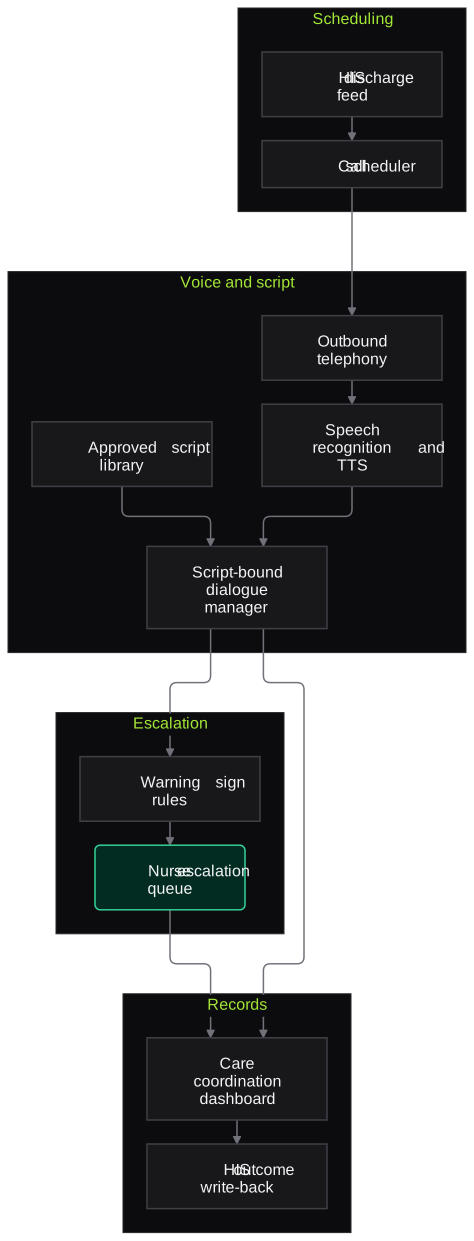
Architecture
- Scheduling
- HIS discharge feed
- Call scheduler with retry and quiet-hour rules
- Voice and script
- Outbound telephony
- Speech recognition and text-to-speech in patient languages
- Clinician-approved script library
- Dialogue manager bound to the script
- Escalation
- Warning-sign rule engine
- Nurse escalation queue
- Records
- Care coordination dashboard
- Structured outcome write-back to HIS
- Recordings and audit log
Inputs and outputs
Inputs
- Discharge list with department, diagnosis category and follow-up date
- Patient and caregiver contact details and preferred language
- Department scripts and warning-sign questions approved by clinicians
- Doctor schedules for follow-up booking
- Nurse escalation roster
Outputs
- Structured call outcome for each patient
- Urgent nurse tasks with call summaries
- Booked or rebooked follow-up appointments
- Department-level follow-up dashboards
- Recordings and transcripts for audit
Where people stay in control
Clinicians write and approve every script and warning-sign question, and a nurse calls back on every escalation. The agent does not interpret answers clinically or tell a patient what to do about a symptom; it routes concerns to people.
Integrations
- HIS discharge and appointment modules
- Cloud telephony provider
- WhatsApp Business API for follow-up confirmations
- Nursing task or care coordination tool
- Quality and patient feedback systems
Guardrails
- Script-bound dialogue, so the agent cannot improvise medical content
- Any positive warning-sign answer escalates, with no model judgement on severity
- Emergency phrases trigger direction to emergency care and an immediate staff alert
- Identity check before any health information is discussed
- Calls only within agreed hours and stopped at the patient's request
Compliance notes
- Patient consent for follow-up calls captured and recorded at discharge, in line with the DPDP Act 2023.
- Designed as a communication aid; clinical assessment of every escalation stays with nurses and doctors.
- Structured outcomes can support the follow-up and patient feedback evidence used in accreditation reviews such as NABH.
A typical pilot
Duration: 4 weeks
Follow-up calls for patients discharged from one or two departments, using a script approved by the department head, with nurses handling every escalation.
Deliverables
- 01Approved department scripts and warning-sign lists
- 02Outbound agent connected to discharge data
- 03Nurse escalation queue
- 04Department dashboard
- 05Pilot review with clinical and quality leads
What we measure
- Reach
- Discharged patients successfully contacted, compared with the manual call register before the pilot.
- Escalation handling
- Time from escalation to nurse callback, and nurse judgement of whether each escalation was appropriate.
- Follow-up booking
- Patients without a booked follow-up who were booked during the call.
- Script adherence
- Clinical review of a sample of calls against the approved script.
FAQs
01Does the AI decide whether a symptom is serious?
No. Clinicians define the questions, and any positive answer goes to a nurse. The agent does not grade severity or advise the patient.
02Who receives the call if the patient is elderly or unwell?
You can record a nominated caregiver at discharge. The agent confirms who it is speaking with and follows your rules on what can be discussed with a caregiver.
03Which languages are supported?
Hindi, English and Hinglish, plus the regional languages of your catchment area. Scripts in each language are translated and approved by clinicians before use.
04What happens if the patient asks a medical question?
The agent explains that a nurse will call back, records the question in a task and continues the script. It never answers clinical questions itself.
Related use cases
- Healthcare & Hospitals
Appointment Booking and Reminder Voice Agent
A Hindi, English and regional-language voice agent that books, reschedules and cancels OPD appointments against live doctor schedules and calls patients with reminders.
- Healthcare & Hospitals
Discharge Summary and Medical Record Structuring
Draft discharge summaries from the inpatient file and turn past records into structured diagnoses, procedures, medicines and allergies, each linked to its source for the doctor to verify.
- Healthcare & Hospitals
Patient Enquiry Follow-Up Automation
Bring patient enquiries from web forms, WhatsApp, ads and missed calls into one queue, reply promptly with approved information, collect reports and route each enquiry to the right counsellor.
- Healthcare & Hospitals
Safety and Patient-Data Leakage Testing for Healthcare Chatbots
Test patient-facing chatbots and voice bots for unsafe medical advice, missed emergency escalation, invented information and cross-patient data leakage, with clinician-reviewed evidence.

Founded by Akhilesh Mittal. 8 years building a security platform for a New Zealand company. IIT ISM Dhanbad and IMT Ghaziabad. Builds production agentic AI.
Start with one department and one document type
Book a discovery call. We will pick one workflow, such as discharge summaries in one department or pre-auth files for one TPA, and scope a short pilot with your team.