Pharmacy Shelf and Expiry Monitoring
Photograph pharmacy shelves, ward stores and crash cart drawers to read batch and expiry dates, find near-expiry and missing items, and flag look-alike medicines stored side by side.
- Capability:
- Computer Vision
- Industry:
- Healthcare & Hospitals
Who it is for
- Chief Pharmacist
- Hospital Pharmacy Manager
- Nursing Superintendent
- Materials and Purchase Manager
The problem
Hospital pharmacies and ward stores hold thousands of items, many in strips and vials with tiny printed batch and expiry details. Expiry checks are done by hand, monthly at best, and crash cart checks rely on a nurse ticking a list at the end of a shift. Expired stock, missing emergency drugs and look-alike medicines stored together are found too late.
Manual expiry checks
Reading expiry dates strip by strip takes hours, so checks are infrequent and near-expiry stock is missed.
Crash cart readiness
A missing or expired item in an emergency trolley is a serious risk, yet checks are tick-box and hard to verify.
Look-alike, sound-alike medicines
Similar packaging stored side by side raises the chance of picking errors.
Stock records drift from shelves
Pharmacy system stock and physical stock diverge, hiding both shortages and dead stock.
What we build
We build a shelf and expiry monitoring app for pharmacy and nursing teams. Staff photograph a shelf, a ward store rack or each drawer of a crash cart with a phone or tablet. Computer vision identifies products from their packaging, reads batch numbers and expiry dates from labels and counts visible units where possible. Results are compared with the pharmacy system and, for crash carts, with the approved list for that trolley. The app shows near-expiry items by date band, missing or extra items and look-alike medicines stored side by side, and records who checked what and when. Pharmacists confirm uncertain readings and decide on removal or restocking.
- Product recognition from strip, carton and vial packaging in your formulary
- OCR of batch number and expiry date on small and curved labels
- Crash cart drawer checks against the approved item list for each trolley
- Near-expiry bands and first-expiry-first-out prompts based on your thresholds
- Look-alike, sound-alike adjacency alerts from your LASA list
- Comparison of visible stock with the pharmacy system
How it works
- 01CaptureStaff photograph a shelf, rack or crash cart drawer with the app, which guides them to cover each section.
- 02Recognise and readProducts are identified, and batch numbers and expiry dates are read from labels.
- 03CompareReadings are compared with pharmacy system stock or the crash cart list.
- 04Confirm uncertain readingsUnclear labels and uncertain products are queued for a pharmacist to confirm.
- 05Alert and actNear-expiry, expired, missing and LASA adjacency alerts go to the pharmacist or ward in-charge to act on.
- 06RecordThe check, findings and actions are logged with time and user for audit.

Architecture
- Capture
- Mobile app with guided capture
- Optional fixed shelf cameras
- Vision
- Product recognition model trained on your formulary packaging
- Label OCR for batch and expiry
- Visible unit counting
- Matching
- Pharmacy system stock connector
- Crash cart list library
- LASA list and adjacency rules
- Review and alerts
- Pharmacist confirmation queue
- Alerts to pharmacy and wards
- Audit
- Check log with user and time
- Reports for the pharmacy and therapeutics committee
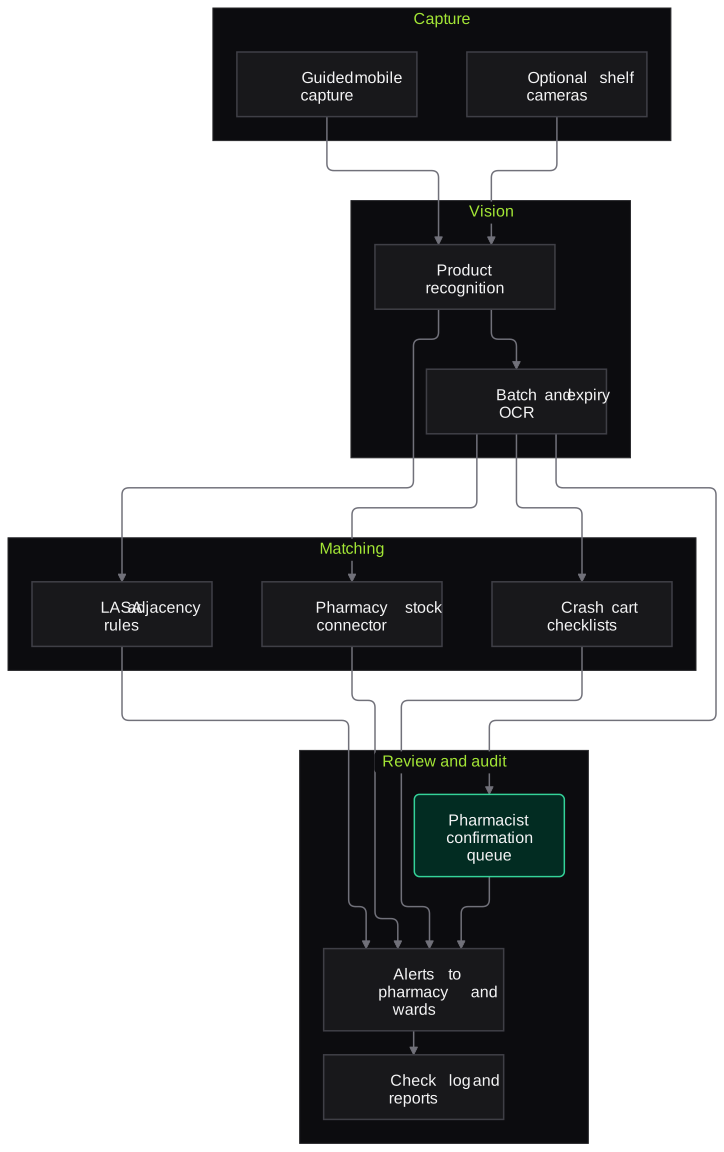
Inputs and outputs
Inputs
- Photos of shelves, ward store racks and crash cart drawers
- Formulary with product packaging images
- Pharmacy system stock by location, batch and expiry
- Crash cart lists per trolley type
- LASA medicine list and near-expiry thresholds
Outputs
- Near-expiry and expired item lists by location
- Crash cart check reports with missing or expired items
- LASA adjacency alerts
- Stock discrepancy list for the pharmacy system
- Audit log of checks and actions
Where people stay in control
Pharmacists confirm uncertain readings and decide on every removal, return or restock. For crash carts, the ward in-charge nurse remains responsible for the check; the app provides evidence and catches what a tick-list can miss.
Integrations
- Pharmacy or inventory module of the HIS
- Materials management or purchase system
- Hospital-issued phones or tablets
- Messaging or task tool for alerts
- Pharmacy and therapeutics committee reporting
Guardrails
- Uncertain expiry readings never marked as safe; they go to a pharmacist
- Product recognition limited to your formulary, with unknown items flagged
- Capture guidance keeps patients and patient data out of photos
- Thresholds and LASA lists owned and versioned by pharmacy
Compliance notes
- Supports, but does not replace, pharmacy record-keeping duties under drug control rules, including registers for scheduled and controlled medicines.
- Medication storage and expiry checks are a regular focus of accreditation reviews such as NABH, and the check log helps you evidence them.
A typical pilot
Duration: 3 weeks
Main pharmacy shelves for a set of high-value or critical items, plus crash carts in two wards or one ICU.
Deliverables
- 01Packaging image set for the pilot items
- 02Mobile capture app with expiry reading
- 03Crash cart list configuration
- 04Accuracy report against manual checks
- 05Roll-out plan and pharmacy system integration plan
What we measure
- Expiry reading accuracy
- App readings compared with manual reading of the same items.
- Product recognition accuracy
- Correct identification on sampled photos, checked by a pharmacist.
- Crash cart findings
- Missing or expired items found by the app compared with the manual checklist on the same day.
- Check time
- Time per shelf or trolley check with the app compared with the current method.
FAQs
01Can it read tiny expiry dates on blister strips?
Often, with good capture guidance and lighting, but not always. Any reading below the confidence threshold goes to a pharmacist, and expired or unclear items are never marked as fine.
02Do we need fixed cameras?
No. Most pharmacies start with phones or tablets. Fixed shelf cameras are an option for high-value areas once the app is working well.
03How does it handle new products or packaging changes?
Unknown packaging is flagged, and a pharmacist adds the product with a few photos. The model is updated on a schedule agreed with your team.
04Does it connect to our pharmacy software?
Yes, through an API, a database view or a scheduled export of stock by location, batch and expiry. If integration is not possible at first, the app works from a stock export.
Related use cases
- Healthcare & Hospitals
Hand-Hygiene and PPE Compliance Monitoring
Measure hand-hygiene opportunities and PPE use at ICU, ward and OT entry points from cameras, with faces blurred on the device and results shown as unit-level trends for infection control.
- Retail, D2C & Quick Commerce
Shelf Availability and Planogram Compliance
Turn merchandiser and store shelf photos into SKU-level facings, out-of-stock gaps, price-label checks and planogram scores, with doubtful detections sent to a reviewer.
- Pharma & Life Sciences
Packaging and Label Inspection
Camera checks on cartons, labels and blister foils that verify batch, expiry, MRP and codes, compare print against approved artwork, and reject mismatches with image evidence.

Founded by Akhilesh Mittal. 8 years building a security platform for a New Zealand company. IIT ISM Dhanbad and IMT Ghaziabad. Builds production agentic AI.
Start with one department and one document type
Book a discovery call. We will pick one workflow, such as discharge summaries in one department or pre-auth files for one TPA, and scope a short pilot with your team.